Monthly Archives: May 2026

the river thames

art deco

the river thames

We had decided that we would spend the first few months familiarising ourselves with the river, we had a little knowledge, having spent a week on a hire boat with our children in the early nineties, but it didn’t amount to much. We were aware that, unlike the canals, the locks had professional lock keepers in attendance, and the water points had a hose attached!! As soon as we were under way it became clear that we were on a river once again and the flow was much more than we had experienced on the Lea. I needed to give Art Deco more power than I had become use to, just to maintain a decent cruising speed, but the one consolation was the fact that more revs equalled more amps into the batteries.

We needed to fill up with water, Teddington didn’t have a waterpoint, but according to the Nicholson there was one at Mosley the next lock up river. The water point was through the lock at the end of the pontoon and we moored there knowing that it would take a while to fill because the tank was empty, so once the hose was in and the water running we went below for a cup of tea. The water tank on Art Deco was under the front deck so we could sit in the saloon with our cup tea to wait for it to fill. We had a very sophisticated way of telling when the tank was full, the water shot upwards in a fountain from the filler! Simple but effective.

Once the tank was full I needed to turn the tap off on the lock-side so I climbed the back steps onto the rear deck and was greeted by what looked like a ocean liner, moored directly behind us! I could see someone peering over the bow and as I emerged he said, “I’ll have the water when your finished, don’t bother rewinding the hose” Once over the shock I replied “just finished” and went to turn the tap off. This was our first encounter with the ‘Magna Carta’, a ‘proper’ hotel boat and it was absolutely gigantic. I learned later that it cruised the Thames between *Cliveden and Hampton Court and was designed to fit into the smallest lock on that stretch of river. After chatting with the crew for awhile we set off up river and soon on our right hand side the beautiful Hampton Court Palace came into view and there was a mooring spot free, so we took it.

By this time it was late in the afternoon and our first day on the Thames had been a tough one, enjoyable but tiring. We were ready for a beer and we got one sooner than we expected. While we were tying up the couple on the boat in front shouted, “When your finished come aboard and join us, the suns below the yard arm so it’s time for drinks!" How could we refuse an offer like that. The owners of the boat were a couple around our age and had spent many years cruising the river on their Dutch Barge, consequently they were a mine of useful information, just what a pair of ‘newbies’ to the Thames needed. Over a few drinks they shared their knowledge with us and when it was time for us to leave we had a wealth of practical tips, setting us up nicely for our River Thames adventure.

*Cliveden is a country house overlooking the river, infamous in 1963 for The Profumo Affair, where John Profumo, the minister for war in Harold Macmillan’s government, ha, two years earlier first met the 19-year-old model and dancer Christine Keeler. Their brief affair became a political scandal when it was revealed that Keeler was also in a relationship with Soviet naval attaché Yevgeny Ivanov. The scandal eventually led to the defeat of the Macmillan government. It is now a five star hotel.

We spent three days at the Hampton Court moorings, the maximum allowed for any one stay, and at £5 per night it was great value for money. There was obviously a charge to visit the palace, but Home Park, the extensive grounds which the palace stands was free to visit and was a wonderful place to while away a few hours. From the mooring at Hampton court we cruised up river, taking our time to familiarise ourselves with our new surroundings and noting places we thought would be enjoyable for our guests to visit. The river didn’t disappoint, there were picturesque riverside towns and villages with plenty of moorings and also more rural places that offered peace and tranquility. We were confident we had made the correct decision to cruise the Thames, it was perfect for our business model, it was now up to us to make it work.

Over the following months we slowly cruised the ninety odd miles up river to Oxford, taking photographs and making note of mooring spots, in preparation of getting a website up and running. The idea was to have our own website where we could explain in detail exactly what we were offering along with pictures of the riverside landscape and a calendar showing availability. It was a wonderful time for us and we enjoyed it immensely and along the way we encountered other couples like ourselves and made many lasting friendships. As you can imagine we had a varied bunch of guests on board from all corners of the country and a few from overseas. We had a few awkward ones it’s true, but thankfully they were few and far between; most guests simply wanted a relaxing time with good food and wine and pleasant company and I like to think we provided just that.

We didn’t have back to back guests, we always left at least a week between them and often much longer. On our website was a calendar showing our availability, which we had total control over and when a booking was made we added a few days before and after their stay to the on line calendar, thereby giving us plenty of time to prepare for the next guests. Our aim was to attempt to make each stay as unique as possible. We asked them before hand if there was a particular place they wanted to visit and we would try our best to do that but it wasn’t always possible.

The main problem was the five miles an hour speed limit on the river and the time taken to passthrough each lock. It was difficult for most people to understand that the pace of life on the river was much slower than they were use to. The cruising speed of Art Deco was actually not much more than a brisk walking pace and once we explained these restrictions the majority of guests left it up to us to provide the itinerary. This was helpful, allowing us to pick up new guests from the same area we dropped the current ones off.

Our first enquiry was unusual, in that the couple concerned wanted to visit us before they committed to a stay. We were eager to please so we agreed to meet them in Caversham, a town on the opposite bank to its much larger neighbour, Reading, where there were good moorings and a large Waitrose supermarket right by the river where they could leave their car. Paula and Derrick called us when they arrived at the car park and I walked the short distance to meet them. We had agreed to provide a simple lunch and afterwards we took a short cruise up to Sonning, where we moored just the other side of the lock and walked through the church grounds to the Bull Inn for a quick drink.

It was a most pleasant inauguration to our new venture and we must have done something right because they returned just a few weeks later for a longer stay and cruise. They became good friends and visited many times, booking at least three cruises with us each summer. They even visited us in the winter months, picking us up from the boat and tacking us to a local pub or restaurant for lunch. It was a welcome diversion for us because there were many weeks in the winter when the river was not navigable due to flood conditions and we were stuck in one place for weeks at a time. Derick was a great guy and we got on really well and went on many walks together, leaving Paula and Joyce to do their own thing. A favourite place was Runnymede where there were good moorings courtesy of the National Trust. There was lots too see, all be it of a cultural nature and not to everyone’s taste, but we liked it. The whole area serves is a memorial landscape and it boasts the Magna Carta Memorial along with the Air Force Memorial dedicated to the fallen servicemen and women and also the JFK Memorial, dedicated to the murdered American president John Kennedy.

Derick was a lawyer with a great sense of humour and he was, of course interested in the Magna Carta Memorial but on one of our visits I suggested we walk up to the monument dedicated to JFK. It was quite along walk, all uphill and when we arrived he stood just looking at it for a few minutes. Eventually he turned to me and said “Dave, I’ve never before been so underwhelmed!” I understood where he was coming from though, for it’s simply a block of marble with a short inscription carved into it and I can’t even remember what the inscription said. It stands in an acre of land that the British government gave to the American people and Derick had something to say about that. Three ladies arrived while we were there and Derick, ever the pedantic that he was, said to them “Do you know, if you had committed a crime you could stand here and the police couldn’t arrest you” They looked at him in bewilderment and simply said “Pardon” “They would need an international extradition warrant” he said “It’s American soil!” I don’t know if they understood or just thought him a mad bloke but they swiftly walked away without saying another word!

2016 was our first summer welcoming guests aboard Art Deco and it was, by far, the year we enjoyed the most, probably because it was new and exciting to us. We did have guests aboard the following two summers and we enjoyed having them but towards the end of 2018 the river was changing. There had been somewhat of an explosion of live a-boards and the river was busier than ever and we found mooring in the popular places, the ones our guests most wanted to visit, became ever more difficult. Also the Environment Agency were desperate to generate more funds from the boating community, which was understandable given that Central Government were reducing their funding but it certainly changed the atmosphere on the river. There were less lock keepers employed, resulting in long queues at the busiest times but also the lockkeepers were the folks who policed the locks and the ones you turned for help and advice. The river was a far less friendly place without them and we actually experienced ‘lock rage’ when some idiot on a floating Gin palace thought it was his given rite to jump the queue. They also policed the moorings under their control in a much stricter way, again it was understandable but left an unpleasant taste.

By the end of 2018 we’d had enough and called it a day as far as taking on guests were concerned. We reverted back to the life of Live a-boards, continually cruising the rivers and canals. We perfected our style with the help of Paula and Derrick, who made many visits during the summer of 2016. They had been on other ‘Hotel’ boats in the past and to be honest they knew more about the business than we did. The only point that I would not move on was that we didn’t make a charge for our services. I had read somewhere of a small guesthouse that welcomed people to stay with them as friends. There was no fixed charge but guests were encouraged to pay a contribution towards the cost of food and accommodation, however much they thought it was worth. It had worked well for them, so I thought we would give it a go. I can honestly say that it worked for us too. We were never taken advantage of, in fact if anything it worked to our advantage, we were amazed at times just how generous people could be. We provided a cooked breakfast, cooked lunch and three course dinner with wine and we all ate together, there by welcoming our guest as friends making for a very laid back atmosphere which everyone appreciated. As well as contributing to our costs we were presented with gifts as folks left us and some guests even turned up with their own home grown vegetables, eggs and home made preserves etc. We were treated to lunchtime drinks in riverside pubs and even the occasional meal. It was lovely, just like living in a bygone era when the pace of life was so much slower and relaxed than it is today.

One decision we did make was to limit each stay to a maximum of four days, the logistics of any longer stay being difficult on a small boat. We also decided to accept mature couples only, no children and no pets, the last two restrictions for health and safety reasons, small children, dogs and cats and deep water are not a good mix. We also realised early on that we needed to make it clear exactly where we could cruise. Although we had a map on our website showing our cruising area we still had requests that included visiting the Houses of Parliament, the Tower of London and Tower Bridge! We were only licensed for the non-tidal Thames, the nearest we could get to these places was Teddington, the tidal lock. I amended our website to state more clearly that our cruising area was Kingston on Thames in the east up to Oxford in the west, a distance of 90 miles.

Anyone who wanted to book a break with us had to telephone first, there was no other way to contact us. The digital calendar on our website showed the dates available but we needed to choose the pick up and drop off points. Early on we had a situation where we dropped a couple of guests off in Reading and we were due to pick up the next guests in Oxford, over 38 miles away, or 5 days cruising. We did do it but it was hard work, which wasn’t a problem but the cost of diesel was! A lesson learned the hard way but we didn’t make the same mistake again. A conversation with the prospective guests gave us the opportunity to arrange a pick up point and discus an itinerary with them and find out what sort of food they preferred. Joyce was a great cook and more importantly she enjoyed creating dishes she knew the guests would appreciate. A great example of this was when a German gentleman asked if she could make an Apple Strudel and she said that she’d never made one before but she’d have a go. She waited until the last day of their visit before she served it and he was so appreciative. He explained that his mother use to make it for him when he was a boy in Germany and Joyce's dish was the best he’d tasted since coming to live in England.

Quite a few guests did take our advice and arrived by train. It was convenient as there are many rail stations along the river and it meant we could pick guests up at one station and drop them of at another station meaning we didn't have to make a round trip and giving guests a chance to visit more places. As for those who insisted on using their own cars we found a website where people who had a driveway that they didn’t use would rent it out and quite a few guests used that and were very satisfied with it.

Our four day maximum rule was broken by our first ‘real’ guests. They were a couple who wanted to cruise the whole of the river from Oxford to Kingston and when I pointed out that with our cruising speed of just four miles per hour and with 31 locks to negotiate we would need at least 5 days, maybe longer if the river was busy. They said, no problem, take as long as you like. I tried again with, we won’t be able to change the bedlinen but again they said no problem, we don’t mind. In the end we had no alternative but to take them so we arranged to pick them up in Oxford. They were arriving by train and luckily the railway station is just a short walk from the moorings just above Osney lock, so on the arranged day I walked to the station to meet them. I waited, carefully watching folks alight from the train and played a little game in my head by trying to guess who our two guests would be. This was to become a regular pastime for me throughout the time we were taking guests but my success rate was zero!

We encouraged guests to come by public transport if possible, for two reasons. Firstly there are limited places along the river where you can leave a car for a few days and secondly, it restricts the amount of luggage they could bring, space being limited on a boat for nonessentials but again my planning failed. I noticed an elderly couple walking towards me and the lady was dragging behind her quite a large suitcase but her companion, well, he was struggling with a gigantic suitcase. I greeted them and thought it only polite to offer to carry one of the cases and the gentleman offered his. I dragged it to the boat and jokingly said to him as I lifted it onto the boat “You sure you’ve not got a dead body in here!” “No” he replied “just books” They were a lovely couple who were obsessed by books, they were retired academics and couldn't visit Oxford, they said, without purchasing a few books. In the end it took us six days to complete the journey and they enjoyed every minute and putting their money where their mouths were, so as to speak, by being exceptionally generous with their ‘donation’ and as they left they presented us with a very expensive ‘coffee table’ book about the history of the Thames and full of glorious photographs. They wrote a very flattering dedication on the fly leaf and it’s a book that we treasure to this day.

We didn’t have any bad guests, as such, most were lovely and appreciated what we did but there were the odd one or two who we were glad to see the back of. There was a couple who we picked up in Henley that I remember well, for all the wrong reasons. The booking had come from the lady who wanted to surprise her partner with something different and I had arranged to meet them in the public car park by the rowing museum on Mill Meadows. As soon as I met them I could sense that all wasn't well. She was lovely with a bubbly personality, but he was the total opposite and didn’t even acknowledge me when we met. They were with us for two long days, he didn’t speak a word at all to me or Joyce in all that time and they took themselves off to the pub each evening. He made it obvious that he didn’t want to be with us and it was only as they were leaving that the lady told us why. It was a new relationship, they hadn't known each other long and she wanted to surprise him and had booked this trip without telling him. Their stay was over the August bank holiday and when she had said she had a surprise for him, he thought it would involve his favourite pass time, golf. When he realised he would be on a boat with two oldies for three days the s**t had hit the fan and they left a day early so he could get a round of golf in before he returned to work. I think that probably that relationship didn’t last long but to be fair to the lady, she was quite generous with payment for their stay. There was still more bad news for our reluctant guest because as we watched them return to their car from the rear deck of Art Deco there was another surprise for him, a parking ticket!

I must stress though that guests like these were the exception and not the rule. As you would expect we did have our fair share of eccentrics stay with us. One gentleman wanted to stay for five days in April, earlier in the year than we would have liked but he was quite insistent. He was also insistent that we pick him up in Henley but I knew he would not be able to leave his car in the rowing museum car park, not unless he wanted a ticket that is. There was something about him but I couldn’t put my finger on it, something in his attitude and he was not the sort of person to take advice I thought. There was a free car park at the end of Mill Lane which is just a short walk from the river that many boaters used and I gave the gentleman the post code. That’s no use to me he said, I don’t have a satnav and don’t want one, I’m quite capable of using a map. Okay I thought be like that and I explained that the car park was behind Henley football and rugby ground. Look for the white rugby goal post I said and call me when you get there and I’ll come and meet you.

The winter of 2015 and spring of 2016 had been particularly wet and a week before he was due to arrive the red boards came out, effectively closing the river. I phoned and told him we would have to cancel because due to the river conditions we would not be able to cruise but again he was insistent on coming, when this guy had made up his mind there was no persuading him otherwise, we would be stuck with him for five days. He did call when he arrived, but again he insisted he knew exactly where we were, he didn’t need my help. I sat on the back deck of Art Deco, a little nervous, I have to admit and waited for him to arrive, trying to guess who he was and when I spotted a scruffily dressed man walking down the riverside path pushing a wheelchair, piled high with all his luggage, my heart sank, I just knew it was him. As he got closer I noticed that he was wearing shorts, nothing wrong with that, you might say but protruding out of the leg of them was a false leg of all things. Not a modern prosthetic type that looked like areal leg but one that consisted of two aluminium rods with a flat metal base as a foot. Apparently he wore shorts all year round, proud to show his artificial leg he said, especially to young children who needed to learn that not everyone was made perfect!

He did stay for the full five days and the red boards too stayed out for the full five days and he was even more eccentric than I had imagined. To be fair he didn’t cause too much bother because he took himself off every morning, only returning in the evening in time for dinner. He seemed spend a lot of his time in the River and Rowing museum which was a short walk from the boat, or simply walking around Henley showing off his artificial leg, no doubt.

There was a final incident that capped a very strange few days for us when on the day before he was due to leave he received a phone call. The conversation was all one sided, and he was just answering yes and no until he finally said; okay then I’ll move it now. "That was the police", he said, "I have to move my Land Rover". It transpired that a lady had called the police reporting that a battered old Land Rover had been abandoned on her drive and it had been there for a few days. She was concerned because a similar incident had happened a few years ago when an unknown car had been parked on her drive for over a week. The body of the driver had later been pulled out of the river at Marsh lock, it seemed he had decided, for whatever reason, to park his car on her drive and jump in the river.

I thought that I should go with him, more out of curiosity than anything else, I wanted to know exactly where he’d parked. We walked over the meadow to Mill Lane where the car park is situated off to the right but he walked up the lane a little further and turned left along a road and there, parked on a pristine white gravel drive in front of a big posh house was a battered old Land Rover. "Why on earth did you park here?" I asked, "It’s a private drive for heaven's sake, can’t you see that?" "You told me to look for the rugby goal posts" he said "well there they are" and he pointed down the side of the house. It was true, the tops of posts could be seen beyond the bottom of the garden, it’s just that they were the wrong ones, they belonged to the local boys' school.

I was eager to get well away from the house before anyone saw us and I waited for him to unlock the door. It's not locked, he said, I never have to lock it. I have my own anti theft device, designed and built by myself, he said with a smug look on his face, I'll show you how it works. Here take the key and try and start her, he said. I didn't want to play games, I just wanted to get the scruffy vehicle off the lady's drive and the quickest way to do that, I thought, was to play along so I did as asked but when I turned the key nothing happened, not even the ignition light illuminated. See he said, triumphantly. Now watch this. He opened the Bonet and flicked a switch. He opened the rear doors and flicked another. He opened the passenger door, reached under the seat and flicked another. Right! he said now reach under your seat and you'll feel a switch. Got it I said. Flick it on he said. Now try and start her he said and the engine burst into life. I jumped out and ran round to the passenger side, telling him to get in.

He started telling me how his anti theft device worked but I cut him short. Just get us out of here I cried. I directed him to the correct car park, thankful to have vacated the poor woman's drive and once we were parked up he went round and turned all the switches off. He slammed his door shut and walked away saying to me, see, no need to lock it up. I’m sorry but I just had to ask him the obvious question; wouldn’t it be easier to lock one door I said, rather than having to go round, opening doors and flicking four switches? He looked at me in astonishment and simply said, no and walked away! He was certainly an eccentric gentleman.

There were others too. We had an elderly couple who joined us for a couple of days and constantly bickered with each other. She was what I would call, an evangelical vegetarian and he most defiantly was not and this was the basis of their relationship. They had been married for over fifty years and had bickered from day one of their marriage they told us. It gives us something to talk about they said!

Another couple, who were Welsh nationalists, not a problem for us, live and let live was our motto, but the gentleman thought himself descended from the Druids. He was convinced he had an affinity with the natural world and believed he could talk with the animals! He would take himself off and talk to the sheep and cows and when he returned to the boat he would, quite seriously, tell us about his conversations. They were a lovely couple though and his wife made light of his conviction which didn’t seem to bother him. They particularly wanted to visit Marlow and as we passed through Temple lock, on our way down river for the final run in to the town I mentioned that mooring places were limited at the best of times but at the time of the year it was nigh impossible. You'll get moored he said, I’ve had a word with the spirits and would you believe it, as we slowly cruised past looking for a moorings by Higginson park a guy on a Dutch barge shouted “We’re leaving, go and turn round, I’ll wait for you and you can slip in as I move out” So who knows, he may have been a genuine Druid after all. Next time I will talk about some more of our guests, the more ‘normal ones.

an artist, two art lovers and a bridge

an artist, two art lovers and a bridge

Peter Hughes

Bexhill Road Bridge (No. 15) on the Lancaster Canal, Ingol Preston

I have drawn and painted all my life. It enabled me to attend Blackpool Art College after leaving school. I graduated as an Illustrator; my path was set. My Father worked at BAe Warton for 40years; my mother raised 10 happy children and went on to run a hotel on Blackpool promenade. Sadly, my parents died in recent years, something I have dreaded all my life; however, they lived long and happy lives.

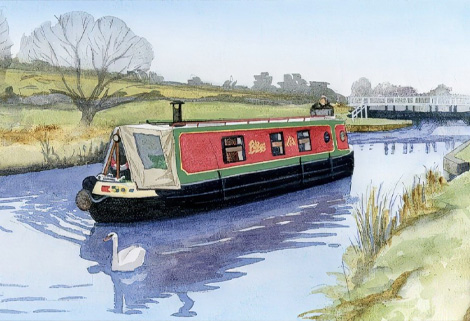
The bridge depicted in my acrylic painting is Bexhill Road Bridge in Ingol, Preston - number 15 on the Lancaster Canal at sunset close to my parents’ house. My father would walk his dog along this part of the canal, over the bridge and into Haslam Park. Today I often take the path, thinking of my parents, reminiscing, recalling happy days of a family. It was when I was on such a walk I decided to sketch the bridge, knowing how my father had loved the area. Over time, and many sketches I decided to paint the bridge. It was therapeutic for me, painting something my father had cherished, an environment that meant so much to him. This painting was for him.

The Harris Museum and Art Gallery in Preston city centre announced its Open Art Exhibition, it was good timing. I submitted my dad's painting for consideration. To my surprise it was accepted along with 406 other Prestonians. I didn’t expect what was to unfold. I received a call from a stranger explaining that she had visited The Harris Museum and had attempted to buy my painting, but she was informed it had been sold. I was so surprised at this news, I didn't expect it to sell, as I wanted to keep it, the painting was for my father, his memory.

I apologised, I explained I hadn’t been informed of the sale, I was so sorry for the lady, she seemed upset, losing the opportunity to buy the painting. She told me it had moved her, jumped out at her in the gallery, it reminded her of her younger days walking her dog along the towpath at Bridge 15. She asked if I would consider a commission, to create another painting of the bridge. I agreed and we planned to contact each other in a few weeks, I remembering her saying you have made my day. I contacted her after completing the painting and invited her to a viewing. She was so happy with it and insisted that it was going to a good home.

To this day I have never heard from the art lover who bought the first painting from The Harris Museum, I hope it brings the same happiness it brought to me painting it and the joy to the lady that placed the commission.

author of the season – summer 26

author of the season - summer 26

anu aladin

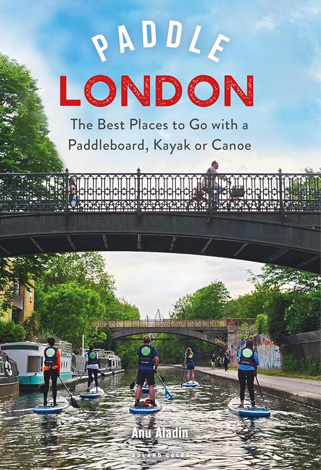
paddle london

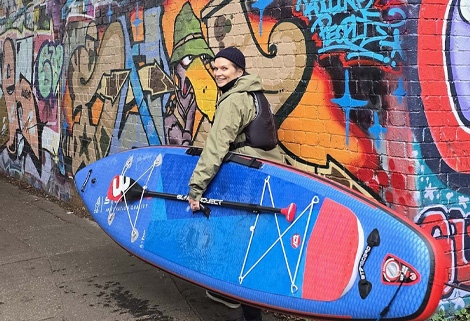
Anu Aladin is a highly experienced paddleboard instructor and writer based in South West London. With more than a decade of paddling experience across the capital, she says she has spent countless hours discovering London’s waterways, sharing her adventures on My SUP Stories and encouraging others to discover how accessible paddling can be in London.

Anu Aladin 

I’m Anu and I live in Richmond. Back in 2010, I was on a beach in Hawaii when I saw a middle-aged guy carrying what looked like a giant surfboard and a paddle. He stepped onto the water, stood up and paddled out like it was the most natural thing in the world. Graceful glide. I was mesmerised.

It took another year before I got to try SUP for myself, on a beginner’s lesson in Falmouth. My legs were shaking, I kept falling off, but by the end of the session, I stood up. And just like that, I was hooked. Why? I’m still figuring that out.

Over the years, I’ve tried all sorts of hobbies. I’m one of those people who dive in deep, then just… move on. But SUP stuck. I’m glad it did. It’s brought me everyday adventures and a brilliant group of paddle friends.

Anu Aladin with her paddleboard in front of graffiti

In a personal article written for Ordnance Survey Maps, Anu describes how stand up paddleboarding helped her through her most difficult times:

"Surprising as it may sound, hopping onto my paddleboard anywhere in London brings me an almost immediate sense of calm. I get up to standing, find my balance and feel the water moving under my board. Everything quietens down. The city is still there. Trains rumble over bridges, people move along towpaths and embankments, traffic hums somewhere in the background, but it all fades away. What I notice instead is the steady rhythm of paddling: the soft glide of the board through the water, the paddle dipping in and lifting out again. My breathing deepens. My shoulders drop. With each stroke, worries and doubts begin to melt away. Even time shifts slightly. I’m no longer in a hurry. I’m simply here, present in a way that rarely happens on land. Perhaps this is what meditation feels like to people who can sit still."

Paddle London - the book

Paddle London is described as 'The definitive guide to exploring the rivers, canals, docks and reservoirs of London under paddle power', and the editor goes on to say that 'paddling in London offers a paddle experience like no other, combining a connection to nature with the vibrant energy of the city's architecture, culture and art.

Elsewhere, it is stated "Paddle London invites you to see the capital from the water. A practical and inspiring guide to exploring in and around London, it features 40 urban and rural routes across the Thames, canals, rivers, docks and reservoirs, combining clear maps, photos and essential guidance with history, wildlife and public transport–friendly access."

The book is a lovely one to hold, with those oversized bendable covers enabling you to both save your page, and shove the book in your backpack without creasing it. And gloss pages throughout which make it more practical for handling near water! Open it, and it is jam-packed with lovely photographs and maps, and text split into very readable paragraphs. Appealing, not daunting.

Once inside, the book contains 40 routes along the London Canals, the River Thames and a few other waterways including the Basingstoke and the Wey Navigations. Each route is graded according to difficulty, with four different levels offering a wide scope from beginner routes to those with a great deal of experience behind them. Starts and finishing points for each route are linked with car parks, and public transport, so you can readily plan your experience.

Everything, it seems, has been carefully researched, and there is a whole section on safety, navigation rules, what you need to take with you, what to wear, and where you can get a licence when you need one. The routes are described in detail, with things you should be aware of, plus wildlife to watch out for, and any local features of interest are pointed out and their history given.

So even if you are not a paddleboarder, the book is of interest. Walkers and cyclists might benefit, and even those passing through London on narrowboats could be interested in specific routes. Especially as good drinking and eating places are also noted.

There is the usual challenge that would come from our readers: why is it London based, like everything else.  So I must mention some of the other books in the publisher's series: 'Paddle the East of England' and 'Paddle the North of England'.  But Anu's book is also a very useful guide for those who wish to take up paddle boarding wherever they might be based. And in it there are links to online groups and those paddleboarders who share their stories and their passion with other people. You could always research your own routes and share with Anu. Then she might be inspired to write another book!


Anu Aladin's book is readily available in good bookshops, on Amazon, and through the  Bloomsbury Publishing Website

all shook up

all shook up

(adapted from Ch. 3 of ‘The Curious Incident of the Bacon Butty a Broken Tiller and a Mid-life Crisis’ - by James Adams)

With my canal enthusiasm in full flow, and now (after two years) looking forward to running my own cruise, I start to venture further afield in visiting canal places of special interest. Therefore, in the following year (1977) I visit several centres including:

• The Caldon Canal
• The Cromford Canal
• Bingley 5-rise staircase locks
• Shardlow (Trent & Mersey Canal)

However, it is only the first of these trips that remains strong in my memory. For on our day-trip to the beautiful Caldon Canal, we visit The Hollybush Inn, a charming canalside pub close to Hazelhurst Aqueduct (canal-over-canal). In a chance conversation with the barman, I happen to mention the lift-bridges, which are a frequent sight on the Caldon.

“Oh yes, those lift-bridges - a girl was almost decapitated on one of those last year. She was on
top of the boat, sunbathing, and got up at exactly the wrong time. Terrible tragedy! But people
are not careful enough. They think the canals are all rural and friendly – but they can be
bloody dangerous places if you haven’t got your wits about you.”

After hearing that, I went outside and felt sick. Would I ever go on a canal or narrowboat again? What was I doing offering to lead a trip with so many young people on board? Perhaps I should stop now! Of course, I was aware of the dangers of locks, and of having limbs outside of the boat through bridges, locks and tunnels. But lift-bridges had never crossed my mind!

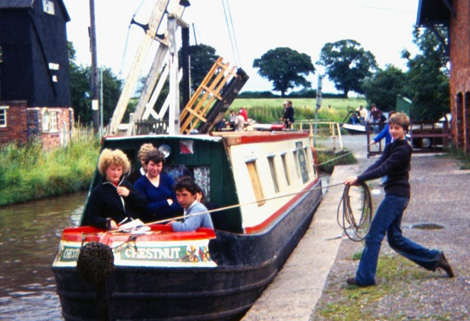
narrowboat chestnut coming through lift bridge

So I seriously think about offering my resignation – before I had even started!

Keep Calm and Carry On

For several weeks I turn over this shocking discovery in my mind, together with Roger and skipper Noel. While similarly shocked, they both agree that tragedies like this should not prevent us from carrying on. For similar tragedies happen all the time on the roads, and we do not stop driving every time we hear of a terrible accident. Take more care perhaps, but not stop altogether. Gradually, I come round, and regain my enthusiasm and focus for the trip that lies ahead, the first week of which I will lead - and with a new route - the Leicester Ring – starting along the Oxford, Coventry and Trent & Mersey canals – with the changeover for week two being at Loughborough.

Before we set off from Rugby however, I have a meeting with all leaders and skippers at which we agree to the following:

• the need to be vigilant about safety at all times, both leaders and members.
• special vigilance is required at all bridges or lift-bridges, locks and tunnels.
• the members on ‘Flamingo’ are most at risk as it has a full-length hard-top which is perfect for sunbathing on.
• The camping boats with their single top plank are more difficult to be comfortable on, though doubtless some will try.
• We all agree that a blanket ban on sunbathing would not be workable or wise - as there are long stretches where there are no bridges at all and, in any case, most canal bridges have plenty of headroom – unless you get up at the wrong time!
• Skippers at the back of the boat have the best view of any bodies on top, that seem unaware of any potential dangers - so skippers should not be afraid to shout or blow the horn to alert the unaware or sleepy-headed.
• We should discourage actual sleeping on the top of any boat. If you must lie down, have your head looking towards the front of the boat, so you can see what’s coming.

It looks a frightening list - but better to be safe than sorry.

Fradley and beyond

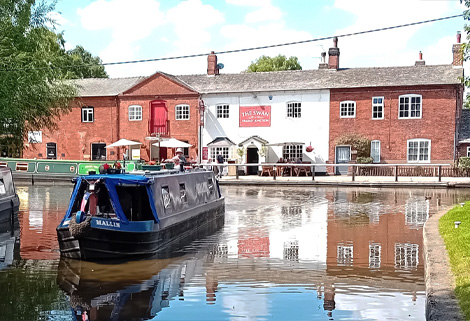
After descending the eleven locks at Atherstone, we continue on for several hours with only two further locks, until we reach Fradley Junction, where the Coventry canal ends, as it makes a T-junction with the Trent and Mersey canal which, as its name suggests, spans almost the entire width of the country. Fradley Junction then, could be deemed to be the epicentre of the English canal system, with the ‘Swan’ pub, at the junction itself, being the most photographed pub on the whole of the canal network.

boats mooring

At the junction itself, we have an unexpected visitor – Ha! Ha! the Spanish Inquisition? Well, almost: as it is a CYFA ‘big-wig’ from London, although you’d never have guessed it, with his leather jacket, long beard and pony-tail. Doubtless he’s come to check up on me – being a new leader – and perhaps on the new chaplains as well. But he was off and away after a brief half-hour with us. Hopefully, he deemed everything to be ship-shape. But it’s a good job that he didn’t stay longer because . . .

Within a few minutes of setting off after our temporary stop at Fradley, I could see and hear a commotion and screams coming from Tern, the first boat to leave. Then a body drops in the water but is pulled out and back on board. Tern is in reverse and emitting a lot of exhaust, as the following boats queue up behind it. I ask Alison to take the tiller, while I jump across to the towpath and run up to Tern, to see what’s happening.

“It’s Kathy sir, she’s scraped her back going under the bridge – then she fell off. But she’s okay now, she says. One of the first-aiders is seeing to her.”

It appears that, as we left Fradley, Kathy had jumped up on to the top plank, ready to do some sunbathing – without realising that a low bridge was coming up. This caught the skipper by surprise and he couldn’t stop the boat in time: narrowboats don’t have brakes!! As a result, Kathy scraped her back on the low bridge arch above, which also knocked her off the plank and into the water. Fortunately quick-thinking members got her out of the water before she got crushed between boat and towpath. When I saw her later, she had indeed got grazes to her back – but she was shocked and realised it could have been a lot worse. I advise the members NOT to go sunbathing on top for the rest of the day – but by the look on their faces they had already learnt their lesson – that canals can be dangerous places, especially if you are not alert.

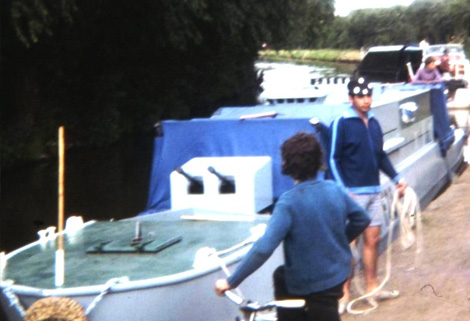
Soon after setting off the following morning, we face a ‘danger’ unexpected by anyone’s reckoning! A Royal Navy destroyer and submarine are in the process of mooring up, seemingly by barging into other boats’ mooring places and taking over! Barmy but true! For at that time the Royal Navy had mocked up two narrowboats to look like a destroyer and a submarine, as part of their recruitment campaign to Britain’s inland cities. But they had clearly annoyed other holiday boaters by their actions and attitudes, as we could see and hear from the altercations on the towpath. It holds us up for a while, before we are able to move on without having being shot at or torpedoed!

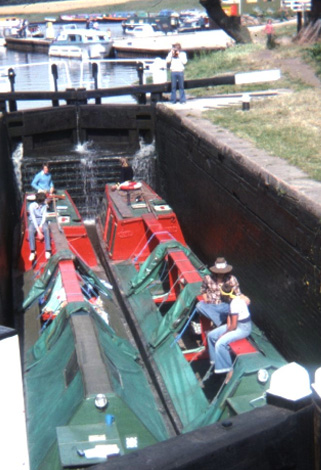
At Stenson lock however, things become more serious. Stenson lock is the first double-lock we have come to and the deepest lock on our route. We go in two boats abreast but not tied up, as we are not in a flight of such locks. Camping boats Tern and Sandpiper go down the lock first [photo: main picture], while Crane and cabin cruiser Flamingo wait above [photo top left] before the water levels are equalised. The gates are then opened, and we gently slide into the lock together. At this point, I step off Crane, just to check that everyone around the lock knows what they are doing, before opening the paddles. The paddles are then opened and lock starts to empty into the canal below – when I spot something that is clearly not right: Flamingo is going down normally – but I notice that Crane is at an angle, the bow remaining high at the top of the lock gate, while the stern is going down fast! What on earth is happening? Something needs to be done – urgently!!

pair of working boats in Stenson Lock

DROP ALL THE PADDLES NOW!” I shout, in the loudest voice I can muster - and I soon hear the paddles rattle down. So no more water is coming in or going out – but Crane is still at an angle and is still in danger of capsizing and going under, stern first. I then realise that Crane’s bow is caught in the lock gate by its fender. I then order the back paddles to be opened (and open one myself), so as to let more water in and re-float the boats, especially Crane Gradually I see the stern of Crane rising up, eventually becoming level with Flamingo. Relief! I then need to see why the bow is still caught in the gate. It’s the front fender – it’s stuck, it won’t move – it’s got wedged tight against the bow, whereas it is meant to lift up if anything gets caught under it. Eventually, with several skippers working on it, it comes free and is still attached by two chains to its two pins. No-one had realised before this incident, that although a bow-fender can look right, it didn’t mean that it’s actually working right.

On the final Saturday morning of the cruise, it’s a gentle mile of canal and two locks, before we arrive at Loughborough – from where the second week’s cruise will start. Then it’s all aboard the coach to Rugby except for those skippers and leaders staying on for the second week. Farewells, hugs and tears abound as folk say their goodbyes to their new friends from all over the country. Yes, there had been some great times along the way – but a few scary moments too - both danger and delight - with hopefully some lessons learned.

painting of boat on canal

mooring lines 7

mooring lines

chapter 7

That night, Ivy sat in the galley with the lamp turned low, the faintest thread of music drifting in through the porthole. She knew it was from the pub, carried across the water like smoke from a fire. Sometimes she caught the beat of a bodhrán, sometimes the bright trill of a whistle. But mostly she heard fiddle, two fiddles, one steady as a river, the other quick and fierce. She didn’t need to see to know which bow belonged to Theo. The storm in his playing was unmistakable.

She rested her elbows on the table, notebook open but blank, pencil idle between her fingers. The coal crackled in the stove, warming the kettle she hadn’t yet poured. The rhythm of the day lingered in her chest: the crush of the market, Meg’s laughter at the pub, the old fiddler’s bow, Theo’s eyes glancing across the crowd. She could almost hear her father’s voice folding it all together. A marketplace shows you the soul of a place. A pub tells you how the people breathe. And the music—ah, the music shows you what they dream of.

She smiled faintly, tapping the pencil once before setting it aside. Belonging still felt like a language she was only beginning to learn, but tonight she believed she might one day speak it.

The next morning, she woke to a knock on the cabin side. She rubbed sleep from her eyes and peered out to see a man in a high-vis vest standing on the towpath. He carried a clipboard and looked equal parts apologetic and official.
“Morning, miss. Notice for you.” He handed her a folded paper, his accent clipped and practical. “Canal works ahead. Lock repair. You’ll need to move one up. We’re closin’ this section for a few days.”
Ivy unfolded the notice, heart sinking a little at the bold lettering. She glanced back at her boat, then at the towpath. “When?”
“Today. Best get movin’ by afternoon. They’ll drain the pound overnight.”

She nodded, thanked him, and shut the cabin door. Her father had always said the canal made its own plans, and you either had to shift with it or find yourself stranded. Still, the idea of moving the boat, managing lines, gates, and the heavy rhythm of a lock set her nerves jangling.
By midmorning, she had tied her hair back and stepped onto the stern, windlass in hand. She wasn’t alone. Theo stood on the towpath a few boats down, violin case strapped across his back, line coiled in his hand. He caught her eye and gave a wry smile.
“Looks like we’re evicted,” he said. His accent softened by humor, a note of challenge tucked in it.
“More like conscripted,” Ivy replied, adjusting her grip on the tiller. “One lock up, they said.”
“Better than ten.” He stepped closer, boot scuffing the gravel. “You handled your boat yesterday. You’ll manage fine.”

His easy confidence annoyed her and steadied her all at once. She braced herself as the engine coughed to life. Together they moved toward the lock, the boats easing forward like reluctant animals being coaxed along.

At the lock, water shimmered between stone walls, gates swollen with age. Ivy wrestled with the paddle gear, arms straining as she turned the windlass. Theo stepped in without comment, his own weight adding momentum until the mechanism gave way and water rushed in. The sound thundered against the stone, spray dampening their faces.

They worked in rhythm, he on one side, she on the other, calling across the chamber, lines swinging, engines humming. Once or twice their eyes met, and something passed unspoken: acknowledgement, respect, the faintest flicker of camaraderie. By the time both boats were settled above the lock, Ivy’s chest heaved with exertion, but her smile came easier.

“Not bad,” Theo said, looping his line with casual precision. “Can’t say the same for your hair, though.”
She laughed despite herself, brushing damp strands from her cheek. “I’ll take that as a compliment.”

They moored just beyond, side by side on the pound above the repaired section. The notice had been right: they would be stuck here until the works were finished. Two days, maybe three. Ivy looked at her boat, then at Theo’s, close enough that the gap between them felt smaller than the water allowed.
“Guess we’ll be neighbors,” she said.
“Guess so,” Theo answered, settling his case on the roof. He stretched, shoulders loose for the first time she’d seen. “Could be worse company.”

The canal settled around them, lines taut, water lapping gently. Ivy felt the moment hang as an enforced pause, a stretch of time neither had asked for but both were bound to share. Her father would have called it canal logic: sometimes the water decides you need stillness together, and the only choice is how you use it.

She leaned against the cabin rail, watching the sky widen above the lock, and wondered what this enforced pause might reveal.

lilith

lilith

the genesis of an obsession

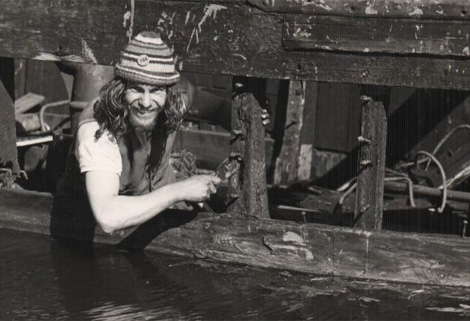
It was October 1974 when I arrived in Chester on a pair of floating chicken hutches. My intention was to live aboard my humble craft for the next 3 years whilst attending the nearby Chester College with the aim  of becoming a teacher.

I soon discovered that I had innocently sailed into a conflict between posh boaters and ‘undesirables’. Because of my ramshackle boats, I found myself classed in the latter category. As one of the chief ‘undesirables’ decided to emigrate to Holland he had to dispose of his assets here. This gave me the opportunity to buy a full length boat for £100. A simple BCN joey.

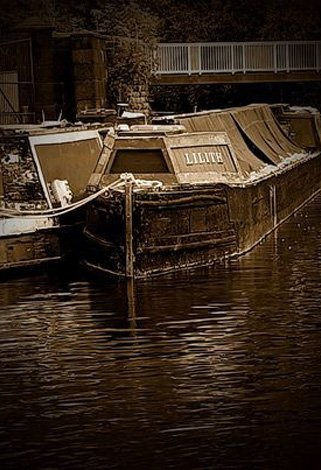
The boat carried a metal plate in each end with the number 9 painted on it, her Stewarts & Lloyds fleet number. She had been part of the huge fleet that used to carry products from Coombeswood tubeworks. Her top bends were painted yellow, denoting that she had later belonged to Alfred Matty, canal contractors. I later discovered that one of the tricks of the seller was to tow away unattended boats, sell them to several people, then disappear, leaving his victims arguing about who was now the rightful owner. Happily. I was never challenged about the ownership of number 9.

At the time I was engaged to an R.E. teacher called Kathy. The romance of the canals had really got to me and I envisaged a future living in a back cabin. She saw herself enjoying life in a nice semi detached suburban house. We compromised on a full length conversion of our new old boat. When she visited to view our future home, I pointed out that the boat needed a name. “Call it ‘Lilith’” she said, explaining that it was Hebrew for a screech owl and that she’d solved someone’s final crossword clue that day by knowing that fact. I won’t go into the mythology around Lilith, but, suffice it to say that it’s rather more than her explanation and evokes strong reactions from people of particular religious affiliations. Anyone wishing to know more should search on t'internet.

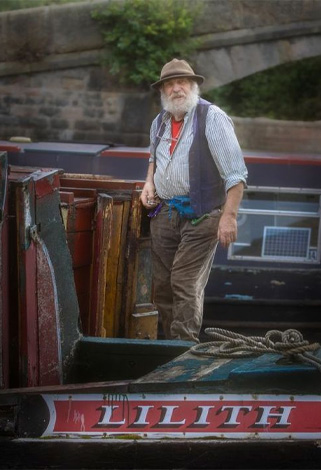
Chris Leah working on Lilith wooden narrowboat

Lilith on Elias Wild mooring

I found a mooring for “Lilith” on a farmer’s field halfway along the Wirral line of the Shroppie. It cost 50p a week! It was clear that before beginning the conversion I would need to do some work on the hull. Opposite my Chester mooring was Taylors boatyard. Alan Parry was busy there rebuilding a classic Taylors cruiser, “Barbara Joan”, which had been burned out by vandals. I asked him where I could get some oak. He advised that I shouldn’t waste my money on oak but should just go to the local timber merchant and buy lengths of red deal. “It’s just as good” he claimed. I was puzzled by this but took his advice as he was a proper boatbuilder. Eventually it dawned on me that he was just being kind. He assumed that, like most wide eyed youngsters that start doing up an old wooden boat, I would soon give up. He wanted to protect me from wasting too much money.

Work really started in the Easter break in 1975. I bought the longest piece of 2” X 8” red deal that they had at the local builders merchant and somehow balanced it across the saddle and handlebars of my folding bike, then carefully pushed the contraption the mile to my boats. I loaded it on to the roof of one of my tatty craft, then set off to deliver it to “Lilith”. I chipped out a plank, cut rough scarph joints on the ends of the new plank and bolted it into place. As I removed one plank, those around it started to disintegrate, so I repeated the process on them.

Soon I got to planks that were curved and so the wood needed steaming. I had no equipment so I approached Alan Parry again. He lent me a gas fired industrial wallpaper stripper to generate steam. David Jones, who had taken over Taylors yard, let me use some space and the master boatbuilder, Arthur Howard, lent me some big G clamps. I put the plank into a long plastic bag, scrounged from a carpet shop, then led steam from the wallpaper stripper into it for a couple of hours.

Whilst the plank was cooking I set up a crude former. I put a stout wooden beam on to blocks so that it was off the ground, then put two more blocks on top of this at what looked like the right distance apart. When the plank was ready I removed it from its bag and laid it on top of the blocks, then used the clamps to bend the floppy plank down to touch the beam halfway between the blocks. I would then lash the plank down so that the clamps could be removed and returned to Arthur. Next morning I would release the plank, now hardened to its curve, load it upon to the boat roof and take it out to “Lilith” for fitting. This method would not work on most boats. Luckily, joeys are of a simple shape with no complex curves or twists.

Lilith wooden narrowboat in 2022

Lilith wooden narrowboat

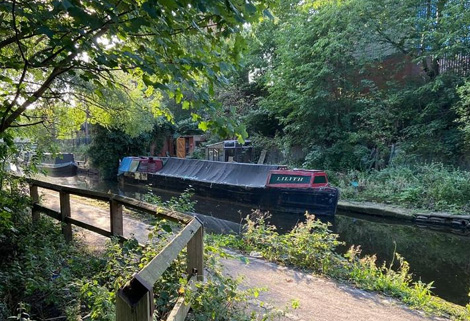
In the 1970s ex Stewarts & Lloyds joeys were everywhere as they gradually dispersed their fleet. Of all the wooden joeys that  in every corner of the network, I’m only aware of 3 survivors. Birchills resides in the Black Country Living Museum. Daisy now belongs to Forces Veterans Afloat and has been somehow re-bottomed in steel. Someone kindly did some research and discovered that No9 was originally built in 1901, though how much original material survived is a moot point. As Lilith she is now celebrating her 125th year, though more than 50 years after her restoration began, she now needs lots of new planks again.

Lilith now belongs to the Wooden Canal Boat Society, a charity devoted to saving historic wooden canal boats, restoring them and putting them to work for the community. Website https://www.wcbs.org.uk/

mooring lines 6

mooring lines

chapter six

By evening, Theo felt the day pressing at the edges of him like an instrument left too long unplayed. The coal bag sat by the stove, the violin case on the bench, but the silence of the boat was heavier than either. He stood at the stern with his hands braced on the tiller post, watching the canal smooth itself into shadow. Lamps along the towpath winked on one by one, reflected twice, once in the water, once in his restless eyes.

He slung the case over his shoulder and started toward the village. The air had cooled, the smell of damp earth rising after a day of sun. Insects skimmed low across the water; bats wheeled overhead, scribbling dark shapes against the indigo sky. The walk loosened something in him, though not enough. The pub lights drew him the rest of the way.

The Crown and Anchor pulsed with sound as soon as he opened the door. Laughter, the scrape of chairs, the thud of tankards on wood. Heat rolled out, fragrant with ale and roasted meat. He stepped inside and felt, for the first time in weeks, the familiar hum of a place that asked nothing more of him than to listen, maybe to join.

Near the hearth, a circle of musicians had gathered. A squeezebox wheezed, a whistle darted, a bodhrán thumped steady as a heartbeat. At their center sat the old fiddler from the market, bow arm moving with the same patient grace, pulling tunes from the strings as if they had been waiting all day to be released.

Theo paused, case strap biting his shoulder. He had half a mind to stay back, let the night wash over him as a spectator. But the music tugged. He recognized the tune as an old reel, one he had bent and twisted in his band days until it was barely recognizable. Here it was played simply, strongly, and unadorned, and the room loved it for what it was. His fingers twitched against the case.

“Ye plannin’ to stand there gawpin’, or ye mean to play?” The old fiddler’s accent carried easily, not sharp but certain. His eyes flicked up just long enough to pin Theo where he stood before returning to the bow.

Theo barked a short laugh, more at himself than the man. He crossed to the circle, set the case down, and drew out his violin. The room shifted to make space, curious but welcoming. He tuned quickly, the strings settling under his fingers like old friends grudgingly reunited.

The next tune began without ceremony. A jig this time, lively and crooked, the sort that made feet tap before brains caught up. Theo joined in the second phrase, letting his bow ride the rhythm, at first cautious, then bolder. The room answered boots, voices rising. He pushed harder, faster, throwing sparks into the tune. The old man met him note for note, his steadiness the keel to Theo’s wind.

Something uncoiled in Theo’s chest. Weeks of tension, nights of doubt, the suffocation of city noise poured out through the strings. He grinned, caught himself grinning, and didn’t care. The session rolled on: reels, waltzes, a slow air that hushed the room until only breath and bow remained. Ale arrived at his elbow without him asking; he drank between tunes, sweat cooling on his temples, laughter spilling easier each time.

Across the room, he caught sight of Ivy. She wasn’t close, just leaning against a pillar, her shopping bag tucked near her boots. Her eyes followed the music, not him exactly, but when their gazes brushed, he felt it. She nodded once, almost imperceptibly, then looked back to the circle. He played on, heart lighter than it had been in months.

By the time the night loosened into talk and scattered applause, Theo’s shoulders felt different. The weight of the band, the weight of silence, both eased. The canal had its own tempo, slower, steadier, and for the first time, he let himself fall into it. He packed the violin carefully, lingered over the last swallow of ale, and stepped out into the night.

The air was cool, the towpath quiet. Water lapped against moorings, a lullaby he hadn’t known he needed. Theo walked back toward his boat with the rhythm of jigs still in his blood and the soft pace of the canal waiting to teach him how to breathe again.

mooring lines 5

mooring lines

chapter five

Evenings on the canal were painted in gold. Lamps glowed from cabin windows, their light doubling in reflections on the water’s surface. Theo leaned against his railing with a violin in hand, coaxing out tunes that had no audience but the ducks and the ripples. His music carried across the cut, threads of melody curling through ivy-clad walls and along the towpath.

From her deck, Ivy listened. She pretended indifference, but her hands stilled on her mug of tea as she watched his silhouette framed in lantern light. The notes were raw, unpolished, and unlike the glossy performances she later learned he had abandoned. Here, he played not to impress but because the music demanded release. And something in her tightened with each refrain.

***

The weight of the shopping bag tugged against her shoulder as Ivy made her way back from the market. The cobbles underfoot gave way to the softer grit of the towpath, but before she crossed the bridge, she slowed, eyes drifting to the pub tucked into the bend of the lane. Its windows glowed amber even in daylight, and the painted sign, The Crown and Anchor, creaked faintly in the breeze. The place smelled of yeast, wood smoke, comfort, and memory, stitched together.

She hesitated on the threshold, then pushed the door open. Inside, the air wrapped around her like a worn quilt, warm, a little damp with steam from the kitchen, heavy with the smell of ale and roasted meat. Voices tumbled over one another, laughter here, a low murmur there, the scrape of a chair against the stone floor.

Behind the bar stood her friend, Meg, a stout woman with cheeks ruddy from both good humour and years near the fire. Her accent curled soft around the vowels, West Midlands through and through. “Well, if it isn’t Ivan’s girl,” Meg said, eyes crinkling as she set a tankard down for another customer. “I’d heard you’d taken the boat. Thought you’d be keepin’ yourself to the lines for a good while before bravin’ us lot.”

Ivy smiled, setting her bag on the counter for a moment’s reprieve. “Needed supplies,” she admitted. “And I thought a quick stop might be safer than learning to cook with coal smoke choking me.”

Meg barked a laugh. “Coal will choke ye, aye, but it’ll warm your toes better than bread and butter.” She poured a half pint without asking and slid it across. “On the house. For comin’ back.”

The ale was golden, a froth catching the lamplight. Ivy sipped, letting the bitterness settle on her tongue. Around her, the pub breathed with its regular rhythm: domino tiles slapped on wood, a dog nosing under tables for scraps, a man near the fire telling a story with hand gestures wider than the truth likely was.

“Feels different without him, doesn’t it?” Meg asked softly, her voice barely carrying past the bar.

Ivy nodded her throat tight. “He always liked the market. Said you could tell the health of a village by the weight of its bread and the boldness of its music.”

“Wise man,” Meg said. “And right enough. Did ye hear old Seamus fiddlin’ out there? Still got fingers quicker than lads half his age.”

“I did,” Ivy said, smiling faintly. “It made me think of Dad. He’d always pause to listen, even when he pretended he was in a hurry.”

Meg leaned on the bar, giving Ivy a look that was both steady and kind. “Then you’ll do the same. You’ve got his ears, girl. And maybe his stubbornness too.”

They spoke a little longer of coal deliveries, of which grocer sold milk that didn’t turn in a day, of how the swans had nested late this year. When Ivy finally gathered her bag and stepped back into the sunlight, she carried not only provisions but a sense of having been woven, however lightly, back into the fabric of the place.

The walk to her boat felt shorter, the canal glinting brighter in the late afternoon. She crossed the gangplank with care, setting the bag down inside before sinking onto the bench in the galley. The space smelled of bread, cheese, and faint smoke from the morning’s stove. She unpacked slowly: apples polished against her sleeve, coal stacked in the corner bin, milk set near the cool of the hull. Each item was an anchor, a piece of ordinary life to weigh against her uncertainties.

Sitting with a slice of bread in hand, she let her thoughts drift back to the marketplace. She had watched children laugh at the fiddler’s tunes, seen women haggle with sharp wit, felt the press and swirl of community around her. To her father, the market had been a gauge, a barometer of belonging. He had loved the bustle, the argument, the way a tune or a loaf could tell you whether a place was thriving.

For Ivy, the market had been overwhelming at first, too many voices, too much movement. But as the day wore on, she had felt something shift. Buying bread, she had been offered kindness. Buying coal, she had been shown strength. Listening to music, she had felt tradition steady her heartbeat. The market had tested her and, in small ways, accepted her.

Her father would have read it as a sign. See, lass, he would have said. The village has room for you, if you’ve the will to claim it.

Ivy leaned back, eyes tracing the worn beams above. Outside, the canal whispered against the hull, carrying both memory and promise. She was not yet fluent in this life, but today she had begun to speak its language. And in the music, both the old fiddler’s steady bow and Theo’s storm-fire glance from across the crowd, she had heard the conversation deepen.

She closed her eyes, letting the rhythm of the day settle. Belonging, she thought, might not come all at once. But it had begun.