Monthly Archives: February 2026

the ‘spanish inquisition’

the curious incident of the bacon butty...

... a broken tiller and a mid-life crisis

Willow Wren Hire Boat

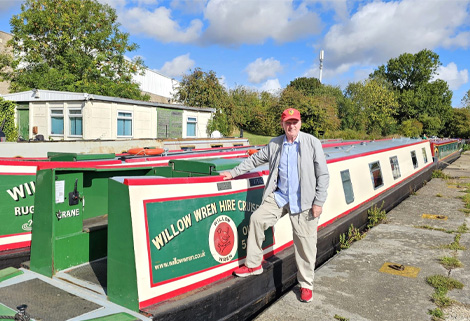
The author returns to the Willow Wren Boatyard, Rugby, from where he first cast off in 1975 - for a twenty year adventure!

“We’ll go on the Canal Cruise – it sounds a bit different” came Mel’s monotone voice.

Still, I’m pleased that she and Alec, the Church’s youth leaders, have made a positive choice for a summer holiday with CYFA (the Church Youth Fellowship Association) – the main Church of England Youth organisation. I had already been a leader on a couple of CYFA holidays based at Independent school campuses, but I’d never really noticed the Canal Cruise before as a potential holiday option.

My next move is to contact Roger, the cruise leader - who is a vicar in a northern parish. I learn that the cruise consists of four seventy foot narrowboats, with room for 35 youngsters plus ten leaders – and he suggests that the two of us should meet up and take one of the boats out on the Oxford canal for an afternoon’s training.

I’m intrigued.

casting off

It’s a fresh and misty February afternoon when Roger and I step aboard ‘Crane’ for my two hours of training in narrowboat handling. Rays of weak winter sunshine filter through the chilly mist as Roger casts off the ropes, then jumps on the back and, with a chug, chug, chug from the diesel engine – the boat slowly slides forward through the water, under Roger’s careful supervision. He will take the boat along the short canal arm until it meets the main Oxford Canal. Turn left and you get to Coventry and the north, turn right and you get to Oxford and London. But not today.

After checking for other unsuspecting boats, we turn right onto the Oxford Canal, and head off for Hillmorton locks, a gentle hour’s cruising away – where we will turn the boat around and return to the boatyard. Once in mid-stream, Roger steps aside and hands me the tiller, my aim being to keep the boat in the middle of the canal where there is (normally) the deepest water. It actually seems pretty easy, until the bow (front) seems to be drifting towards the left bank. So to correct, I naturally push the tiller to the right – but that only makes the drift worse, and we end up close to the bank! So Roger takes over to deal with the immediate situation, and he soon gets us back into the middle:

“You see James, it’s the opposite of driving a car. In a car, if you want to go right, you steer to the right. But on narrowboat, if you want to move the boat to the right, you take the tiller to the left! And vice-versa. It’s completely counter-intuitive.”

So I work on this basic principle as I need to correct the boat’s natural drift almost all the time and full-time concentration is required. Not as easy as I thought! So I find myself always
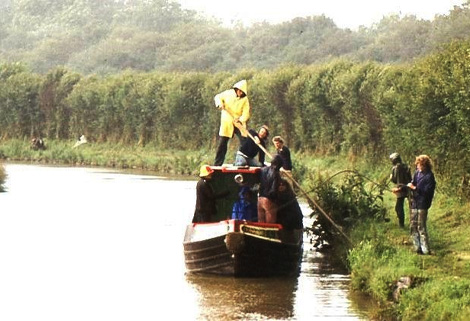
keeping to the middle of the canal

the aim is to keep the boat in the centre of the canal!

checking the line of the bow which is 70 feet in front of me. The next problem is when I realise that the bow takes quite a few seconds to respond to the tiller’s movements. And it’s easy to think that it’s not moving and so you correct with the tiller – too early – and then get confused as to whether you are going left or right. Then panic sets in! So basically, you need to shift the tiller – and then wait 10 seconds for the boat to respond. The longer the boat, the longer it takes to respond – and we’ve got 70 foot of it, pivoting in the middle! It’s another steep learning curve, but I’m enjoying it, as eventually we arrive at Hillmorton locks where Roger offers to turn the boat around in the ‘winding hole’. The way to do it, it seems, is to steer the front of the boat into the apex of the winding hole and keep the throttle going gently forward, with the tiller hard over, as the back turns in the opposite direction to the front. Then, with a few bursts on the reverse throttle, the boat drifts back to mid-canal and pointing in the opposite direction from where we came. Simples!

On the return journey, I now face the horror of seeing another boat coming towards us in mid-canal, so I need not to panic, but to get the steering steady and spot on, as I nudge Crane slightly to the right without hitting the bank. This I manage to do and the boats pass easily with several feet of water between us - relief! Roger now lets me steer the boat all the way back to the boatyard, where he assists with the throttle, in order let the boat gently slide to a stop right next to the Willow Wren wharf. Easy if you know how.

“Well done James - you picked that up really well. I’ll put you down as one of our eight skippers on the CYFA cruise. There will always be two of you on board to help each other.”

For me, a new world has just opened up, and I’m excited at the prospect of the forthcoming CYFA cruise, meeting up with Roger again, and with many new leaders and members to get to know - hopefully more affable than my own church’s youth leaders. Still, at least they are giving it a try - they might even enjoy it! But doubtless they are, like me, a bit apprehensive at starting out on new adventure - not knowing what lies ahead and what the outcome of their choice might be.

spanish inquisition

Amid the excitement of learning how to handle a 70’ narrowboat, I had conveniently forgotten about another aspect of the CYFA Canal Cruise, that Roger had asked me to take over from him: chaplaincy duties. Among other things, this included my ”getting alongside” the church-based youngsters on an individual basis, to help and guide them with their faith. I was rather taken aback by this because, for whatever reason - perhaps my own introversion - this did not sit comfortably with me.

I did not want to become, or be seen as, a sort of evangelical Spanish Inquisition!

Therefore in some reflective moments before the holiday itself, I found myself asking some pertinent questions:

In my new adventure, how would I fare?

How would my church’s youth group take to it?

Would the holiday be a one-off experience, never to be repeated?

Would my boat-handling skills be good enough?

But, more to the point, how would I cope - as the Spanish Inquisition? It felt more like a difficult place to be, rather than a soft cushion or a comfy chair! [1].

“Ha! Ha!” I think to myself. “But no-one expects the Spanish Inquisition” - least of all, me!
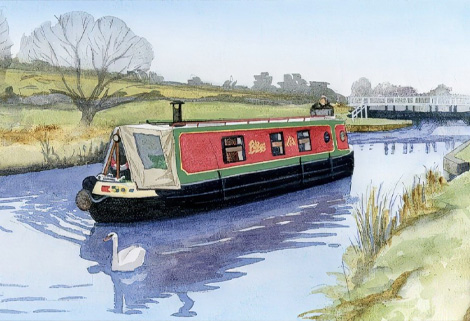
painting of boat on canal

1. This refers to the well known sketch in Monty Python’s Flying Circus. First shown on TV in 1970, now available on You Tube. It’s worth a watch! In point of fact, the phrase “No-one expects the Spanish Inquisition” was also a joke, as the Spanish Inquisition actually wrote ahead to its victims, to advise them of their impending arrival, and their need to be upholding orthodox morals and beliefs.

mooring lines 4

mooring lines

chapter four

The canal had its own way of waking a man. Theo was still learning it. He sat cross-legged on the roof of his narrowboat, feeling the cool damp seep through the denim of his jeans, the violin balanced against his knee. Around him, the world was undecided, half caught in the tatters of mist, half revealed by the sun’s gold intrusion. Every sound felt close here: the plink of water against steel, the caw of a crow staking territory, even the faint tick of his instrument’s peg as the morning chill shifted the wood.

He drew a slow breath. Mornings on the cut were too honest. No crowds, no distortion, no lights or amplifiers to dress up the truth. Out here, every note landed bare, stripped of decoration. If you played carelessly, the canal threw the carelessness back at you. If you played fiercely, the water remembered.

He lifted the violin into place, the chin rest cool against his jaw. The first stroke of the bow rasped a complaint rather than a greeting. He grimaced and tried again, dragging the tune forward, willing his fingers to find the shape. What came out was neither polished nor broken, but something in between, like a voice cracking on a confession. It was the kind of sound he had fled the city to uncover again, the one that lay beneath noise and applause. Yet hearing it made him restless.

Theo told himself he had wanted this: an escape from the band’s suffocating rehearsals, the dressing-room arguments that never quite erupted but never quite settled. But quiet was its own tyrant. It left him alone with the ache of wondering whether the fire inside him was dwindling. The last gig’s applause had sounded obligatory. Even his bandmates had stopped meeting his eyes.

The bow slipped, screeching against the string. Theo swore softly and lowered the instrument. He rubbed his face with the heel of his hand, hair falling into his eyes. You asked for space, he reminded himself. You begged for silence. Now here it is. So, what’s your excuse?

A crunch of footsteps on the towpath pulled him back. He turned his head, and there she was, the woman from the boat down the line. Yesterday, he had seen her fumbling with her mooring lines, tying and retying with the anxious energy of someone who wanted mastery but had only muscle memory to show for it. He had noticed the raw line burns on her palms, the way she stared at the water as though waiting for permission. Today, in the clear light, he noticed more.

Chestnut hair pulled hastily back, a jacket that seemed chosen for memory rather than warmth, boots that were still learning the towpath. She carried herself like someone who had inherited both a vessel and a burden.

Theo felt a flick of recognition, as unwelcome as it was undeniable. She carried weight in her shoulders the way he carried it in his chest. Different stories, same gravity.

“You always sneak up on people like that?” he asked, because humour was easier than truth.

Her apology came quickly, cheeks colouring. And when she said she had grown up on the boat, her chin lifted in that way people do when they’re daring you to contradict them. Theo studied her, letting the silence lengthen. The line marks. The stubborn glint. The grief she tried to swallow.

“Doesn’t mean you belong to it yet,” he said. The words had sharper edges than he intended, but the truth was like that. Boats didn’t reward sentiment. They respected patience, rhythm, and respect. Bloodlines didn’t make the knots hold.

Her eyes flashed, defensive, then shuttered. He almost regretted it. Almost. He had lived too long with false applause; better to give her honesty, even if it stung. When she asked if he belonged, he laughed quietly. Did he belong anywhere? Not really. Only to the violin, and even that relationship felt precarious these days.

“For now,” he said, and played again, letting the notes dismiss her and protect him both. Yet when she walked away, the sound of her footsteps lingered, a rhythm his bow tried to echo without meaning to. He watched her disappear into the mist and, against his better judgment, felt that he would notice her absence more than he should.

By midmorning, he was restless. The boat’s cabin was too small, the silence too loud. He slung the violin into its case and set out toward the village. The towpath underfoot had its own percussion: the crunch of gravel, the soft give of damp earth at the edges. Crows stalked the furrows of nearby fields, and the smell of tilled soil carried on the breeze.

Theo’s reflection in a window caught him as he passed. Tall and lean from a life of touring, shoulders slightly stooped from too many nights carrying gear and too many mornings waking up in borrowed beds. His hair dark, unkempt, brushing the collar of his jacket—framed a face that wore its fatigue honestly. Eyes a shade between green and grey, depending on the light, always seemed older than the grin he could still summon when he wanted to charm. He had the hands of a musician: long-fingered, calloused, restless even when idle.

The bridge appeared around a bend, stone arched and moss-flecked. Just beyond, the day widened into a market square. Theo paused at the edge, taking it in. Stalls spilled colour against the grey stone: oranges stacked in pyramids, jars of honey glowing like captured sunlight, loaves dusted white with flour. Voices tangled in the air, vendors calling prices, children laughing, the occasional bark of a dog tied to a post.

It should have been ordinary. To Theo, it felt theatrical, like a stage set designed to remind him what community looked like. He drifted among the stalls, hands in pockets, the violin case bumping against his leg. A baker offered him a heel of bread, warm from the oven; he bit into it and tasted both kindness and salt. At another stall, a woman sold coal by the sack, her arms corded with strength from lifting more than her share. Theo bought a small bag, the weight digging into his shoulder, grounding him.

At the far end of the square, music rose: another fiddle, but not his. Rough, rustic, joined by a squeezebox and a whistle. A group of locals had gathered, tapping feet, laughing when the rhythm wobbled and then righted itself.

Theo felt his chest tighten with recognition. The fiddler was an older man, late sixties, hair silver but still thick, posture steady despite the years. His violin bore the marks of long service: varnish worn pale where fingers had pressed thousands of tunes into it. He played with a simplicity that carried weight. No flash, no showmanship, just melody drawn clean, like a well-cut stone.

Theo lingered at the edge, listening. The old man’s bowing was economical, each stroke purposeful. It was music shaped by tradition, by nights in pubs and mornings at fairs, by repetition until the tunes lived in muscle and marrow. Theo’s own style had always been fire and edge, leaning on speed, bending notes until they broke. This man’s style was river water: steady, patient, inevitable.

Their eyes met briefly across the crowd. The old fiddler’s gaze was sharp but not unkind, as if measuring Theo without judgment. Theo inclined his head in acknowledgment, and the man answered with the barest nod before slipping back into the tune.

Theo’s fingers twitched at his side, itching for the bow. Yet he stayed still. This wasn’t his stage. Not yet. He let the melody wash over him, feeling both humbled and provoked, aware of how much he had to learn and how different their paths had been.

As the crowd clapped and coins rattled into a cap, Theo turned away. He had come here to disappear, not to measure himself against tradition. Yet he carried the sound with him down the row of stalls, a counterpoint to his own restless fire.

And through it all, he found his thoughts circling back to Ivy, the raw hands, the stubborn lift of her chin. Belonging was something they were both wrestling with, though in very different arenas. He adjusted the coal sack on his shoulder and walked back toward the canal, violin case knocking against his hip, the echo of two very different fiddles playing in his mind.

mooring lines 3

mooring lines

chapter three

The next morning arrived with an optimism that felt almost unfair. Sunlight burned the mist away in uneven patches, leaving the canal striped in gold and shadow. The roof of Ivy’s boat glistened with dew, droplets rolling into thin lines before vanishing at the gutter seams. Birds took the day as their cue to be loud gulls squabbling over scraps, blackbirds stitching their notes across hedgerows. The world was awake whether she was ready or not.

Ivy emerged from the cabin squinting, a mug in one hand, her father’s cap in the other. She hadn’t worn it yet, only carried it like an object that she still needed permission. She turned it over in her fingers, thumb tracing the faint curve where his hand had always adjusted the brim. Finally, she set it on her head. The weight was small, but it changed how she felt her spine stack itself. She looked out across the cut and whispered, “Well, here we are.”

A man passed on the towpath leading a pair of dogs that strained in opposite directions. He lifted a hand in greeting. Ivy managed to return the gesture without spilling her coffee, though her smile felt unpractised. People along the canal noticed newcomers. Some tested them with silence, others with conversation. Either way, the water carried word faster than gossip had any right to travel.

She busied herself with the small work of the boat, checking the fenders, tapping the deck boards with the toe of her boot to listen for any hollow places, coiling a line that didn’t strictly need coiling. Each action steadied her, though underneath it all ran the pulse of the memory from yesterday: the man with the violin, Theo, his music threading through the fog. The canal had introduced them, but only on its terms. She wasn’t sure she wanted more, and she wasn’t sure she had a choice.

The sound of hammering drifted down the row of moorings. Someone was making repairs, the metallic rhythm irregular but determined. She followed it with her eyes and saw an older man in overalls repairing a hatch cover on his boat. He looked up, caught her watching, and tipped his flat cap in acknowledgment. Ivy nodded back. A little exchange, small as a coin, but it felt like her first earned currency on the cut.
By mid-morning, she knew she couldn’t avoid the errand any longer. Supplies were thin; she needed coal for the stove, milk, bread, and things to turn the galley from storage into a kitchen. The nearest village was a mile along the towpath. She set out with a canvas bag over her shoulder, boots crunching the gravel in a rhythm that matched her nerves.

The path curved past fields furrowed from the last ploughing, crows stalking the ridges like inspectors. At a bend, the sound of music stopped her in her tracks. Violin again. Not distant this time, but immediate, close enough she could hear the rasp of bow on string, the breath between phrases. Theo sat on a low stone wall, the case open at his feet, the bow dancing quickly and sure across the strings.

She considered turning back before he noticed. But the choice evaporated when he raised his head, eyes finding hers with the same inevitability as yesterday. He finished the tune before speaking, the last note hanging like a question.

“Morning, line-burn,” he said, his mouth tugging into that half-smile.

Ivy felt heat rise in her face. “That’s not my name.”

“It could be,” he said easily, resting the violin against his knee. “Names come from somewhere.”

She adjusted the strap of her bag. “I’m Ivy.” She put the word down firmly, as if staking a claim to the ground.

“Theo,” he said, though she already knew. The woman with the dog had told her, but hearing it from him was different, like a secret repeated for the first time.

For a moment, neither spoke. Birds chattered in the hedge. A barge engine grumbled in the distance, its thrum carrying along the water. Theo tightened his bow hair, more ritual than necessity. “Off for supplies?”

She nodded. “Trying to make the boat liveable.”

“Coal yard’s just past the bridge. Grocer’s across from the pub. You’ll find both faster if you ask, but you’ll remember better if you get lost first.”

“Do you always give instructions that sound like riddles?” she asked.

He considered that, then grinned openly for the first time. “Only when they’re true.”

She surprised herself by smiling back. The wariness didn’t vanish, but it shifted, made room for curiosity. She adjusted her grip on the bag strap and moved to go. “Thanks,” she said.

Theo lifted the violin again, bow already coaxing a new melody. “See you on the water, Ivy.”

His music followed her down the path, weaving into the rhythm of her footsteps until she couldn’t tell if she was carrying it with her or if it was carrying her. By the time she reached the bridge, she realized she was humming along.