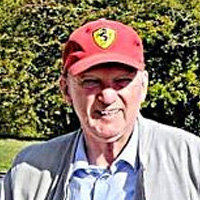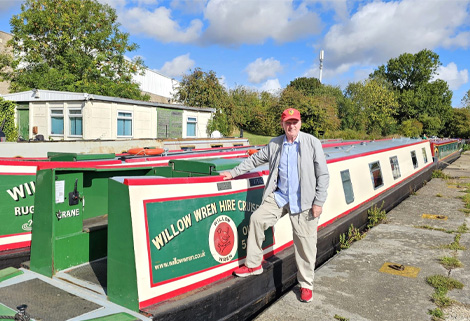
The author returns to the Willow Wren Boatyard, Rugby, from where he first cast off in 1975 - for a twenty year adventure!
“We’ll go on the Canal Cruise – it sounds a bit different” came Mel’s monotone voice.
Still, I’m pleased that she and Alec, the Church’s youth leaders, have made a positive choice for a summer holiday with CYFA (the Church Youth Fellowship Association) – the main Church of England Youth organisation. I had already been a leader on a couple of CYFA holidays based at Independent school campuses, but I’d never really noticed the Canal Cruise before as a potential holiday option.
My next move is to contact Roger, the cruise leader - who is a vicar in a northern parish. I learn that the cruise consists of four seventy foot narrowboats, with room for 35 youngsters plus ten leaders – and he suggests that the two of us should meet up and take one of the boats out on the Oxford canal for an afternoon’s training.
I’m intrigued.
casting off
It’s a fresh and misty February afternoon when Roger and I step aboard ‘Crane’ for my two hours of training in narrowboat handling. Rays of weak winter sunshine filter through the chilly mist as Roger casts off the ropes, then jumps on the back and, with a chug, chug, chug from the diesel engine – the boat slowly slides forward through the water, under Roger’s careful supervision. He will take the boat along the short canal arm until it meets the main Oxford Canal. Turn left and you get to Coventry and the north, turn right and you get to Oxford and London. But not today.
After checking for other unsuspecting boats, we turn right onto the Oxford Canal, and head off for Hillmorton locks, a gentle hour’s cruising away – where we will turn the boat around and return to the boatyard. Once in mid-stream, Roger steps aside and hands me the tiller, my aim being to keep the boat in the middle of the canal where there is (normally) the deepest water. It actually seems pretty easy, until the bow (front) seems to be drifting towards the left bank. So to correct, I naturally push the tiller to the right – but that only makes the drift worse, and we end up close to the bank! So Roger takes over to deal with the immediate situation, and he soon gets us back into the middle:
“You see James, it’s the opposite of driving a car. In a car, if you want to go right, you steer to the right. But on narrowboat, if you want to move the boat to the right, you take the tiller to the left! And vice-versa. It’s completely counter-intuitive.”
So I work on this basic principle as I need to correct the boat’s natural drift almost all the time and full-time concentration is required. Not as easy as I thought! So I find myself always
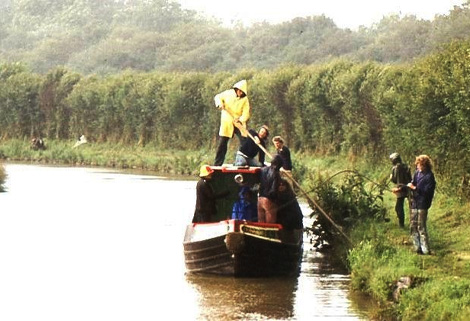
the aim is to keep the boat in the centre of the canal!
checking the line of the bow which is 70 feet in front of me. The next problem is when I realise that the bow takes quite a few seconds to respond to the tiller’s movements. And it’s easy to think that it’s not moving and so you correct with the tiller – too early – and then get confused as to whether you are going left or right. Then panic sets in! So basically, you need to shift the tiller – and then wait 10 seconds for the boat to respond. The longer the boat, the longer it takes to respond – and we’ve got 70 foot of it, pivoting in the middle! It’s another steep learning curve, but I’m enjoying it, as eventually we arrive at Hillmorton locks where Roger offers to turn the boat around in the ‘winding hole’. The way to do it, it seems, is to steer the front of the boat into the apex of the winding hole and keep the throttle going gently forward, with the tiller hard over, as the back turns in the opposite direction to the front. Then, with a few bursts on the reverse throttle, the boat drifts back to mid-canal and pointing in the opposite direction from where we came. Simples!
On the return journey, I now face the horror of seeing another boat coming towards us in mid-canal, so I need not to panic, but to get the steering steady and spot on, as I nudge Crane slightly to the right without hitting the bank. This I manage to do and the boats pass easily with several feet of water between us - relief! Roger now lets me steer the boat all the way back to the boatyard, where he assists with the throttle, in order let the boat gently slide to a stop right next to the Willow Wren wharf. Easy if you know how.
“Well done James - you picked that up really well. I’ll put you down as one of our eight skippers on the CYFA cruise. There will always be two of you on board to help each other.”
For me, a new world has just opened up, and I’m excited at the prospect of the forthcoming CYFA cruise, meeting up with Roger again, and with many new leaders and members to get to know - hopefully more affable than my own church’s youth leaders. Still, at least they are giving it a try - they might even enjoy it! But doubtless they are, like me, a bit apprehensive at starting out on new adventure - not knowing what lies ahead and what the outcome of their choice might be.
spanish inquisition
Amid the excitement of learning how to handle a 70’ narrowboat, I had conveniently forgotten about another aspect of the CYFA Canal Cruise, that Roger had asked me to take over from him: chaplaincy duties. Among other things, this included my ”getting alongside” the church-based youngsters on an individual basis, to help and guide them with their faith. I was rather taken aback by this because, for whatever reason - perhaps my own introversion - this did not sit comfortably with me.
I did not want to become, or be seen as, a sort of evangelical Spanish Inquisition!
Therefore in some reflective moments before the holiday itself, I found myself asking some pertinent questions:
In my new adventure, how would I fare?
How would my church’s youth group take to it?
Would the holiday be a one-off experience, never to be repeated?
Would my boat-handling skills be good enough?
But, more to the point, how would I cope - as the Spanish Inquisition? It felt more like a difficult place to be, rather than a soft cushion or a comfy chair! [1].
“Ha! Ha!” I think to myself. “But no-one expects the Spanish Inquisition” - least of all, me!
1. This refers to the well known sketch in Monty Python’s Flying Circus. First shown on TV in 1970, now available on You Tube. It’s worth a watch! In point of fact, the phrase “No-one expects the Spanish Inquisition” was also a joke, as the Spanish Inquisition actually wrote ahead to its victims, to advise them of their impending arrival, and their need to be upholding orthodox morals and beliefs.