hannah pierce

featured author of the season - summer 2024

hannah pierce

Hannah Pierce trained as an actor before writing, producing and performing in theatre for young people and adults across the UK and abroad. She has worked a number of roles since, but a common thread of presenting live arts is always central to her career.

Alongside her “real job”, Hannah has written for the stage, and her one-woman show on the valiant adventures of an online dater received critical acclaim. All Boats Are Sinking, her first book, is a memoir of love, life and chaos on a narrowboat, perfect for fans of Dolly Alderton, Helen Fielding and Phoebe Waller-Bridge, which has been called "a vibrant, often hilarious emotional and physical journey” by Ian Moore, author of Death and Croissants and “heart-warming, hilarious and honest” by actress Michelle Dockery.

Hannah Pierce on board narrowboat

hardstanding in snow

After a break-up, some hit the gym; some cut their hair; others have a one-night stand. In the aftermath of her break-up, Hannah bought a narrowboat.

Finding herself newly single aged thirty she knew she needed a fresh start. Forced to move out of her boyfriend’s flat her options were limited: move back to her parents, live in a flat share or spend all of her disposable income on renting solo. Instead, in an attempt to claim some independence and a semblance of control in her life, she made the fateful decision to buy a boat…

Newly single and plunged into life on the water, we follow Hannah as she quickly learns to live with Argie Bargie, her 45-foot narrowboat. In this compelling account of her slightly chaotic but certainly never dull life aboard, we follow Hannah as she tries to hold down a hectic career and social life while learning to navigate the strange new world on the waterways of London. Getting to grips with the intricacies of boat life, including exploding toilets, disappearing hulls, and the curious glances and questions from pedestrians on the towpath, Hannah discovers how empowering living alone can be while also being surrounded by a brilliant group of friends. All this as she tries to balance the tension between owning her singledom and giving in to a deep desire to find love.

However, when a turbulent relationship with a senior colleague and the advent of the Covid pandemic coincide and threaten to sink her, Hannah feels the need to escape. Sniffing out an opportunity for adventure, and in a bid to let go of the past and find her true self, Hannah embarks on a 250-mile odyssey from the bustling streets of London to the tranquil yet dramatic waterways of West Yorkshire. The nature of travelling by boat means that progress isn’t the fastest, and so as well as navigating 357 locks, including some of those in the infamous Huddersfield Canal, Hannah trains for and competes in a socially distanced marathon, and embarks on adventures with old friends – and some surprising new ones (hello, Tyson Fury!).

Discovering the beauty of the different canals and waterways across England, and the ever-changing landscape, Hannah writes beautifully about the pull of the water and the calming nature of life so close to it. As winter approaches and she nears the end of her journey, Hannah allows the ups and downs of the last 4 years and her empowering journey north to really sink in and arrives in Todmorden for her winter mooring stronger and more confident in who she is than ever before.

Peppered with entertaining lists, recipes, maps, footnotes and diagrams, and spanning hundreds of miles of the British waterways, All Boats Are Sinking is an uplifting and often hilarious story of adventure and personal growth, and of a woman trying to keep her boat and life afloat. And to answer that perennial question: yes, it's cold on the boat in winter.

book - all boats are sinking

interior of a narrowboat

narrowboat cruising

Here is an extract to give you a flavour:

Becoming accustomed to my home was a joy. I’m a master at pottering and I took great care in unpacking and arranging my belongings, stopping to enjoy a cup of tea out on deck, or to reposition my chilli plants in order to receive the most light in the ever-changing position of the stern.15 Coming home to a new location after a long shift at work was something I looked forward to immensely, as I discovered new areas of London and their Tube and Overground stops. I would chuckle to myself at the brief ownership I felt over a new neighbourhood, even if it was only mine for a few days. I would spot other boaters on the trains, casual creatures amongst the hordes of city workers and nighttime revellers. They were instantly recognisable with their grubby fingernails, fantastic tans, worn boots, loose shirts and a cork keyring hanging from their frayed pockets.

I moved the boat a lot in those first few weeks; short moves, occasionally with friends and more often than not with Megan’s assistance. My aim initially was to head east, where I could enjoy the remaining summer months near my work and Megan’s boat. From Alperton in West London, I journeyed through Kensal Rise and Little Venice, delighting every time I managed to complete a move without incident, and filling up on water with a hose trailing from a tap on the towpath to the bow of my boat where the tank is stored. With Megan on board, we tackled the Maida Vale and Islington tunnels, cruised through London Zoo and Regent’s Park and scaled the trio of iconic locks at Camden flanked by footbridges and hundreds of tourists and sunshine seekers. We travelled through the trendy neighbourhoods of Haggerston and Broadway Market and I took mental notes of all the places I wanted to stop for longer next time I passed, whenever that might be.

I would stand at the tiller with my support bubble of friends, chatting about everything and anything. We’d start the cruises with tea and biscuits, and end with a barbecue and beers on the roof, bringing candles out to keep the mozzies away and wrapping up in blankets as the sun set on another beautiful day on the canal network of London. When my friends were gone, I closed up the doors to the world outside and embraced being alone inside the boat. I had become used to being in close proximity with towpath users. No longer self-conscious, I felt comfortably hidden within my home and enjoyed overhearing snippets of conversation from those who didn’t know I was so close.

I was forever repositioning my belongings. It had become clear that everything I owned would have to be on display and the careful placement of kitchen utensils and books, toiletries and tinned food was key to creating the boat’s warm ambience. There was no room for untidiness. I bought pot plants from Mare Street florists to fill every spare surface. My personality couldn’t hide on Argie, and I was enjoying discovering how both the boat and I were evolving in that regard.

Sleep had never been so peaceful. The evenings would turn in as the canal-side activity calmed. Boats stopped moving through, and the birdsong quietened. With limited electrical appliances at home to distract me, I was going to bed earlier and sleeping deeper. The boat’s movement rocked me into my slumber. It was humbling to wake up in bed, so close to the water and canal wildlife.

This was not only my first boat, but my first time living alone, and I was enjoying every minute of it.

Hannah PierceFollowing the publication of All Boats Are Sinking (Summersdale Publishers), Hannah looks forward to taking on her next writing project, and intends to find inspiration through her imminent foray into a little-known thing called “motherhood”. She now lives in South London with one foot still firmly rooted on Argie – moored somewhere in the UK.

Hannah's book is available from Summersdale Publishers as an e-book or in Paberback. It is also available on Amazon.

jan vallance

featured roving canal trader

Jan Vallance - The Art Boat

I suppose I was always going to end up on the canals.  I just didn’t know it. When I was young, I used to play near the canal, and it was the route I took when walking to visit friends. The canal has always fascinated me. I even remember riding my bike along the frozen Peak Forest Canal one year to see a friend.

My mum’s house backs on to the canal so back in 2010 when I was looking for somewhere to live with my children after selling our house, she suggested a boat at the bottom of the garden. I needed no persuading. That was where I moored for the first few years. Nowadays, children having flown the nest, I continuously cruise.

narrowboat on the move

jan vallance with painting

I have lived on my boat for around 14 years now. I travel much more during the spring and summer as that’s when the festivals and floating markets are. In the winter I tend to stay in a smaller area, generally the North West to be nearer family.  My boat is my home, studio and gallery.

I love the winter on my boat especially when it snows. It’s really magical then and snow scenes are one of my favourite subjects to paint.

I never feel lonely. In the spring and summer, I often travel with others who are heading to the same market or festival. I might spend a couple of weeks with another boat and then not see them again for a few months as they’re on a different route. Lots of hellos and goodbyes, but I love it. Last year I travelled from the Llangollen canal through Yorkshire with the Hippie Boat for the whole season, that was a fabulous experience. The Yorkshire canals had not been on my radar before then.  I’ll definitely be going back for another dose of those inspiring canalscapes.

Three years ago I was joined by Lily.  A lovely little rescue dog from Macedonia.  It took her a while to settle, but she is becoming the perfect studio and boat dog.  She encourages me to get out and explore the areas where I moor.

The Art Boat

art studio in narrowboat

I started painting canal scenes 10 years ago, around the same time I got my trading licence and joined the RTCA. Before that, my subjects and styles changed quite frequently. When I began painting the canals and waterways, I didn’t expect to still be doing it now, but I’m hooked. The canals wind through cities and countryside, forming beautiful green corridors or industrial landscapes. With the changing seasons, diverse wildlife, and the people who use the canals, the opportunities for paintings are endless.

Getting my trading licence changed everything. I was suddenly presented with a means to sell my work and be inspired be the changing seasons and locations while I was doing so.  How many artists get to travel and sell their art in person? I still can’t believe how lucky I am to have found this way of life.

snowy canal scene

Two of my paintings - a snowy canal scene and the Pontcysyllte Aqueduct on the Llangollen Canal.

pontcysyllte aqueduct

I’m a member of The Guild of Waterway Artists.  The Guild is a collective of artists who specialise in capturing the beauty and essence of the UK's inland waterways. Established in the 1980’s, the guild aims to promote and exhibit artwork inspired by canals, rivers, and other inland waterways.  I’ll be exhibiting  with other Guild artists at Braunston Historic Boat Rally at the end of June.

I sometimes get asked why I don’t have any artwork actually painted on my boat. I do occasionally think it would be nice if my art spilled over into my boat’s exterior and interior, but I have never really been someone who needs to be in a beautiful space. I wake up thinking about paintings and making them, but don’t feel an urge to decorate the place I work in with my art. That doesn’t mean I don’t care about the space I work in, but I can turn any room into a workspace. I become oblivious to my surroundings when I’m working. Places for me become somewhere to create, and I leave a trail of finished and unfinished projects everywhere I go.

I like the fact that my artwork is only temporarily mine. I become very attached to a piece during the painting process, but then once it is finished it goes on to be someone else’s story. I like to think that people can make an emotional connection with my art, whether it evokes a memory of a place or a particular feeling. Many of my paintings reflect my journey on The Art Boat, but I hope that for anyone viewing the scene, it becomes their journey too.

jan vallance artist

I trade as The Art Boat. You can view my work on my website, or in person by visiting my events page and finding out where I will be. This year I am extremely excited to be taking part in Brinklow Marina’s first Arts Week from Saturday 13th-Sunday  21st July.

Visit my Website… or follow me on Facebook…

Brinklow Marina Arts Week…
The Guild of Waterway Artists…

what’s that smell?

the boating bard

what's that smell?


Goodness me what's that smell?
Where's it coming from ?
We didn't have eggs for breakfast
But something don't half pong

Is it coming from the bin?
Or perhaps the toilet's full
Or maybe it's the sink
Is there water in the hull?

Have you looked inside the fridge?
Or checked the washing basket?
Do you think that it's electrical?
Did we have the wood stove lit?

Is it something in the canal?
Are the radiators too hot?
Did we leave the pots last night?
Have we got more fruit bowl rot?


eggs with faces


Is there gunk in the shower trap?
Are we passing a local hatchery ?
No it's coming from the engine bay
We've cooked another battery


paul robert watson

featured author of the season - spring 2024

paul robert watson

How it all came about is a little hazy. At some point, I must have agreed to the idea of a narrow boat holiday. Certainly, I was not the prime motivator and red wine was probably involved.

So it was that I found myself in a darkened room watching an instruction video on the basics of boat handling, how to negotiate a lock, mooring a vessel and the like.

That was Easter fourteen years ago at Market Harborough, then the base for hire company Canal Times, With me were my wife, Sue, and daughter, Rosie, her friend, Hannah, and her mum and dad, Linda and Dean.

Although we didn't know it at the time, we were about to embark on a journey that would lead us to travel, if not the length and breadth of the waterway network, then large sections in the north west and Midlands.

We emerged blinking into the daylight, were shown a model of a lock, then ushered aboard Hartley's Best, carrying our gear for a four-night trip. Briefly we were informed of the boat's operation. Push the throttle lever forward to go forward, back to go back; steer left to go right and visa versa. Oh, and reversing is tricky, but you'll get the hang of it. Honestly, to this day, I never really have.

Our instructor rather hastily stepped off at the entrance to the marina and we were left to our own devices.

The secret of happy cruising, at least in the early stages, is that you have to be prepared to leave your dignity on the quayside. Forget about looking nonchalantly professional like a seasoned boater and embrace the laughter you will inevitably hear from the gongoozling crowds, just like I did.

Yes, I was the first to get wet, left clinging to a top rail while my feet dangled in the water. Why did the girls draw the blind as my face appeared outside the kitchen window? All I could hear was the sound of embarrassed chortles.

A swing bridge? All right, we can manage that. But who's getting off to operate it? The sequence, so blindingly simple, had to be worked out for our first effort.

Turning for the first time was also a challenge and the bottom of Foxton Locks is hardly the ideal place to learn. After a display of cringeworthy ineptitude, we managed to moor.

Paul Watson - Foxton LocksEven for experienced boaters, Foxton can be the cause for some head-scratching. Long, steep, with staircase locks, your readers will be all too familiar with the scenario. We read the instructions and, with the aid of the lock-keepers on duty, we made it to the top. It felt as though we had scaled Everest, such was the sense of achievement.

On we cruised. With no locks, this was easy. Through Husbands Bosworth tunnel, then a stride across the fields to the White Hart, all the while becoming more enamoured with this boating life.

A better executed turn and an excursion to Welford on the way home provided the crew with greater confidence and Foxton was negotiated without incident. After good food and drink at the Black Horse, we returned to Harborough.

The trip, as they say, had seemed like a good idea at the time. And it really was.

Within six months we had become shareholders in Sometimes, an Ownerships vessel. You'll be familiar with that particular sorry tale but the syndicate survived without incurring too many losses, unlike some less fortunate.

I had become a committed boater rather than an accidental one.

So why not employ some of the experiences, sights sounds and scenes in a story that I had long hoped to write?

And that's how Cut to the Chase became a reality.

the book

cut to the chase by Paul RobertsCut to the Chase, some of which is set on the canal network, is available as an e-book from the Kindle store.

It is an adventure story, in which the main character, John Clubb, finds himself at the centre of a web of police corruption and drug-running.

Part of the story is based in and around Braunston and the tunnel, of which I have personal experience, having been a canal boat owner for the last 13 or so years.

The basic premise is that Clubb is on the run from a gang of drug smugglers and a corrupt policeman. He escapes their attention but is pursued from Scotland to the south east of England and thence to the Midlands.

An ex-policeman himself, he is aided by a former colleague, Brian Digbeth.

He escapes on his old narrow boat, Longfellow, aboard which he attempts - very slowly, naturally - to evade his pursuers. The plot eventually takes him to Scotland, where he is able to assist the police in tracking down the drug-runners and corrupt officers. And, of course, there is a twist in the tale.

The novel is published as an e-book on amazon under the name of Robert Watson and will cost £2.35, although it will be available free for a limited period. A paperback version is planned if reaction is favourable.

Paul Robert Watson

Paul Robert Watson considers himself to be a Derby lad, as it was there that he spent his school days. Throughout his adult life, he worked as a journalist, working mainly as a sports journalist and editor.

He is a member of a syndicate which own NB Sometimes, currently moored at King’s Orchard marina, where she has undergone an extensive programme of renovation and repair.

He lives in Egginton, not far from Burton, with his wife Sue. They have a grown-up daughter, Rosie.

The novel is published as an e-book on amazon under the name of Robert Watson and will cost £2.35, although it will be available free for a limited period. A paperback version is planned if reaction is favourable.

Paul is happy for readers to contact him for more information.

Please call him on 01283 736383.

bob chase – barge fiodra

featured roving canal trader

bob chase - barge fiodra

Fiodra was carefully designed to be a flexible, floating, event platform and a place to live. We have been running a successful programme of our own events since 2018, as well as hosting a huge variety of events for hirers.

This project brought together my experience and several passions. I come from a maritime family, my father was a marine pilot and one of my brothers the skipper of a tug. I began living on my first boat in 1990. I have also had a career in community arts and in venue management. I have always found hosting shows, cinema and events to be great fun and rewarding.

I began designing Fiodra before I left my final full time job at the National Autistic Society in 2016. She was built in Poland, to my design, by the Viking Canal Boat Company. After delivery in 2017 we took her on a maiden voyage to Bristol and back. We launched our business in Spring 2018 with a residency in Paddington Basin. We hosted story telling with Kate Saffin, poetry from the Canal Laureate Nancy Campbell and classic canal films.

Since then we have travelled most of the waterways we have access to in a wide beam. We have made visits to Oxford, Guildford, Maidstone, Hertford and all points on the Grand Union. We used the opportunity to explore what worked and what didn't work onboard.

barge fiodra - mindfulness

Barge Fiodra - Art Gallery

By adding (removable) gallery panels and 12v gallery lighting we were able to create a beautiful gallery space for visual artists. Our first season in Little Venice was in partnership with the Guild of Waterway Artists. It was successful from the get go and we have since been able to host many exhibitions of paintings, illustrations and textile arts.

This Easter (2024) we will be hosting a textile art exhibition by Marissa Stoffer. Marissa stayed on Fiodra last summer on the River Lea where she collected the natural dyes she has used to create this work. Check out our website for details.

We also managed to install a micro-cinema in the boat using a digital projector and high quality sound system. Everyone loves the experience and we have been able to show several indie films including the launch of the film TIDES. However we quickly discovered that mainstream films were uneconomic for us to show in a cinema with only 24 seats.

We have also tried our hand as a Cafe and Jam Shop. Fiodra is designed with extra features that enabled us to register as a food business, with a 5 star hygiene rating. Selling home made cakes, coffee and tea on the back deck worked really well. My partner Moira also sold her gourmet jams. She usually delivers locally by bicycle under the banner of the Jam Pedlar.

barge fiodra - cinema barge

Our latest project, the Floating Camera Obscura, was inspired by another partner, Ben Nathan from Pinhole London. Photography is another string to my bow, having a diploma in photography and having worked, as a photographer, in London for several years.
​
Ben and I have now run several pinhole photography workshops onboard with young people. We convert the saloon into a darkroom where photographs can be developed. We also teach the history of photography and have installed three camera obscura onboard. Everyone is
amazed to see this fascinating technology on a boat!

Besides our own projects we have grown the hire side of the business. It took a knock during Covid but we now have to turn people away. Our partnership with Tag Venue has been very productive especially when they made us a SuperVenue because of our positive reviews.

It’s impossible to list all the events on the boat but they have included: Argentinian wine tasting, the launch of a music CD, meditation workshops, environmental talks, poetry evenings, pinhole photography, yoga, and of course lots of family parties.

barge fiodra - café barge

barge fiodra

What's next?

Well I'm the sort of person who loves a new idea and enjoys making it happen. I just don't have the stickability to carry on forever. So now I feel ready to let go of this project and look for a new challenge. Travelling all the canals, we have not been able to see, in a narrowboat, is one distinct possibility.

What would be lovely is to find someone who wants to build on what we have achieved or to take things in another direction altogether. It’s a fantastic opportunity for someone. Just by doing a few hires a year it is possible to cover the main costs of boating and live afloat for free.

If anyone wants to find out more about Fiodra they should go to https://sale.fiodra.co.uk/

I’m really happy to discuss plans and ideas with any potential buyer.

Bob Chase 6/3/24

Bob Chase - Barge Fiodra

I've been around boats since a boy. My (late) father was a marine pilot, in the Wash, and from a local fishing family. My brother Bill was skipper of a tugboat. We built boats for ourselves large and small over the years and my family owned a few canal boats. I've lived on two narrow boats on the southern English canals. Fiodra is the newest and biggest vessel.

After careers in photography, arts management and technology, I am now a freelance mindfulness teacher and web-consultant. Oh! and I run Fiodra.

You can find out what is happening, where and when by visiting Fiodra's Website

lead barnerds

lead barnerds

On New Years Eve 2023-24 in a pub called The Bull, I had the pleasure of making the acquaintance of a lovely couple, Gerry and Lin, who incidentally publish this magazine. Gerry was to perform the cabaret act later that evening, and he and My Creator clicked instantly as they propped up the bar supping beer and exchanging stories.

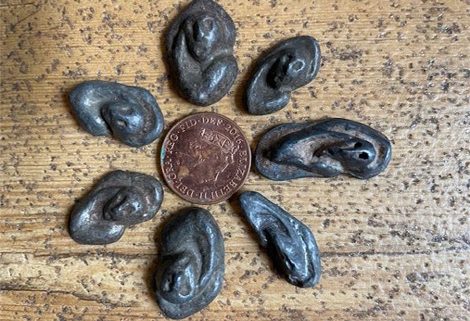
Then the subject of art cropped up. My Creator, as I call him, who goes by the pseudo name of Barn and whom I can only describe as a scruffy arty sort, reached into his jacket pocket and pulled out the silver tin that he keeps little lead sculptures of me in. He opened it and placed seven copies of me on the bar top in front of Gerry.

group of seven lead barnerds

“They’re called BARNERDS for want of a name, a nerd you met in a bar, thats me!” Then Barn asked, “So which one talks to you ?”

Gerry’s eyes narrowed as he studied the group, then he picked one up between forefinger and thumb, “It’s heavy for such a small sculpture,” he said.
“That’s 'cos it’s made of lead. I cast a thousand of them, I’ve only got about a hundred left.”
“Umm lead eh,” Gerry pondered, “Where did you get the lead from?”

Now I’ve noticed a lot of people ask that question when given a copy of me, and My Creator always tells them the same story about when he was a kid, and his grandfather gave him seven old lead musket balls.
“He said they were from The English Civil War, objects designed purely to kill and maim, whereas I remould the lead into pieces of art.”
“How did you make a thousand of these out of just seven musket balls?” Gerry asked, doing the maths.
“Ah I made the rest of the mix up with lead that I nicked off a church roof, ha ha !" He laughed at his own joke.

Barn went on to explain that for the past quarter century he had been distributing these little lead sculptures all around the planet.
"North, South, East and West. I leave them in interesting places, some to be found, others not, to reside there for eternity! But mainly I just give them to nice people I meet on my travels, often folk I get chatting to whilst sitting at the bar in pubs or cafes, or I give them to waiting staff and street buskers as tips. Mind you, I always ask them if they want to except a BARNERD first, I don’t want to force my art on people, and if I get the chance I bless them and ask that they wish for World Peace and Global Stability.” Barn elaborated on his wish, “World Peace as in to stop the wars we humans inflict on each other and Global Stability as in super volcanos, earth quakes, asteroid strike, etc. This beautiful planet that we all live on is very fragile, we need to respect and look after it," he added.

With that Gerry ordered two whisky’s; they chinked glasses, shook hands and toasted the wish.

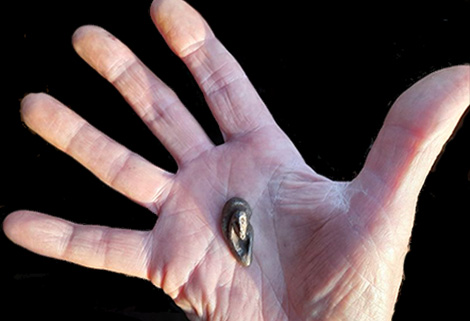
barnerds are tiny

“How do you make these Barnerd’s?” Gerry went on to ask.
“Oh easy! I melt the lead in a ladle over hot embers then pour it into clay moulds in batches of seven. Seven's my lucky number. Then, when the casts are cool enough, I knock them out of their moulds and then I hold each copy of The BARNERD aloft, I bless the universe and make my wish.”
“And what's this strange pose The BARNERD’s supposed to be in?" Gerry inquired as he studied me more closely.
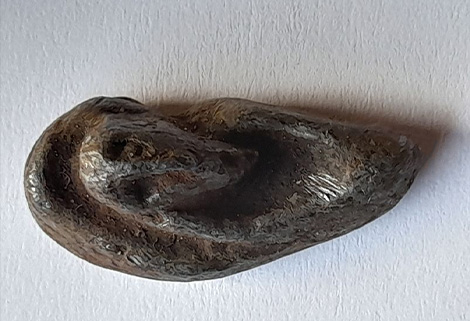
“It’s got one arm wrapped over the head and the other wrapped under the chin; it’s giving itself a cuddle of sorts.”

My Creator demonstrated and Gerry immediately imitated the pose. Anyone watching the two ageing gentlemen sitting at the bar in this peculiar position could be forgiven for thinking that they’d had one too many...

“I’ll keep my BARNERD safely in my wallet until I find a nice place to put it on my canalboat,” Gerry promised.
“Wow you live on a canalboat!” Barn exclaimed, “I’ve scattered a few copies along towpaths over the years, maybe some of your readers have found one”.
“Who knows,” said Gerry. “ I’d be interested to hear from anyone that has."
“You probably will,” I mused to myself.

the benefits of an engineering apprenticeship

the benefits of an engineering apprenticeship

with the rothen group

Seventeen-year-old Apprentice Engineer, Lewis Douglas, has explained how he has progressed within his role at The Rothen Group during the first year of his career on the waterways. With boats, college, and growing as part of a team, Lewis has discussed just how the business is helping him achieve success.

Lewis Douglas, Rothen Group

In 2022, I was in a similar position to many students leaving high school after completing my GCSEs.

I had secured my Maths, English and Dual Science qualifications and needed to figure out what to do next.

During this time, I was presented with multiple options for my future: attend sixth form to complete A-levels, join a college and receive a BTEC, or enter an apprenticeship and earn while I study.

practical learning

I knew sixth form wouldn’t work for me as I didn’t thrive in the classroom. In my mind, I wanted a course that allowed me to learn through action instead of behind a desk. It was during this period that I heard about the engineering apprenticeship with Rothen Group working on the canal network. The concept of it intrigued me, so I decided to apply.

Now in my second year at college, it’s safe to say I definitely made the right decision. My education is split into three-week blocks where I’m either attending classes at Rease Heath College or working with Rothen Group team putting the theory I’ve studied into practice.

In the past year I’ve taken engineering theory into the field with my colleagues, who have in turn shown me how to apply it to our work. It has been amazing to learn about river/canal management in the classroom and then do it alongside an industry professional the following week.

working with canals

One aspect of the job that I’ve come to love is just how different every day is. When I’m out on site with my colleagues, I could be fixing a canal lock gate, dredging a river, or working on heavy machinery such as workboats and diggers. Two days are simply never the same. When I joined the team, I was surprised to learn how exactly the canals work, and how much time and effort goes into waterway maintenance.

Rothen Group

Rothen Group

Few people know that canals require preservation work, such as relaying the base to prevent leaks. Many that we see today were built in the 1700s and 1800s and you simply can’t expect them to remain perfect over such a long period of time. We work in an incredibly niche industry with very few businesses conducting our kind of work, meaning there are only a small number of trained individuals who can ensure preservation work is correctly carried out. It’s amazing to think that in two years’ time, once I’ve completed my apprenticeship, that I’ll be one of them.

future prospects

As it stands, I don’t believe my education will stop once I’ve finished college. I’m already in discussions with the senior team at Rothen Group to undertake further qualifications at a university level in engineering, with a role ready for me once I graduate. This is something that I never even considered applying for ahead of working with the team. I may only be a year into my career but the support I’ve received to help me achieve a bright future has been astounding.

By applying for the engineering apprenticeship, I have been able to learn about such an exciting and versatile industry while being able to wake up each morning looking forward to work. That’s all anyone can ask for when they’re starting their career. If you know that a desk job isn’t for you and you want to work in an everchanging, enriching environment, I recommend applying for an apprenticeship with Rothen Group.

For more information about The Rothen Group, please visit their website

boat licence fees for 2024-25

boat licence fees for 2024 to 2025

The Canal & River Trust is today confirming an increase of 6% in Boat Licence Fees from 1 April 2024 for both private boat owners and boating businesses. The rise is based on the latest Bank of England forecasts that inflation will remain at around 4.5% through until April 2024.

The surcharges for boats without a home mooring and wide beam boats, and changes to the prompt and online payment discounts, announced on 4 October, will be applied in addition to this rise.

Boaters can use a new online calculator on the Trust’s website to calculate what the licence fee will be for their boats: licensing.canalrivertrust.org.uk/LicencePrices.

Richard Parry, chief executive at Canal & River Trust, said: “The recent years have been a challenge for organisations and individuals alike. We know that the cost-of-living crisis will have affected many boaters and we have thought long and hard about the licence fee rises we are introducing. There is support available for boaters, and we urge people who are struggling to get in touch with our team.

“The Trust has been heavily impacted by the adverse economic environment. Over the past few years, we’ve faced significant increases in a range of our costs, notably the prices of energy, fuel, materials, and other construction demands. Meanwhile our government grant is reducing in real terms and is due to be cut sharply after 2027, unless our Keep Canals Alive campaign and the multi-organisation Fund Britain’s Waterways campaign persuade Government to revisit its decision. We must act now to plug the funding gap, or we risk seeing canals decline and, ultimately, the risk of closures.

“We’ll continue to secure as much income as we can through our commercial and charitable activities and focus our resources on those priority works which are required to support navigation, and on controlling our costs where possible. The 2,000 miles of waterways that we care for comprise 10,000 assets and structures, many of which are up to 250-years-old, and they are vulnerable to the extreme weather events that are becoming more common. We are continuing to invest in an extensive ongoing programme of works that will safeguard the future of boating on the inland waterways.”

The cost of the licence, which accounts for around 11% of the Trust’s income, has largely kept pace with inflation since the charity was formed. Whilst this is a valuable component of the Trust’s income stream, boaters will not be expected to bear the full brunt of the funding shortfall but will have to make some contribution. The Trust is also working to generate more income from its property and non-property endowment, and from other commercial sources such as hosting utilities and water transfer. A step-change in income generation from towpath users and other supporters is targeted, with fundraising income projected to grow by 10% each year – whilst other commercial waterways income, including from anglers, paddle sports and moorings, is also set to increase.

The Gold Licence charges, agreed with the Environment Agency, will increase by 10% from 1 January 2024. This reflects the higher increases applied to fees in 2023. The surcharge for boats without a home mooring will be applied to Gold Licences from 1 January 2025. The additional wide beam surcharge is not applied to the Gold Licence as it already factors in a charge for wider boats.

The Trust will continue to support boaters who may be struggling to pay their licence fees on a case-by-case basis. This may include arranging flexible payment plans and signposting to relevant services, for example the Waterways Chaplaincy, local authorities and Citizens Advice. For more information visit: canalrivertrust.org.uk/enjoy-the-waterways/boating/do-you-know-a-vulnerable-boater

More information on boat licences is available here:  canalrivertrust.org.uk/enjoy-the-waterways/boating/buy-your-boat-licence/long-term-boat-licences

gill shaw

featured author of the season - winter 2023

gill shaw

Gill Shaw has been a professional and highly successful photographer of people for more than 25 years. She is an Associate of the Master Photographers Association and Royal Photographic Association, and she has photographed people from all walks of life from the royal family to islanders on a remote island in Africa.

Now Gill has outstepped her comfort zone, and published a book which looks into the lives of some of the people who live or work on a canal boat. 'Canal Boat Lives' is primarily a book of photographs, and is presented in  conjunction with a National Touring Exhibition. The book follows on from the success of another book of photographs and individual comments entitled 'The hero inside'.

canal boat lives

the hero inside

gill shaw - slightly offstage

Canal Boat Lives

Gill's book, Canal Boat Lives, is in landscape format - in keeping with the Pearson Canal Guides, and with a cover in keeping with the traditional green and red of canal boats.

The book is primarily a collection of photographs, and the text inside consists very largely of the words of the boaters who are photographed. Most of these boaters seem to be based in the South East, more specifically in and around London. But in fairness to the author, there was never any intention to spread the coverage nationwide.

In the volume, there are gathered several musicians, a graphic designer, a writer, a psychotherapist, a foreign correspondent, a pair of DJs, an archaeologist, boat builders, a theatre company and a delightful young boy with autism. The boats photographed include a variety of steel narrowboats including one which has been turned into Del Boy's Robin Reliant. There are also a couple of widebeams - unashamably being described (and indeed shown) as floating luxury apartments.

The photographs are, of course, quite stunning, and those photographs which reveal the inside of boats show that each boat has its own individual style and personality, reflecting the boaters who dwell in them. It is good to see those who not only live aboard, but work aboard to keep themselves afloat.

It would have been easy for Gill Shaw to present a rather romanticised view of life on canal boats, but she does not shirk away from those who mention toilets, the cold and the mud, although these seem to be rather incidental to this wonderful way of life. She doesn't dwell on boaters who struggle to keep going; who cannot afford moorings, and cannot maintain their boats satisfactorily. But she does give us some insight into the lives of people who work hard to keep themselves afloat - such as the young man who repairs, and apparently lives and breathes bicycles which he has rescued from the canal.

The aim of the book is to give us a glimpse of the variety of life on our inland waterways, and the author does a stunning job in presenting the lives behind the colourful boats in Little Venice, Regent's Park and other collection points in and around London. The impact of the book would not be so great if the viewpoint looked at the less colourful boats on the system.

What Gill Shaw does show is that, contrary to the beliefs of many, all boaters are not wasters on benefits or little more than water gypsies. In fact there is as much of a cross section of people as you would find on land. But on boats, well it seems, people do have something a bit special.

This book is a must for anyone interested in boating life. You can view it from many different angles. From the coal merchant who lives in a tiny cabin, to the floating palacial rooms of the wide beam. From those who live in a house, but holiday on their boat, to those who have no home mooring but drift around the countryside from one place to the next. Then those that move sweetly from one marina to the next, living nowhere in particular, but always having the benefits of water and electric - and showers.

Life on a boat is the same as life on land. You live within your means, and in keeping with your dreams. And the ultimate success of Gill's book must lie in the fact that the nature of humans is to be ever curious, and to enjoy glimpses, however brief, into the lives of others. You cannot help browse through the pages, read little snippets, put the book down, and pick it up immediately to read a little more...

You can buy a copy of Gill Shaw's book 'Canal Boat Lives' from Amberley Publishing,
The Hill, Merrywalks, Stroud, Gloucestershire GL5 4EP.

Copies of Gill Shaw's books are also available on Amazon.

permission to come aboard part two

the boating bard

permission to come aboard, part II

If you come to visit me
Make sure you've had a wee
And bring some semi skimmed milk
If you want a cup of tea

I usually have some sugar
And drinking vessels for one each
Though they may be tannin stained
Because I don't use any bleach

I prefer if you take your boots off
And leave your hound at the door
I don't want muddy pawprints
All over my laminate floor

You will take me as you find me
It's a little busy in here
But I'll clear a walkway through
And I'm sure we'll uncover a chair


wet and muddy boots

Please don't outstay your welcome
I find conversation trying
It's hard to wax lyrical
Where my underwear is drying