erewash canal 55th rally

erewash canal preservation and development association

55th anniversary rally 27 - 29 May 2023

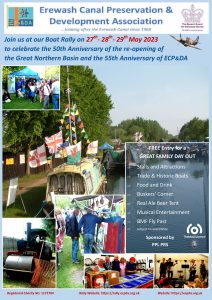
In May 2023 the ECP&DA will be hosting a boat rally at the Great Northern Basin at Langley Mill. The rally is to celebrate 55 years since the formation of the association and also 50 years since the restoration of the basin, lock and surrounding area.

Following our formation in 1968 the association is still going strong and we now own Sandiacre Lock Cottages and the cottage at Langley Mill, which is our headquarters. We have an ex British Waterways work boat that we have restored. The boat, named Pentland enables us to carry out work along the canal. This includes lock repairs plus vegetation and litter clearance. We are currently involved in restoration work at Langley Mill with the Friends of Cromford Canal on the Beggarlee extension. This will take the Cromford canal under the A610 via two locks.

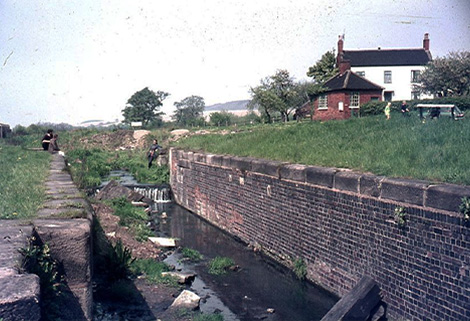
Langley Bridge lock before restoration

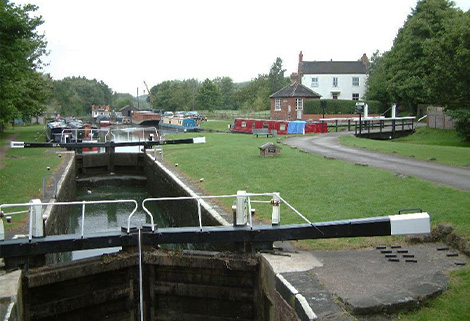
Langley Bridge Lock, Erewash Canal

The rally will include a mixture of trade, historic and private narrowboats plus trade stalls and display stands from other canal groups. Public entry to the rally is free. The rally will begin with historic narrowboats Bath and Meteor setting off from Anchor Bridge at 10:30 carrying the Long Eaton Silver Band to the opening ceremony by the lock at 11:00.

Other attractions are:

  • Food and drink, including real ale tent.
  • Musical entertainment sponsored by, PPL PRS. Buskers corner.
  • Battle of Britain Memorial Flypast (subject to availability).
  • View boat and butty Oak and Ash in Langley Mill Boatyard dry dock. The boatyard will also have a display of engines and those that are ticketed are for sale.
  • The Victorian pump house will be open with opportunities to learn about its purpose and how it works.
  • Take an informative guided walk along the restored stretch of the Cromford canal and learn about ongoing plans for the future.

If planning to come along with your boat please book in; forms are available on our website 
Further information and booking forms for rally can be found in the news and events section of our website.

update on sticky fuel situation

sticky fuel

update from river canal rescue

Last summer, River Canal Rescue highlighted the problem of sticky fuel and how this was causing an uncharacteristic peak in fuel-related component breakdowns not linked to diesel bug.

Managing director, Stephanie Horton, comments: “We first became aware of the issue when we had two identical jobs where fuel injectors were diagnosed as needing an overhaul, yet their replacements stopped working within a week, and the injection pumps were found to have failed even though the diesel was clear and bright.

Our engineers found in both cases, the injector pump racks had seized solid and the nozzles were blocked, and when replacing the plunger filter head, they found the fuel had a sticky, syrup-like substance. Alongside stuck injection pump racks, injectors and filter head plunger failures, we also had cases of fuel filters blocking with wax inside them.

Initially we suspected sugar in the fuel, but sugar stays crystalline instead of dissolving. We’re now considering it may be related to a change in fuel and fuel treatment additives. This is not contamination in the traditional sense (all the samples sent away for analysis are clear); it’s only the smell of turps that alerts us to a problem.

“Following discussions with several leading fuel analysis companies, we’re now working with a university lab to use IR spectrum analysers and range of samples/treatments to see if we can identify what is causing sticky fuel.”

Stephanie concludes: “RCR is taking these steps as cases are increasing to two-three per week, and although there are some trends and patterns developing in the more cases we see, it’s important to have scientific evidence to back-up our theories. As an industry we must work together to find a solution.”

bottle full of sticky fuel

Here, two boaters share their experiences:

Unpleasant & expensive

Dear RCR,

Re the ‘sticky fuel issue’, we had a similar episode with our narrowboat nb ‘Many Meetings’ in August 2020.

Our narrowboat was launched in October 2011 and up to the incident had done 2,850 hours. We cruise in the summer and over winter, we’re at Aston Marina near Stone, Staffordshire.

In 2018, we did the Severn Estuary from Sharpness to Bristol and, in preparation for that, had the fuel polished in July. There was absolutely no water or contamination in the fuel.

In 2019, the boat was serviced by our engineer in the spring, and again filters and fuel were clean. We then went up to Lincoln and Boston via the Tidal Trent. We refuelled twice at Sawley Marina, twice at Burton Waters Marina and finally topped the tank off for the winter back at Aston Marina, when we arrived back there in October.

Due to the pandemic, the boat remained unused until 20 August 2020. Before taking the boat out, I checked the engine and fuel filter, and checked the fuel draining from the filter was clear, which it was. We over-nighted at Weston before continuing to Great Haywood on 21 August, and the engine (a Beta 43) ran fine.

On the morning of 22 August, the engine was reluctant to start and produced clouds of white smoke. Luckily, there was an Anglo Welsh hire base and their engineer said he would take a look at the boat the following morning, which he did.

The engineer checked the fuel and filters, which looked fine, and drained off some fuel, which was clear. He then removed an injector and tested it. He found the injector was blocked and so replaced all four injectors. The engine started and ran fine.

The following morning we set off, but only went a few miles south before stopping for the night. The engine ran fine.

The next morning, the engine wouldn't start. The brilliant engineer from Anglo Welsh came to find us on his day off and, after a couple of hours, he finally managed to get the engine started but it was running quite roughly. Gingerly, we made our way back to Great Haywood.

At Great Haywood, the engineer removed the injectors to check them and found they were welded shut. He put one in a vice and tried to pull the centre pin out with a pair of pliers, but it was completely jammed solid.

The fuel feed for the engine is above the bottom of the tank, so we removed the bottom drain and dumped the tank contents of 135 litres of fuel. We used the bottom drain and a powerful pump to rinse the tank and ensure that any contamination was washed out. We then put another 35 litres into the tank and dumped that to rinse the tank out.

Anglo Welsh very kindly disposed of the fuel for us. When we drained the tank, we took a sample from the very bottom of the tank, which did not look very healthy - although the rest of the fuel looked fine.

We replaced the four injectors again (those things are not cheap), drained all the fuel from the engine and filters, and ran the engine on clean fuel from a 5 gallon drum for an hour or so. We then put 100 litres of new fuel into the tank and ran it on that successfully. Subsequently, the engine started and ran fine. You can be sure that when (hopefully) some normality returns, I will take a fuel sample from the very bottom of the tank before we set out again.

It appears the contamination was settled at the bottom of the tank but the motion of the boat meant some of it got picked up into the engine. The engine ran fine and the injectors worked OK when the engine was hot, but it seems when the engine cooled down, whatever it was blocked the injectors.

Altogether an unpleasant experience and very expensive - dumping 170 litres of fuel and putting in eight new injectors. However, all credit to Anglo Welsh and their brilliant engineer.

Robin Sundt, Redhill, Surrey.

A bit of a pain

Re: contaminated fuel, I have experienced the same problem with my boat and it was a devil to get rid of and until I run it again, I have not proved it is gone. My boat is called Pyrus and is kept in the Grand Union at Blisworth, Northampton. It has a Greaves twin cylinder engine which is built in India and is a development of a Ruston Hornsby unit. Below are the chain of events I experienced:

1. August 2019. Having returned from a long trip through Shropshire, Wales and the North we returned to our mooring intending to have a rest for a few months from boating. In advance of mooring up, we filled up with diesel at Rugby Boats, near Weedon, and I added Fuel Set (as I have always done since owning the boat in 2012).

2. October 2019. We have a heritage cooker installed in the boat which runs on diesel and this packed up. On inspection, by draining the filter, the fuel came out looking like water, with a grey tinge. Not pink at all. I had not run the engine since August and did not at this time. I change the filters every year about April/May and they are always clear of any debris/water in the bowl.

The UK agent for Greaves is close to me and came down to help clear the problem. We syphoned a lot of fuel off to the point we thought it was clear and added two or three bottles of Marine 16 to treat it.

3. November 2019. The engine started and appeared to run OK. At this time the engineer visited to sort the cooker, but found contamination still present. It looked like frog spawn. Also by this time when trying to clean the fuel, the tank was below half-full.

4. January 2020. I got Tankbusters to polish the fuel. Took about 4 hours after which the fuel looked to be the correct pink colour and again more Marine 16 was added (the tank was also topped up at Blisworth marina). The cooker was sorted and that and the engine seemed to be working OK, following a test trip up the canal for a day. Shortly afterwards lock down was imposed which put a stop to any further use.

5. July 2020. I took the boat out for the weekend. At the end of the first day the engine was running a little lumpy. The next day only one cylinder was working and I struggled to get back onto my mooring. The injectors were seized so I took them to be rebuilt.

6. August 2020. Injectors back in boat - took it out for a 6 hour test. This started very well but as I was returning it started to run lumpy again. The following day I found the injector pump racks were seized and I assumed the injectors would be affected (which proved the case when I took them in to be fixed). I used diesel specialist, Colchester Fuel Injection, and I gave them a sample of diesel to test. The results were about 4% bio which is within limits.

7. September 2020. Injectors and pumps back in engine but not started. I pulled the boat to a local boat yard and had all the fuel removed and the tank cleaned out. Pulled the boat back onto the mooring where it was filled with fuel from fuel boat, Jules fuel. No additive was put in and I do not intend to use any. The cooker works, but I want to test the engine over a day trip as recommended by Colchester Fuel Injection rather than a short quick run.

All in all a bit of a pain. My engine is rather agricultural and simple and it is the first issue I have had with it ever. I thought it would run on water. Obviously not and this fuel has been a real issue. Hopefully I am over it now.

Chris Browne, Chelmsford, Essex.

abigail joy tobler

featured author of the season - winter 22 - 23

joy tobler

Abigail Joy Tobler’s love of waterways has, sadly, never found her on a canal boat. She has, however, paddled dug-out canoes on rivers in Mexico and Brazil. In England she has enjoyed many hours walking the Thames towpath near Henley whilst dog-sitting for friends over many years. She enjoyed watching the many passing canal boats navigating the locks, and always felt especially blessed when catching glimpses of a kingfisher.

She began writing poetry whilst battling severe depression and has continued during happier times. Many poems are triggered by things heard or seen, and often reflect her Christian faith. She has published 6 collections of poems plus the booklet ‘Tales from the Towpath.’

tales from the towpath

pebbles, puddles and poppies

Joy has had a very varied and adventurous life. When she was young she was a very active sports person, especially in cricket which was her great love. A change of ambition following injury saw Joy become a grammar school teacher, with her subjects being Mathematics and Religious Education. She also studied linguistics and translation.

Joy married a Swiss, and together they went to Mexico where they underwent 6 months of jungle living and survival training. This was followed by a long period in Brazil, where Joy taught literacy and Bible translation to a group of indiginous peoples.

They lived in a village along the banks of a little jungle clad island in the middle of the Amazon delta swampland. All of the houses were on stilts, without walls, and palm thatched. Joy had three sons while she was in Brazil, athough they were all born in the city as malaria (and consequent miscarriages) were rife in the villages.

After thirteen years of life on the banks of the Amazon, Joy had to leave Brazil because of her husband's ill health. Returning to the UK, Joy worked at the home office of the mission, Wycliffe Bible Translators. At some stage she developed M.E. which damped down her life for 25 years. It was at this stage that she began writing her poetry.

Eventually, Joy moved to Sheffield to be nearer her sons and their respective families. She continues to be an active church member, singing in her church choir. Some of her poems have been set to music as anthems and one as a carol.

crossbeams - abigail joy tobler

tides, teasels and teapots

Abigail Joy ToblerAbigail Joy Tobler, better known as Joy, has written several volumes of poems. Her books are available to buy from Joy herself, although there is some availability on Amazon

You may contact Joy by email:


RCTA donate to waterway charities

RCTA donate to waterway charities

£500 each to Waterways Chaplains and Forces Vets Afloat

Since the start of Covid19 the Roving Canal Traders Association (RCTA) along with many other charities, non-profit making groups, business's & traders that make up our canal network have had a tough time. This year however, things returned to almost normal & our Floating Markets started to take off once again. This meant that we have been in a position this year to resume our annual charity donations as voted for by our members.

This year our members voted for the Waterways Chaplaincy charity & the Forces Vets Afloat Project with a donation of £500 to each.

The Waterways Chaplains work alongside Canal & River Trust to make sure boaters who have fallen in hard times or need some sort of support are not missed or lost in the system, they work with food banks around the country & make sure that essential meal, bag of coal or fuel gets to those who might otherwise go without, they maintain contact & support in so many ways. Our traders often come into contact with some of the Waterways Chaplains who are very supportive of our events so it was suggested that our donation was presented to the charity via Waterways Chaplains Malcolm & Stephanie who live beside the Shropshire Union Canal in Market Drayton & are very well known within the boating community. Mark Chester Senior Chaplain said “This donation of £500 will make a real difference in the lives of some of the boaters we encounter.”

Sue Meades presents cheque to Waterways Chaplains

The Forces Vets Afloat Project are close to finishing one of their donated boats nb Daisy ready for a Forces Veteran to make her their home. The founder of this project Andy Flint said "what a lovely email to wake up to" when we informed him of the donation. We hope it helps them with ongoing projects.

We also make a smaller annual donation to CRT if possible, as without their support Floating Markets & other waterways events would not take place.

RCTA is open to all licensed Roving Traders & we welcome new members via our website www.rcta.org.uk. We strive to support Roving Traders and open up as many trading opportunities as possible. We are run solely by volunteers & are always looking for new volunteers to help with moving the Association forward.
the voyage of friendship 4 – the oxford canal

the voyage of friendship

part 4: the oxford canal

Hello again friends; my journey continues.

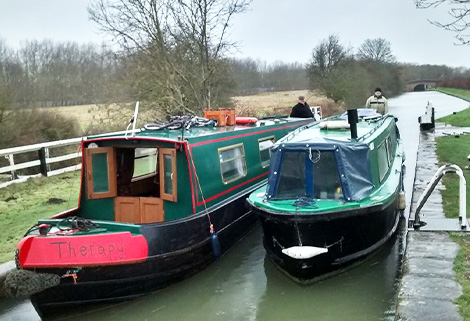
At last I reached the gentle and picturesque Oxford canal where I wait for my next companion, Helen my best friend from Scotland. Not all middle-aged women would travel to the other end of the country to spend a cold week on a narrowboat but Helen arrived at lunchtime full of enthusiasm. Bunty galloped down the towpath to meet her new aunty.

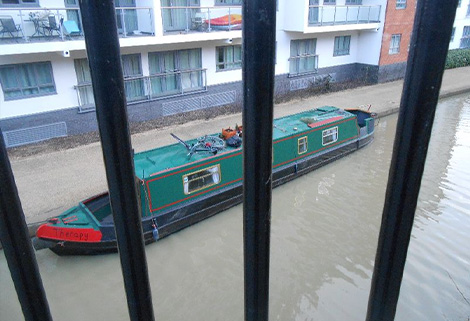
I had done all necessary engine checks in the morning and tried to start Therapy up, and despite trying my usual tricks with connections and plugs she failed to catch. As I was moored opposite a boatyard I asked the nice man to come and take a look and needless to say his magic hands started her immediately. I did all the boating chores (topped up with diesel, bought a bottle of gas, pumped out the loo, filled up with water and dumped the rubbish) and Helen and I were off.
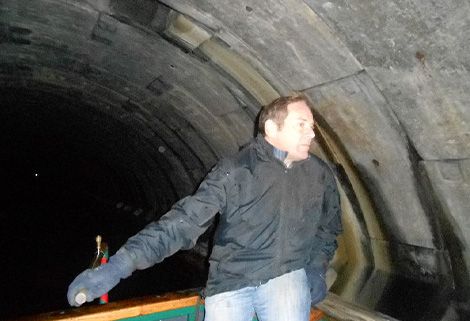
swing bridge on the Oxford Canal

The voyage has been carefully planned around the winter navigation stoppages, which is canal speak for locks being closed for repairs. At Braunston where I will turn off the Oxford and onto the Grand Union Canal, a flight of 6 locks will close on Monday 12th January and we had just a week to get there. It was important to make the most of daylight hours and I had to be a tough captain to have my crew up and ready to go at 8am. Bunty always helped with this.

Mostly the weather was very kind to us with fantastic bright sunny afternoons, despite storms in Scotland that brought down trees in Helen's garden and put out the electricity for thousands. On Wednesday we arranged to pick up a friend Rosemary and we cruised into Banbury just as the sun set and just as Helen's daughter, Alice appeared under a bridge to meet us. Some big winds blew up to challenge us and give us bad dreams about becoming unmoored at night, on Thursday and Friday but our steering skills were improving all the time.
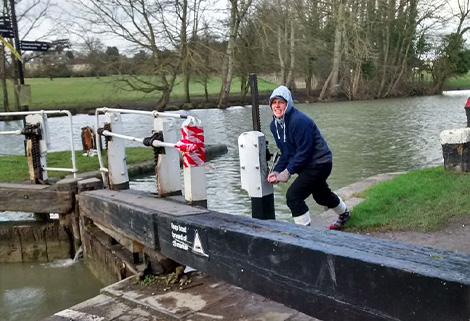
The week went by too quickly and Friday evening found us moored just outside Braunston with a short run into town left for the morning. I did the usual checks before starting therapy only to find that I couldn't get her going again. Helen and Alice had to catch a train from Rugby to London for an onward flight to Inverness and a decision was eventually taken for my poor friends to walk the last couple of miles into Braunston while I waited for the canal AA to come and help me. As I said goodbye, I noticed that Alice had a wriggling puppy secreted about her person as she tried to steal Bunty!

Alice falls in love with Bunty

walkers on the Oxford Canal towpath

Soon a 15-year-old boy walked towards me waving- he was the engineer come to help me. He quickly and efficiently bled air from the engine and promised that she would start first time every day from now on. He also tried to persuade me that he is 22 but I must be getting old.

I cast off and enjoyed a slow cruise into Braunston, successfully mooring up by myself despite the strong winds. I felt very pleased to be in Braunston on Saturday night, ready to take on the flight of locks before they close on Monday.
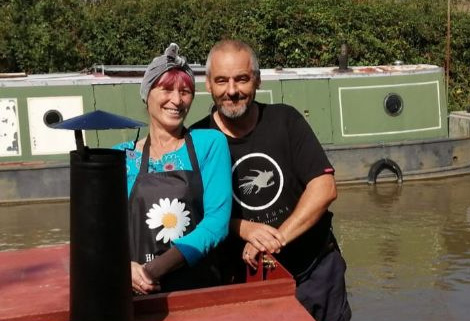
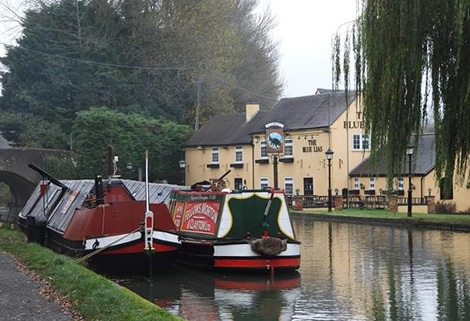
I look forward to my next companions arriving and setting off on a new canal that will eventually take me to London.

Best wishes all,
Sally

wendy witch

featured roving canal trader

wendy witch

I live aboard Merly B, a 67' Tyler Wilson nb built in 1988, with my husband whom we call Mr. O and Henry the dog. We're continuous cruisers.

Wendy Witch and Mr O

Wendy Witch

We bought our first boat, Irene, in 2001. She was a 57' iron BCN boat built in 1927, a beautiful boat with great character. She had a 3 pot lister (situated inside next to the loo!), 12v power only and a foot pump if we wanted water, no hot water. She had several leaks, every time it rained we got all the pans out to catch the water. It was damp, smelly and noisy. We were so excited to be living afloat that none of these things mattered.

A few years later we decided to have her lifted out and surveyed. Complete disaster! Her hull was extremely thin in places, she had rotted from the inside due to the leaks. Always get a survey before buying! We learnt the hard way.

We were advised to weigh her in and use the money for another boat, but we had fallen in love with her and so decided to have her overplated. 18 months later she was floating again once more, that was a great day!

Wendy Witch - Irene before welding

Wendy Witch - Irene after welding

In 2018 we bought Merly B and we feel so blessed, another beautiful boat but this time with hot running water, proper plug sockets, lights, even a heated towel rail! Also an engine conveniently placed under the back deck, not inside the boat! This is our forever home.Merly B narrowboat

my business

My Wendy Witch business began in 2000. I'm a White Witch and Celebrant. I have been pagan all my life. My beliefs and skills have been passed down through generations and I'm proud of my heritage.

I have been reading the Tarot since I was a child. During the winter my Tarot readings are on board, in the warm weather outside on the towpath. The readings are an hour long, I don't like to rush and we have tea, coffee and sometimes cake!

Wendy Witch, Hallowe'en

a selection of Tarot Cards

inside narrowboat Merly B

I also conduct Handfasting Ceremonies (Pagan Weddings), Baby Naming Ceremonies and Memorial Services. These celebrations are becoming very popular as many people are looking for alternatives to traditional ceremonies. Pagan Rituals have very few rules so the Ceremonies are customised to suit and every Ceremony is different.

Handfasting Ceremony conducted by Wendy Witch

baby naming ceremony conducted by Wendy Witch

As a Pagan I celebrate the 8 sabbats or festivals throughout the year. I even have a Pagan Altar outside my boat. My altar is a log which I keep on the roof whilst travelling and place on the towpath when we moor up. I decorate it with nature's gifts - flowers, fruit, seeds, stones, feathers etc and redress it for every Sabbat. It makes a great talking point for passersby!

Altar on towpath beside Merly B narrowboat

decorated altar on towpath beside narroboat Merly B

During the summer I have a plant stall with annuals and perennials which I grow on the roof. All the proceeds go to The Huntington's Disease Association. The only thing I initially missed when we moved onboard is my garden but I soon realised that it's amazing what you can grow in a pot!

Living on a boat has been a dream ever since I can remember, making it a reality has been a wonderful experience. We are within nature, detached from 'normal' life. Many of my customers remark that they never knew this canal life was here, even though they drive over it often; "Do you live here all the time?"

The boat people, the wildlife, the seasons, the freedom...all of these things make the canal special, like a long, wet village.

I am truly at home living on the cut, I feel I belong here and here is where I will stay.

the voyage of friendship 3 – a new year

the voyage of friendship

part 3: a new year

Hello again friends and Happy new year to all.

I'm back on board Therapy following a quiet Christmas and a brilliant New Year holiday with all our children and grandchildren.

The boat survived being locked and moored up at Abingdon for a week or so and a driech Saturday morning saw me re-stocking and checking before taking off again for her last couple of days on the Thames. Am I sensible, out in the cold getting soaked? I wasn't 100% sure as I waved to Ewan and cast off again.

My companions for this leg were to be Lynn and Chris from Lambourn but both had been poorly and couldn't make it. I hope you're both better soon and will join me further on. However my son Stephen, here for the holidays with his wife and baby, had just had his own plans cancelled and was serendipitously available. His Vietnamese wife found it rather cold but made sure we all had supplies of hot chocolate. It was lovely to be back on my journey despite the rain and great to spend bonus time with my son. As the sun set, we moored up at Iffley lock and walked into the village for
supper.

Sally Kershaw with her son Stephen

I was very lucky that my week off had been dry and the current of the Thames had not been strong. However, by the next day the rain had changed that and yellow boards on the locks indicated that current was increasing. By the time we reached Osney lock, the last one on the Thames before we needed to turn off and on to the Oxford canal, the boards were red, which means strong current, moor up immediately.

What should I do? If I didn't get through today it could be a week before the water drops, or even longer. Friends are scheduled to meet me in Oxford and lock closures further on mean that I need to get onto the more benign canal and away from the mercies of the river. Also, we had only half a mile to go before the turnoff. I made my mind up when a small riverboat, the only other moving craft we'd seen all weekend, joined us in the lock. If he was up for it, so was I.

The current was very strong as we left the lock and I bravely left the driving to Stephen. Even with high revs, Therapy struggled to move forward in the current but we carefully and patiently pushed on.

We could see a low bridge on our right and the small channel we needed to steer down. The water level was high and the current flowing very fast- would we even make it under the bridge? We needed to go through in the centre to avoid knocking the equipment stored on the roof.​ I feel sure that my orders, such as "no steer, left" and "quick, put her in reverse" did nothing to help, but Stephen, with the bravado of a young man who had never driven a narrow boat before, took her successfully through and out of the raging current of the Thames, suffering only a telling off from a resident boat owner for going too fast.

piloting a narrowboat in the rain

But now ahead of us was an even lower bridge, apparently one of the lowest canal bridges in the country, I was later told. We ducked our heads to avoid losing them and groaned as the precious bicycle on the roof was scraped and thrown about by the rafters. But we were off the Thames and onto the gentle Oxford canal. The bike had a buckled wheel and broken breaks, but the journey will go on!

We moored up close to the railway station where I walked my hero son and his family to catch their train to Gatwick airport from where he would fly back to Berlin. My voyage has resumed and I'm looking forward to travelling with friends through Oxford tomorrow and further north to see where our adventures will take us.

Take care, have fun in 2015 and please meet me if you can.

Love from Sally

the voyage of friendship 2 – home for christmas

the voyage of friendship

part 2: home for christmas

Hello friends and family,

The voyage continued well last week, and I enjoyed my first night spent alone aboard "Therapy", moored in a sheltered spot between Pangbourne and Beale Park.

On Monday morning I met Sue Allen, with her husband Joe (whose birthday it was) and their beautiful wee girls. Sue and Joe have lived on a narrow boat in the past and it was great to have experienced folk with me on the Thames where the yellow boards at the locks sometimes pronounced that the current was increasing. At Goring, Joe and little Trixie left us, and Hannah and Ash came aboard. Sue was Captains mate, her old boating skills obviously coming back, while Hannah and Ash worked out lock duties.

Sally Kershaw with Bunty     narrowboat Therapy moored on pontoon      child on board a narrowboat  

I was delighted with our progress as we reached Wallingford soon after lunch and we decided to press on to Benson. The book showed a great public mooring and we glided into the jetty well before dusk. Sue called Joe, but as we started to arrange a little birthday surprise for him on the boat an officious person approached us to let us know that we couldn't moor here and suggested we moved a mile or so up the river. OK, we cast off again to seek another mooring spot. The sun was starting to go down now and a slight tension crept in as we looked ahead for possible places. I could see a green bank and directed Sue in towards it. As we approached I realised that it was too shallow, but Therapy was already grounded on the remains of a tree. We were stumped! The sun was almost disappeared now, but Ash saved the day when Hannah held on to his legs and he hung over the side to push us off the wood. Once free we cruised on in the fading light to find a very suitable mooring outside Shillingford Bridge Hotel. We quickly re-staged the birthday surprise for Joe, who'd met us with the car and sang a hearty "Happy Birthday" to him. Many thanks to all for an excellent day.

After another cosy and enjoyable night with my puppy, Bunty, Tuesday was set to be a very relaxing day as we'd gone further than expected yesterday. Bunty is settling in well aboard Therapy, and I hope will be a confident boat dog.

Lambourn friends, Katharine and Libby were my "shipmates" today and arrived shipshape and Bristol fashion at the appointed time. Again, the weather was kind, and we had a quiet day's cruising, reaching Abingdon an hour or so before dusk. Our only brush with difficulty was at lunch time. We had moored at a very quite spot for half an hour to eat cauliflower cheese, when the land owner appeared from nowhere to let us know that "we could not moor there". Is this a phrase I will have to get used to on the river? I wished the chap a super Christmas, let my puppy off to pee, and we cast the boat off into the current again.

Ewan met us at Abingdon, we moored and locked up the boat and headed home for Christmas.

Happy Christmas and many thanks to all those who've helped me and to those who plan to meet me further on.

Warmest wishes,

Sally

the voyage of friendship 1 – early days

the voyage of friendship

part 1: early days

Hello friends and family.  

Ewan, Bunty (our puppy) and I left Newbury on Friday morning  aboard Therapy, the narrowboat that will be home for me for the  next 3 months.

Sally and Ewan Kershaw                  Bunty tiny Jack Russell puppy

Jenny and her family joined us at Thatcham in time  for lunch and we continued through to Midgham.  

Waking up next morning I realised I'd left my purse in the pub where I'd joined the youth work team for a Christmas meal on Thursday evening. By some coincidence we were only a mile or so away and I  was able to take my bike from the roof of the boat and go to collect it- relief!  

Rhona and Andy joined us at Woolhampton where they quickly  learned locks and took over the windlasses (or winder things, as Rhona called them). We moored up at Theale where I jumped on my  bike again to meet my YOT colleagues for another Christmas meal -  again it was conveniently close by great coincidence.  

On Sunday we made great progress through Reading, with the surreal experience of cruising right through the Oracle centre on a  busy Christmas shopping day.  

And then out onto the Thames and turn left towards Oxford. Going from the little canal to the big wide river was exciting (and colder),  but the locks easier as they are electronic.  

Dave Wraight and his lovely family joined us from Mapledurham to Pangbourne. The children were a little reticent to start with but then  really enjoyed  themselves. Dave used the trusty bike from the roof  of the boat to collect his car and pick them up later. You can join this trip for a very short time, just 1 lock or stay for a while.  

At dusk we moored in a sheltered spot by the trees and I said  goodbye to Ewan, Rhona and Andy. Thanks for all your help.  

Today, Sue, Joe and their little ones will join me, hoping to get to Wallingford. We hope Hannah will meet us later too.  

The adventure has started and I look forward to seeing you further  on.

Sally

albion adventure

albion adventure

I was very happy to attend the MNA Boat Club AGM in September 2022 at the little Norfolk Broads village of Neatishead. The following day I was able to take part in an event associated with the AGM – a day out on the Broads on the ‘Albion’.

Wherry Albion

The wherry 'Albion'

The ‘Albion’ is one of two surviving Norfolk Wherries, and the only one currently sailing. She is owned and operated by the Norfolk Wherry Trust who purchased her in 1949 in order to preserve her as an example of the Norfolk Wherry, the sailing barges who served the Norfolk Broads and were specifically adapted to the conditions prevailing there.

‘Albion’ is now 125 years old; some 65 feet overall and able to carry up to 40 tons of cargo. She is maintained in first class condition by the Trust and is operated by a team of volunteers and is funded mainly by passenger charters, one of which I joined.

I joined her at the Trust base at Womack near Ludham with some other Boat Club members – fortunately my Sat-Nav was able to find the location - and after a safety briefing and issue of lifejackets the ‘Albion’ got under way. We left our jackets etc. in the hold as it looked as though we were in for a warm shirt sleeves rig day, the hold also contains a toilet and a cooker and plenty of seating.

‘Albion’ is berthed in a little dock on the River Thurne. She has no engine but power is supplied by a dinghy with an outboard lashed to one quarter with a fender between. The outboard is usually operated by the Mate, who jumps into the dinghy to change the throttle setting when required. Security is maintained by a red safety line attached to the ‘Kill Cord’ and fastened on Albion’s quarter.

We set off down the River Thurne with this method and set the sail.

Perhaps a word about the ‘Albion’s unique rig might be useful at this point. The mast is unstayed, apart from a forestay, there is no other ‘Standing Rigging’. The mast is therefore a very substantial spar. It is stepped in an equally substantial Tabernacle at the fore end of the hatch and the foot is furnished with a very substantial counterweight, which rises up through the foredeck via a hatchway when the mast is lowered, by slackening the forestay purchase. The single sail is suspended from a very substantial gaff, which extends the sail such that the leach is practically vertical.

The halyard system is unique to the Norfolk Wherry. All other vessels with gaff sails have two sets of halyards, one for the Throat and one for the Peak. The wherry has one halyard which leads up from the deck through a double block at the mast head, through a single block at the throat of the gaff, back to the masthead block, down to a block with a span attached to a couple of points on the gaff, and leads up to and is finally made fast to the masthead block. The sail is then hoisted by the halyard led to a geared winch at the fore side of the mast. The sail was actually hoisted on this occasion by myself and another Boat Club member, and it was not a very heavy job.

We sailed down the Thurne and then ascended the river Bure. The conditions were a mainly cloudy day with light winds, often diminished and diverted by vegetation on the banks and thus we were able to experience every point of sailing many times, and in rapid succession! ‘Albion’ tacked and gybed as necessary with little fuss, assisted by the dinghy outboard when necessary, the throttle operated by the Mate who jumped into the dinghy from his normal position by the little knee-high ‘cockpit’ at the after end of the hatch from where he also tended the mainsheet, cleated on the after end of the coaming, where necessary.

We arrived at Horning which was our lunch stop, and where some of the passengers departed and our MNA President, Vivien Foster OBE, joined us for the return trip. I had elected to stay on board ‘Albion’ for the whole day as being a unique experience, not to be missed. I was offered a spell at the helm which I enthusiastically accepted. She is steered by a very large rudder, some six feet in length, which is controlled by a substantial tiller operated from the little knee-high cockpit which also leads by a further step down into a little cuddy, crew accommodation when she was working. The only helm order I was given was ‘Keep her in the middle’, which I endeavoured to do. Not surprisingly she takes a little while to respond to her helm, and a bit of anticipation as to when to take helm off is required, she certainly is not hard to steer in those conditions.

We noticed some black rain clouds creeping across the Broads to one side of us but thought that they would probably pass astern, so we continued to sail in our shirt-sleeve rig. Most other traffic has given us right-of-way up to this point, indeed the Skipper had told us that we had precedence over most other traffic on the Broads. However, at this moment a charter sailing yacht crossed our bows and then tacked back, putting her on a collision course.

The Skipper ordered the helm over and told the Mate to let go the Mainsheet to depower the sail. As she started to respond we were suddenly engulfed in a heavy rainstorm with a heavy gust of wind; with which, with the helm already over and the mainsail running out to right-angles, ‘Albion’ headed for the reeds along the bank, where she remained pressed to the bank.

The mainsheet continued to run out and unrove and the sail, with no Standing Rigging to inhibit it, continued around to the fore side of the mast. The downpour continued and all hands, including Vivien our President sitting on the foredeck, were drenched to the skin by this time!
The Skipper suggested that I step into the Cuddy, I don’t think that this was in consideration for my welfare, because as well as himself and the Mate there was also a Trainee Skipper and a Trainee Mate on board and I am sure that he decided that he needed experienced hands at a time like that. I might therefore be slightly adrift as to the sequence of events following.

the Wherry 'Albion'

Norfolk Wherry 'Albion'

The squall had eased and the first task was to re-reeve the mainsheet and get the sail back abaft the mast, the sail was then lowered onto the deck and the task of getting her off the bank was commenced. This was accomplished by the use of the dinghy with its outboard and the use of the ‘Quants’; long poles with a fork on the bottom and a shoulder button on the top used to pole the vessel in the way that a punt is propelled by punt poles.

Once ‘Albion’ was under way, with propulsion provided by the dinghy, it was noticed that there were lightning flashes visible close by. Standing Orders are that in the event of lightning, the mast is to be lowered, so the forestay purchase was slackened off and down came the mast to join the gaff and sail on top of the hatch.

It was then time to get below and remove my sodden shirt. A kind member of the crew kindly loaned me a dry tee shirt to wear under my waterproof jacket, now perhaps a bit superfluous! When I returned it when we docked, it was sopping wet below the waist where it had been in contact with my wet trousers!

I did have the temerity to ask the Skipper, trying not to teach granny to suck eggs, whether it would not be useful to have a figure-of-eight knot on the end of the Mainsheet. He replied that they had given some consideration to this very point and had decided that; in the event of having to let go the mainsheet for any reason, it was better for the sail, unencumbered by any Standing Rigging, to go forward of the mast to de-power it. I have to admit that this made good sense.

Thus we returned under power to our dock, where we helped to turn her and back her in to her usual berth. So ended a very interesting and enjoyable day, enlivened by a bit of excitement!

I was most interested to learn more about this unique sailing craft, evolved to satisfy the local conditions on the Broads which I had only read about before. I knew something about the evolution, equipment and handling of the other classic British sailing barge, the Thames ‘Spritty’, of which there are many surviving still, but I can only applaud the efforts of the Norfolk Wherry Trust in maintaining and operating this almost unique example – there is another partly restored privately owned wherry in the Trust’s dock, but she is not rigged at present.