
As part of the Spring Budget announcement, the Government stated that it is not changing the treatment of private pleasure craft in Great Britain where they will continue to be able to use red diesel and pay their fuel supplier the difference between the red diesel rate and the white diesel rate on the proportion they intend to use for propulsion.
Read More
waterways chaplaincy
From Iris, on the Kennet and Avon canal
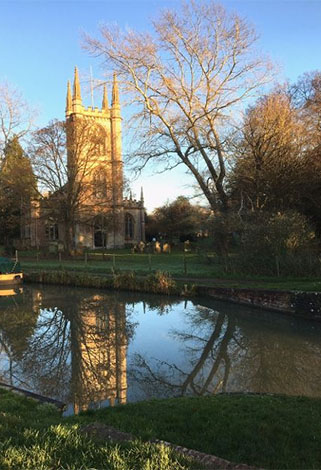
I have recently become a Waterways Chaplain. Have you not heard of such a person? It is said that we are the waterways’ best kept secret!
We are a community of trained volunteers who walk the towpaths and river banks of Britain, offering a friendly chat and our help to any boater in need who confides in us.
Because of these uncertain times, I have had to train online and haven’t yet been able to begin this ministry. I offered myself for training when I learned that our vicar and his wife are waterways chaplains (our church is beside the canal) and it seemed a worthwhile and pleasurable ministry to pursue.
I have had some experience as I worked for the Citizens Advice Bureau for twenty years so have been used to listening to folks’ problems and doing something about them if at all possible. Sometimes a client would say, as I showed them out after our interview, “Thank you for your time. You have helped me so much,” when, in fact, I had done nothing except listen to them.
That is the first and most important part of any ministry, to listen. I expect we have all had the experience of trying to confide something to a friend, only to be told, “Yes, I know what you mean. That happened to my aunt Nellie some years ago when...” and off they would go with their own appraisal of the situation and not listen to a word you wanted to say, and in the end, you just give up.
I knew nothing about living on the water when I volunteered – nothing about life on board a narrow boat, nothing about licences, safety on board, mooring regulations, boat engines, onboard accommodation, places to pump out toilets or take on water, or how to operate the locks.
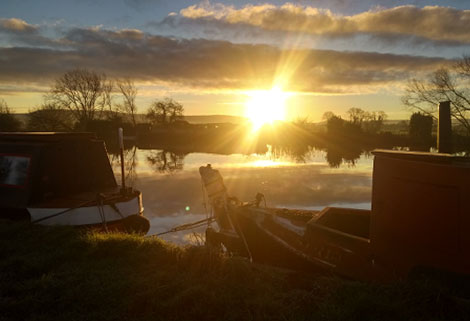 I was quite overwhelmed with this alternative way of living. I had thought that every boater I saw was there for the fun of it and was having a good time, not realising the back stories and sometimes great needs that had arisen for a variety of reasons. We chaplains are here to help in whatever way we can. We are not here to get you into church if you don’t want to come!
We remember that the first miracle that Jesus performed was practical – turning water into wine to save the embarrassment of the bridal party when the wine had run out and their sponsor was calling for his glass to be refilled.
We learn the etiquettes of boating – helping to get the boats safely through the locks; not stepping aboard without an invitation; not peering through windows – as if we would!
We commit to walking at least a mile a week alongside the water, or the equivalent for the chaplains on the Broads. We are happy just getting to know the boaters – at least, those who don’t dive inside the cabin when they see us approaching – and having a chat about our dogs or the weather. We may also be able to signpost someone to the nearest chemist or foodbank or help fill out a form to claim a benefit.
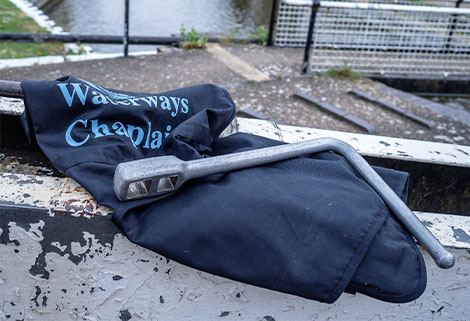 You will know us because we are given a dark blue gilet to wear with “Waterways Chaplain” printed on the back.
You will know that we belong to a nationwide organisation and will try to help in any situation we meet where a boater is in need or trouble.
So do please speak to us if you see us passing your boat. We trust that you don’t bite and we certainly don’t! A cheery “Hello!” will be very welcome.
And if anyone reading this is intrigued and would like to know more about becoming a chaplain, please get in touch. There can never be enough of us!
You can find out more by visiting the Waterways Chaplaincy website
fi’s fabulous floating emporium
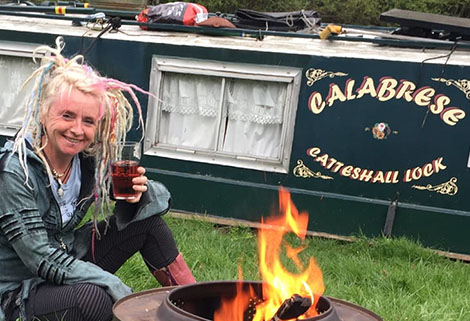
 One of the most colourful characters on the cut is Fiona Lewis, who lives and trades from her narrowboat Calabrese. She is a registered roving trader, with her business very aptly named "Fi's Fabulous Floating Emporium". Fi is currently based on the Gloucester & Sharpness Canal.
For the past twenty years, Fi has been a self employed Festival / Event Trader, making most of her own stock. She moved onto a boat in 2017, and found it was fairly easy to transfer her creative skills onto the water.
Because of the restrictions currently imposed upon our society, Fi is concentrating upon her online sales, but she is hoping to expand 'Fi's Fabulous Floating Emporium' and also open a floating tuck shop, with hot snacks, 'yummy cakes' and organic squash.
early days...
 Fi, herself a mother, comes from 'a beautiful large family with lots of lovely nieces and nephews'. In fact, at the last count, she has 19 great nieces and nephews!
She believes she always had a creative streak - probably inherited from her Granny Hedwig. Growing up, she was continually making things from cardboard, fabric or twigs.
When all the girls in the family wanted parties and hair-braids and face-painting were in high demand, one of them (that's Fi and her three sisters) had to learn the necessary skills.
Of course it fell to Fi! She remembers her very first hair braid which took almost an hour to perfect...
Anyway, she got faster, and before long she found herself running her own children's party business.
moving on...
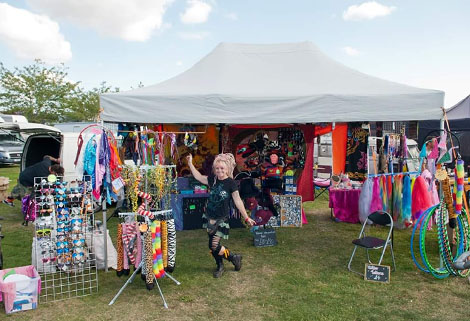
Fi continued to do well with her party business but it wasn't enough to keep her occupied - she needed something more.
Eventually she decided to create her own stall for selling goods at festivals and other field events.
This meant that as well as the face-painting and braiding, she could now also sell a range of festival clothing and other goods.
This went well for a while, but Fi soon began to realise that many festival stalls ended up selling much the same sorts of goods. She decided she needed something unique so that her stall could stand out from the rest. So Fi began making some of her own stock.
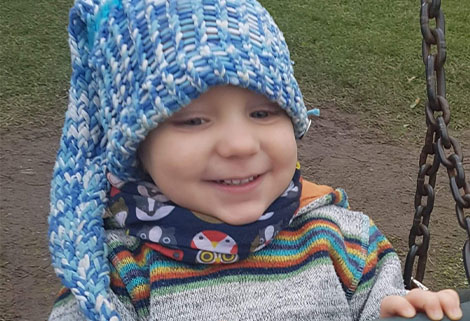
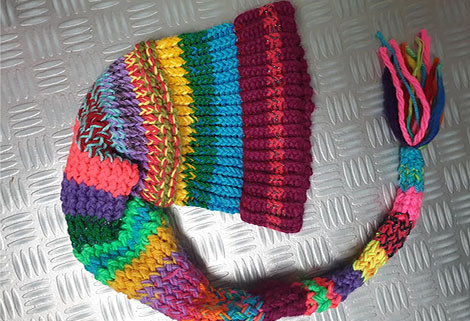
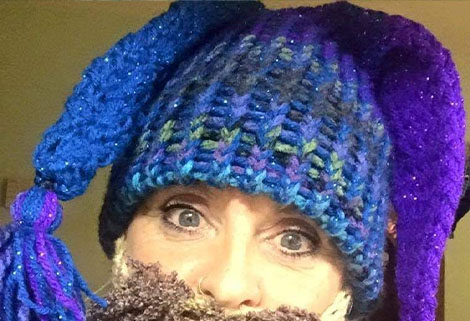
Hats were one of the first things she began to make. They proved so popular, that 15 years later she is still creating them. Understandably, as they are all unique, and as funky as you want them to be. Needless to say, they are among her best selling items!
goods on offer...

hand made hats from Fi's own designs
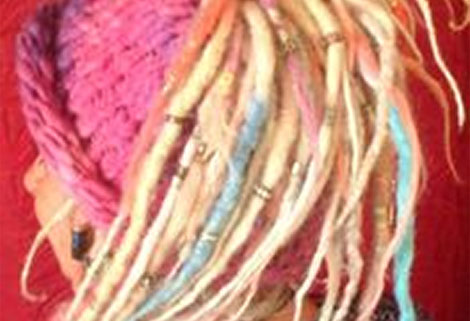
hair accessories - dreads, hair bands, braids
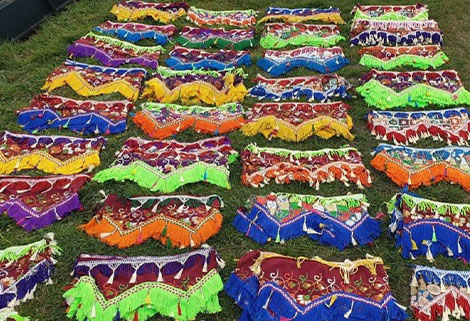
bags - sourced from India and Fair Trade
fair trade items - from homewares to clothing (from recent trips to India)
festival clothing and accessories
bandanas for dogs
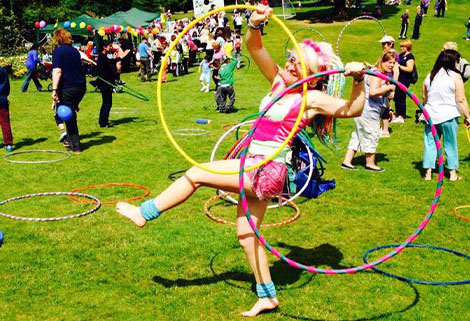
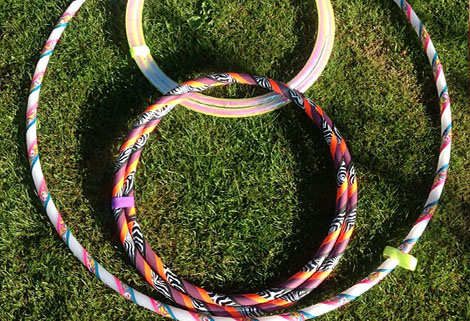
hula hoops in different sizes

covid restrictions and trading
 2020 was almost a write-off for trade, affecting traders on and off the water.
But it was a year in which Fi managed to enjoy her floating home and get some home improvements done too!
She says:
"I love my life on the water and the people I surround myself with. I like meeting great characters with great stories to tell."
 Fi's Fabulous Floating Emporium is currently based on the Gloucester and Sharpness Canal.
You can follow Fi on Facebook to see where she is trading, or you can buy from her online.
You can also contact Fi by email
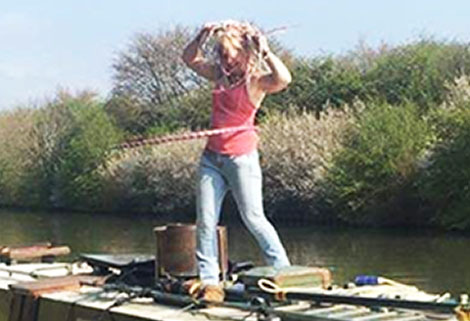
And if you do come across her on the towpath, do stop for a chat. She might even show you how to hula hoop!
boaters asked to trial WaterNav
CRT forced to return unlawfully seized boat
Canal & River Trust (CRT) was forced to return a seized boat following the threat of legal action by its live-aboard owner. The charity had seized the boat, which actually had a valid licence at the time, on 6th August 2020 without obtaining a Court Order, which is unlawful if a boat is used as a home. The Human Rights Act 1998 entitles citizens to have the proportionality of removing their home assessed by an independent court and to defend themselves in a fair trial.
The boat, Milasa, was returned to its owner Paul Buga on 24th November 2020 after his solicitor commenced Judicial Review proceedings against CRT. CRT had claimed that the boat was not Mr Buga’s home and that there was no evidence that he lived in it. However, Mr Buga lives in a pair of boats of which Milasa is the motor boat. Milasa was therefore Mr Buga’s only means of complying with the law regarding boat movement. The Solicitor argued that Milasa had a valid licence, was an essential part of Mr Buga’s home and that it had moved in accordance with CRT’s current requirements. A Claim Form should have been issued giving Mr Buga the opportunity to defend himself in Court against the removal of the boat.
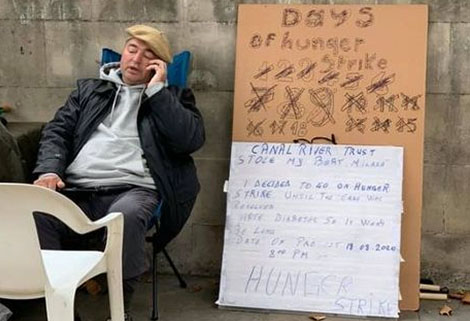 Paul Buga had previously been on hunger strike for more than two weeks outside Downing Street in an attempt to get his boat back from CRT. Alerted to concerns for his wellbeing, the NBTA stepped in to support him and to find him a solicitor.
CRT returned the boat to the owner on the River Lea free of charge, paying for craning and road haulage from Chester. The boat had been seized by CRT and its subcontractors Commercial Boat Services (CBS), who took it to premises believed to be under CBS control at Greenwalls Farm, Dodleston, Chester. The NBTA believes from previous experience that all boats seized by CRT are taken by road to these premises.
In the course of assisting Mr Buga, the NBTA identified a number of defects in CRT’s online licensing system. Mr Buga applied online for a 12-month Rivers Only licence, paid for it, and was provided with a correct receipt for the licence. However, the CRT online licensing system recorded this as a 6-month Standard Canal and River Licence, which happened to be the same price. This occurred twice. This discrepancy was central to CRT’s decision to seize the boat, as CRT’s computer system wrongly flagged the boat as unlicensed when in fact the licence had 6 more months to run. This appears to be a systemic problem with the CRT online licensing system. The NBTA advises boaters to check that the licence that they bought and received a receipt for is the same as the licence recorded on their CRT online licensing account.
east midland waterways to get £4m winter makeover
The Canal & River Trust, the national waterways and wellbeing charity, is investing £4 million on a four-month programme of repairs on the East Midlands’ historic waterways.

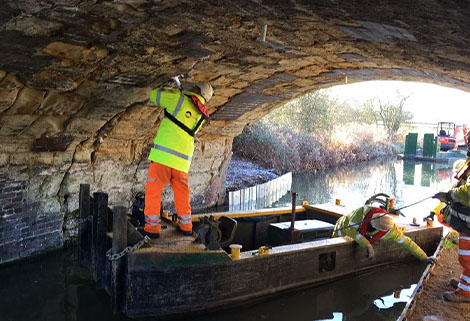
As part of the programme, which will continue until March, the Trust’s expert teams will be replacing lock gates, dredging sections of canal and carrying out a host of tasks to keep the 200-year old network working.
The programme includes:
- New handcrafted lock gates being installed at Blue Bank Lock, near Glen Parva in Leicester. Works are also taking place to repair historic brickwork within the lock.
- A new control system being installed at Stamp End Lock in Lincoln, the East Midlands’ only guillotine lock (where gates are lifted overhead rather than the more common gate opening).
- A new pedestrian footbridge being installed at Derwent Mouth Lock in Derbyshire, making it easier for people to make their way over the lock.
- New lock gates installed at Stanton Lock on the Erewash Canal.
- Replacing the concrete cill, which forms a watertight seal with the bottom of the lock gates, at Long Buckby Lock in Northamptonshire.
- Lifting in new gates at Lock 15 of the Grand Union Canal, Northampton Arm.
Phil Mulligan, regional director for the Canal & River Trust, said:
“This winter’s works are obviously important for encouraging boaters to visit the East Midlands but, with research telling us that time spent by the water can help us to feel happier and more relaxed, they will also contribute to improving people’s mental and physical well-being.
“Our waterways have offered a really important lifeline for so many people this year, providing the perfect spots for local recreation, exercise or just to unwind. That’s why it’s so important that we keep them open and safe for everyone to use, whether you’re out on your boat or enjoying the towpath.
“By carrying out these works we will be protecting our historic waterways for future generations and ensuring that they can make a real difference to people’s lives today.”
This winter the Trust is investing more than £45 million on waterways across England and Wales. The lock gates on the East Midlands’ waterways weigh several tonnes and typically last around 25 years. Each new gate is made to measure and handcrafted from seasoned oak so that it fits perfectly in the lock chamber.
For more information on the work of the Canal & River Trust, including how to support through volunteering or making a donation, go to www.canalrivertrust.org.uk.
a curious case of sticky fuel
sam keay – gangplank spirits and preserves
My name is Sam Keay, I am originally from Cumbria. In my past I took my children to Africa where I worked as a volunteer teacher. We lived there with no running water or electric. When I returned home, I worked for Lancashire Wildlife Trust, Myerscough College and The Open University.
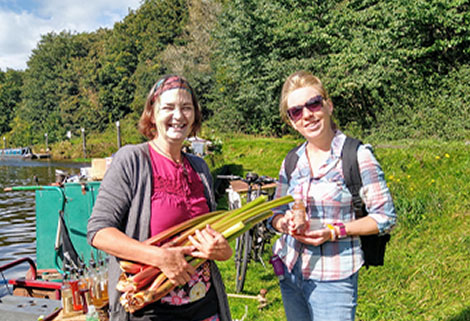 I now live and work on a travelling narrowboat business. I began as ‘Cake on the Cut’ making homemade cakes, hence my Salted Caramel Gin. But I have slowly evolved into ‘Gangplank Spirits & Preserves' and I make foraged fruit gin, whisky, rum, vodka, chutney, jam & cordial. I also open as a café selling soft drinks and crepes, and I have a fully licenced bar.
I was brought up growing a lot of our own produce; we had a big allotment, and bottled and froze the spoils. We had a Big Damson tree at the bottom of the garden, and it was my job to climb it. My Damson Gin recipe has been handed down through the generations and is still my favourite. I spent much of my childhood blackberrying and scrumping apples, so my business has really grown from my beginnings.
early boating
Growing up we had quite a few narrowboat holidays. I was only a few weeks old when we crossed the Pontcysyllte Aqueduct where I was apparently cosily tucked in my Moses basket in the bow.
We always hired boats out of season, when they were cheap, and I remember running ahead to do the locks, my hands sticking to the frost on the lock gates. Something must have appealed to me and stayed with me, because it seemed a very natural step to move onboard, although I did wait until my children had fled the nest, as I wisely decided I couldn’t live with two teenagers on a narrowboat!
living aboard
 I’ve been boating 15 years now and I’m still very in love with the lifestyle. The towpath is a friendly place where people like to talk to each other and help each other out. Most boaters are unmaterialistic and happy with the simple things in life, a fire, good company, a stew in the pot, and a pint.
I’ve had a lot adventures in the past 15 years that I wouldn’t trade for anything, I think I’ve seen all the 7 wonders of the canal system and so much more. Some of the highlights are:
Crossing the Ribble Link several times, never without a last minute crisis. The first time, I’d only had the boat 2 months and had to be towed by the coastguard as my alternator belt snapped halfway across.
The beautiful Kennet & Avon Canal, surrounded by stone circles, white horses and a history of crop circles. We enjoyed digging out the inflatable canoe and taking picnics paddling down the Avon and mooring right in the centre of bustling Bristol.

Toiling over the stunning Pennines, with empty pounds, badly maintained heavy double locks, dog tired and muddy, but exhilarated and very alive.
Last year I fulfilled another small dream and cruised her up the Tidal Thames from Limehouse to Oxford where my little hippie boat sailed alongside the gin palaces and big working barges. I cruised past the Houses of Parliament and the London eye feeling ridiculously small and excited.
every day is different
 The everyday small adventures are just as fun, all the windy rainy days, being blown across the cut, fallen trees blocking the canal, single handing swing bridges that open on the wrong side, going down the weed hatch for the third time in a day...
I enjoy seeing the country through the perspective of the waterways, a city looks very different by water, and I love that one day I can be moored in a city centre and the next moored in an isolated country haven. I feel very privileged to watch a heron hunt from my window and a kingfisher flit by.
There are a few downsides, I hate trying to organise deliveries for my business, dealing with black and white thinking bureaucrats who can’t understand that you don’t have an address, and the never ending fixing things can be a challenge but more than worth it.
good and bad days
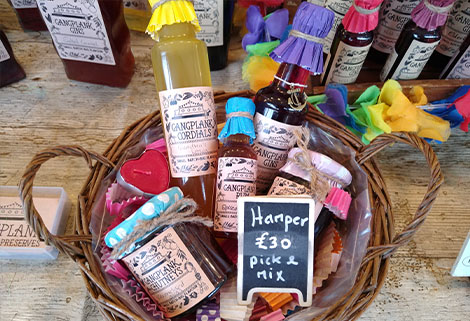 This year has been one of the most difficult I’ve ever had on the cut. I had to have a complete re-plate of my boat during lockdown and borrow the money in one of the most financially challenging years for my business.
I managed to break my ankle just as the job was completed and an exceptionally good friend, a fellow trader, lost her battle with cancer and we had to give her a ‘virtual’ send off.
I’ve also had a few previously unheard-of negative conflicts with trading on the towpath, mostly from other very anxious struggling businesses that have seen me as a threat to their livelihood.
keeping going
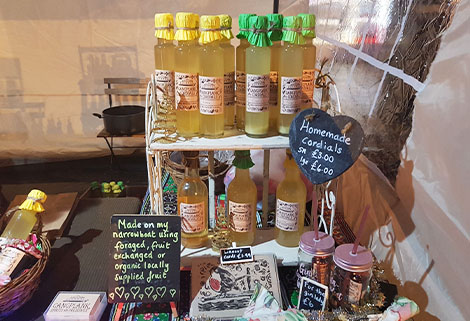 Fortunately this has been more than compensated for by the number of super generous people who have gone out of their way to support me and my small business, and realising more than ever what fantastic friends and family I’m lucky enough to have.
All of my festivals, events and floating markets were cancelled this year which is my normal bread and butter to see me through the winter, so I have had to trade on the towpath wherever and whenever it’s been possible.
 The public have been incredible, people have really been trying to support the small business owner for which I am immensely thankful. They have literally kept me afloat.
new website
My son made me a website at the end of last year and it was an unforeseen huge help to my business this year. It has really taken off for obvious reasons and I also have some interest in supplying my produce to gin bars and artisan shops.
If you fancy some truly homespun ‘It’s A Wonderful Life’ Christmas Spirit please look at my products on www.gangplank.shop
pick me up and then you kar go
Throughout the past year there have been plenty of discussions about deliveries being made to households during the current Covid 19 pandemic crisis, ranging from booking a delivery slot from a supermarket to getting your favourite take away food.
Over the past 10 months, we at Bearingtech have reported on the emergence of drone and autonomous deliveries and the importance that drones and robots now play in everyone`s lives, ranging from park rangers, farmers, parcel services and medical suppliers.
The biggest concern for the majority of people is the contact element that is carried out when a delivery person turns up at your home, especially when we are being told by the government to avoid contact wherever possible to help remove the possibility of spreading the virus even further.

future sight on UK roads...
Well, how about if the deliveries could be made by an autonomous source, a robotic vehicle that could bring goods without the use of human contact?
Sounds a bit like science fiction, but in fact it is now available and up and running and hitting the roads. Kar –Go is a state of the art self-driving delivery robot that has been built by the Academy of Robotics who are a technology institute with an extraordinary team of engineers, researchers and scientists.
They specialize in creating technology to perform or simplify complex tasks by combining the best techniques from machine learning and mechatronics to building powerful self-adapting machines and task specific artificially intelligent software.
The car uses artificial intelligence and a specially developed management system to provide a contact free service.
The success of the invention shows how driverless vehicles could eventually become a common site on our roads and streets delivering parcels across the length and breadth of the country. The whole system is very similar to the autonomous bus and tram service currently being used in Germany and Holland, with parcels being substituted instead of passengers.
This however is not the first type of autonomous delivery service that has been put into practice, some drones have been carrying out automatic drop services for a number of years especially in hard to reach places such as the African plains and the outback`s of Australia where normal road deliveries can take days, sometimes weeks instead of hours.
Another delivery giant, Amazon also tried and tested a similar robotic road delivery service in America alongside their drone prime air service.
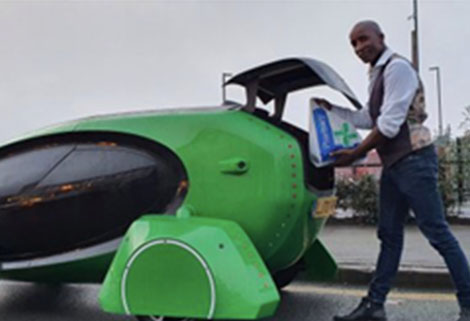
autonomous vehicle with safety driver backup
The Kar-Go vehicle will be able to drive itself to and from the senders delivery hub to the customers address and hand over the parcel automatically by using its on board robotics, without the need for human contact.
Thanks to its unique system, the electric vehicle is capable of delivering to city centres as well as rural and suburban locations.
It focuses on the small shoe-box size shaped parcels, where delivery costs can account for the third of the cost value, part-increasing pressure on margins for both retailers and logistic companies.
“Artificial Intelligence can be magical if used the right way”
With a capability of covering 60 miles, which is more than the average daily delivery round, when fully loaded on a single charge this autonomous robot could dramatically reduce the environmental impact that normal delivery vehicles have.
William Sachiti the founder of Academy of Robotics said, "Kar-Go`s first deliveries represent a key milestone for the wider automotive industry. Alongside our partners at Eurovia UK we have been working closely with DFT`s Centre for Concerned and Autonomous Vehicles (CCAV) and key London stakeholders.
"What makes it magical for me is that we applied AI and robotics in a useful and good way, the technology is there when it is needed and out of the way when it isn’t.
"The design has been developed as a green alternative to fossil fuel delivery vans, which will enable logistic companies and retailers to help keep delivery costs down, while providing a more convenient delivery experience”.
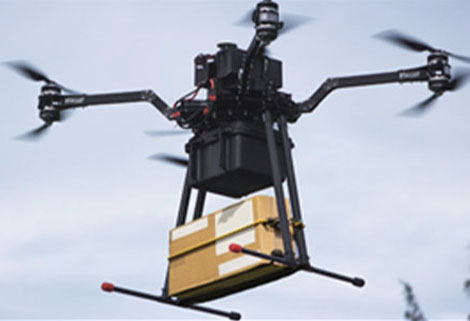
drone delivery in flight
After talking to a wide range of courier companies they all agreed that during the first lockdown, they were busier than ever, with some drivers expected to deliver up to 180 parcels a day, which is virtually impossible to maintain and causes considerable stress to the drivers concerned.
In a landmark first journey, the Kar-Go successfully transported medical supplies from a pharmacy to a care home in Hounslow Greater London without a hitch.
Although the delivery was autonomous, in accordance to current legislation there was a safety driver on board who could take control and take over at any time if the need arises, with an extra layer of safety provided by its nearby command hub centre, which ensures that safety is at the heart of everything we do.
Beginning with semi- autonomous deliveries, the level of autonomy will be gradually increased from the command hub, Academy of Robotics have instant secure access to remote monitoring and controlled supervision of the vehicle if it is in an autonomous mode.

future high-rise buildings with drone drop off chutes
On a final note, even Architects are now looking at different designs for autonomous deliveries in new buildings, with drone drop off rooftop chutes being introduced into building plans which take parcels directly to the customer.
Drones seem to be here to stay, and by the looks of things getting better everyday and enhancing the way we live, watch this space for future developments.
Once upon a time only Father Christmas came down the chimney, but not anymore. Looks like Rudolph and friends are surplus to requirements.