therefore do not worry about tomorrow

therefore do not worry about tomorrow

for tomorrow will worry about its own things

Mindfulness. Living in the present, not fretting about the past nor worrying about the future. So hard to do, yet if we can achieve it how much happier we might become.

I heard recently that it is not possible to be anxious and thankful simultaneously because of the way our brains are wired. Therefore if we can count our blessings instead of filling out heads with anxious thoughts, our anxiety should lessen. If that actually works, isn't that be amazing, because there is certainly alot to be anxious about…our health, climate change, nations at war, debt, our concerns for family and friends, to name but a few. Loved ones dying, our dying, loneliness, hunger, cold, things we may fear. The world can be a very hard place to live in. It is small wonder there is so much depression and hopelessness around.

depressed man

I'm sure the God I believe in did not want a world such as this. He designed a place of beauty and joy, where he wanted humans to live in harmony with one another and the nature around. Our free choice and our greed has destroyed so much yet each of us, individually, can work towards making a positive difference to where we live and those we encounter. Kindness, empathy, a smile can make such a change to someone else's day. Having time to say hallo and be a listening ear to our neighbour.

We are so blessed to be part of the boating community. From reading the feeds on some of the narrowboat Facebook groups you can sense how kind and helpful people are towards each other. Of course there are always those who appear embittered, grouchy, angry. But maybe we have to wonder the root of those emotions. What life blows has led to someone becoming so unhappy and discontent?

The joy of spending time with a tiny baby, who looks at life with contentment, reminds me that we are born innocent and so often it is our circumstances that lead to trauma which then leads to dis-ease. Spring is a time of new beginnings, fresh growth and vibrant colour. Perhaps we can make a difference to our neighbour by offering a hand of friendship, listening to their concerns and seeing what we might be able to do to help.

For instance, I have just read a book highlighting the work of Christians Against Poverty (CAP). The work they do turns around the lives of so many people who have spiralled into debt and just don't know how to get out of it. All the stories spoke of advisors who came alongside, non judgemental, caring and wise, able to enable the debtor to regain control of their lives without shame or loss of dignity. To give them a fresh start and hope for the future.

buds on bare branch

Now, more than ever, we need to look out for one another, spreading a little kindness and love. I have an image of a bare winter tree, save for some tiny buds, that gradually turn into lush green leaves all gently swaying in the breeze. Each of us can be a leaf on that tree, living alongside one another in community, offering both shade from the sun when the world gets too hot and being a thing of beauty in itself to those who are in need around us. However small and insignificant we may feel we each have the ability to make a big impact on those around us and make our world a better place to be.

starry starry nights

starry, starry nights

I should start off with a confession – I have never sailed on a canal. Ever. I have walked along canals, and gazed wistfully at the beautiful boats drifting past, but I have never negotiated locks, or sat on the deck of a boat sipping a glass of wine at sunset. I’ve never even set foot on one. So why is this landlubber writing for CANALS ONLINE?

Because I am on a mission to spread the word that sky watching is a hobby that can be done anywhere, by anyone. Several times a year my partner Stella (her actual name, yes) and I, and our cat Jess, leave the real world behind and head off to Kielder Forest in Northumberland to spend a week or so in our caravan under some of the darkest skies in the UK. Up there, at the beautiful Kielder Campsite, away from the light pollution that blights our towns and cities, the stars shine like jewels tossed up into the heavens, the Milky Way looks like it is airbrushed across the sky, and when it is visible the Evening Star, Venus, actually casts shadows.

I’ve written articles and features about “camping astronomy” for many magazines, and many people have told me that they inspired them to look at the night sky for the first time during their holidays, taking advantage of being under skies much darker than those they have at home. The last time we were up at Kielder a couple told me that the only other time they had seen such a beautiful sky was when they were on a canal holiday – and it got me thinking. I’d never thought of that before! But it made sense that people holidaying on our canals would sometimes find themselves in remote places, under very dark skies, wishing they knew more about what they were seeing “up there”.

If you’re one of them, this is for you.

Let me take your hand, lead you outside, away from the TV, and introduce you to the night sky...

Dalby Stars, Dalby Forest, N Yorks

noctilucent clouds

Obviously I have no idea if you are reading this on holiday or at home, but it’s a safe bet that at some point in your travels you will find yourself somewhere far away from the streetlights and security lights that dim our view of the stars these days. This “light pollution”, the arch-enemy of stargazers amateur and professional, means we can only see the brightest stars from our towns and cities, but from a remote country location you’ll see thousands . I know from my own experience that most campers and caravanners have looked up in awe at a star-dusted sky – perhaps walking back from the toilet block in the middle of the night or trying to slide their campervan door open quietly after an evening at the bar – and wished they knew more about it, and I imagine CANALS ONLINE readers are the same. So where do you start?

Simple. Just put on a warm jacket, go out and look up! If you’re moored somewhere dark you can get started right away, but you might need to get off and look for a darker place nearby. If you do, be sure to stay safe, and go with company.

And then? Then you wait.

As long as the Moon isn’t in the sky, as soon as you look up you will see a few stars, maybe a dozen or so, but if you take the time to become “dark adapted” you’ll see many, many more, as your eyes release special chemicals which make them more sensitive to faint light and open up their pupils wider than usual too.

After half an hour or so – and during that time don’t be tempted to sneak a look at your phone, its bright screen will send you right back to square one! - you’ll see that the sky is full of stars, and there are two main differences between them. You’ll see that some are brighter than others, and that they’re not all the same colour. To understand the reason for these differences you need to know what stars actually are. Concentrate; here comes the science part...

Many centuries ago, long before Professor Brian Cox stood on a mountain top with his hair wafting in the wind, waxing lyrical about the beauty of the universe, people had some very funny ideas about stars. They thought they were holes in the fabric of sky, allowing a heavenly light to shine through from another universe or realm, or that they were mystical objects surrounding Earth, flickering and flashing with reflected sunlight. After centuries of study with telescopes, satellites and space probes we now know stars are actually enormous balls of hot gases, incredibly far away, like our own Sun. In fact, if you’ve ever looked up at the Sun on a hot summer’s day you’ve already done some astronomy!

Why? Because the Sun – you know, that blindingly-bright object you sometimes glimpse in the sky while on holiday - is simply the closest star to the Earth, and all the stars we see in the sky are distant suns too.

And those different colours? They are an indication of how hot they are. You might instinctively think that a red star is hotter than a blue one because we’re used to thinking of red things being hot (fire) and blue things being cold (ice), but in fact the exact opposite is true for stars: red stars are cooler than white or blue stars! Red stars have surface temperatures of around 3,000 deg C, while blue stars are around 10,000 deg C! It actually makes sense if you think about the different temperatures of flames: a flickering yellow candle flame is a lot cooler than a bright blue-white flame shooting out of a blowtorch.

Orion, Kielder

stars at Kielder

The brightest few hundred stars have their own names, many of which you’ll be aware of even if you’ve never looked at the night sky. The names of stars like Vega, Deneb, Altair and Antares are familiar to us through science fiction films and TV series, through advertising and song lyrics.

They’re everywhere.

But not all stars are the same. Some stars are faint, some bright, but just because a star is bright in the sky that doesn’t mean it is close to us. It might actually be a low energy star that only appears bright because it is very close. Likewise, a faint star might actually be a very powerful star that only appears dim because it is a long, long way away from us. If you imagine stars as celestial light bulbs, of different sizes and wattages, shining different distances away from us, you’ll get the idea.

Once you’re properly dark-adapted the next thing you’ll notice is that the stars make patterns and shapes. It’s as if the sky is a huge join-the-dots puzzle stretched out above your head. You might already know a few constellations – most people can recognise the pan-shape of the “Big Dipper” (also known as “The Plough”) and probably the pinched hourglass shape of Orion too - but that’s about it. There are actually 88 patterns in the sky, and they are known as constellations.

You already knew that, I’m sure, but you need to prepare yourself for a surprise here - the Big Dipper isn’t actually a constellation.. !

The star pattern we call “The Big Dipper” is an ‘asterism’ , a small pattern of stars that is very striking to the naked eye, which forms only part of an actual, much larger constellation. The Big Dipper represents the tail and body of Ursa Major, The Great Bear. If you’re moored somewhere with a dark sky you’ll see the fainter stars around it which make the bear’s legs and head, but you’ll struggle to see them from anywhere with light pollution.

The Big Dipper is very useful for finding the most famous and important star in the whole sky – Polaris, aka the Pole Star . Time for Surprise number 2: despite what many people believe (and give as answers on TV game shows or in pub quizzes) the Pole Star is not the brightest star in the sky!

In fact the Pole Star is only the 50th brightest star in the sky, only as bright as the Big Dipper’s stars.

Polaris is only important because it is the only star in the sky that doesn’t move – positioned directly above the Earth’s north polar axis, as the Earth spins all the other stars wheel around it.

Finding the Pole Star is easy. Two of the Big Dipper’s stars, called “The Pointers”, point right to it.

From the UK Polaris and the Big Dipper are visible all year round, but that’s not true of other stars and constellations. We don’t see the same constellations all the time. Every season has its own sky because as the Earth orbits the Sun we look out into different parts of the universe at different times of the year. So, many of the stars and constellations we see in the summer are not visible in the winter, and vice versa.

This means that it’s impossible to “learn the sky” in one night, or even in one week or one month. It takes a whole year to learn all the stars and constellations visible from where you live.

sun halo at Kendal

Venus sunset, Kendal

What else can you see up there on your next clear holiday night, apart from stars and constellations?

Well, if you can see a star that is very bright, so bright it really catches your eye, this is almost certainly a planet. We can see the planets Mercury, Venus, Mars, Jupiter and Saturn in the night sky with just our naked eye, and a sixth, Uranus, with a pair of binoculars, if you know where to look. The seventh, Neptune, needs a small telescope to see it. Of those planets, Venus and Jupiter can appear strikingly bright in the sky, so bright they are sometimes reported as UFOs! How do you tell stars and planets apart? Simple. Stars twinkle, planets don’t.

Which planets will you be able to see when you go out stargazing? That depends on when that is. Because planets change their position in the sky from night to night, week to week and month to month it can be hard figuring out which one is which. Charts in books and magazines can help you identify them but the easiest thing to do is download a "planetarium app” on to your phone before leaving home. (see the info box)

What else can you see in the sky when you look up on a clear, dark night?

Well, if the Moon is up you’ll suddenly realise just how bright it is, how its blazing silvery-blue light drowns out almost everything else. Out in the dark countryside the brightness of the Moon often shocks town- and city-dwellers. But the Moon doesn’t look the same all the time. You’ve probably already noticed that, as the month progresses, the Moon appears to change shape from a fingernail-clipping thin crescent hanging low in the west after sunset to a dazzlingly bright disc in the southern sky late at night and finally to a crescent again in the eastern sky before sunrise. These different shapes are known as the “Phases” of the Moon, and they’re caused by sunlight illuminating different areas of the Moon as it moves around the Earth.

By the way, despite what those fun-loving minstrels Pink Floyd told us, there is no “Dark side” of the Moon. As it whirls around the Earth all of the Moon is illuminated by the Sun at some point, but because the same side faces us all the time, it just appears to us that the other side is always dark. It’s only “dark” in the sense that we used to know nothing about it, until satellites and Apollo capsules orbited the Moon and sent back photos of it.

If you’re lucky you might see a shooting star zip across the sky while you’re looking up. Astronomers call them meteors, but another popular name is “falling stars”, which is ironic really because they aren't stars at all. Meteors are tiny pieces of space dust burning up in Earth’s atmosphere. Meteors have a reputation for being very rare – so rare it’s traditional to make a wish if you see one – but on most nights you will see a few shooting stars falling at random, and on certain nights of the year we can see many more – a meteor shower. These happen when Earth ploughs through a stream of space dust left behind by a passing comet, and then, for a few nights in a row, we can see dozens or more shooting stars every hour – weather permitting, of course. There are around half a dozen good meteor showers every year, and lots of more minor ones too. If you find yourself under a dark sky in mid-August you’ll be able to watch the annual Perseid shower, which is one of the best of the year. It reaches its peak after midnight between Aug 10th and 14th and if you look up then you’ll definitely see more shooting stars than usual. Eventually. If there’s no Moon in the sky. And if you don’t fall asleep...!

light polluted night sky at Kendal

milky way from Kielder

One of the most beautiful sights in the night sky is the Milky Way , but you will only see that if you’re under a really dark sky between late August and early October, because that’s when it’s best seen from the UK. To the naked eye the Milky Way looks like a misty band of light cutting the sky in half, almost like a long, faint cloud of smoke rising up from a distant campfire, but if you look at it through a pair of binoculars you’ll see it’s actually made of millions of faint, pinprick stars...

When you stare up at the Milky Way you’re looking at our true home in the universe. Here comes another science section...

As you now know, our Sun is a star, but it is just one star in a truly enormous group of over 200 billion stars – a group we call the Milky Way. We now know, after centuries of study, that the Milky Way as a spiral shape, like a huge Catherine wheel. We also know it is spinning as it moves through through space, but unlike a Catherine wheel that whizzes around so quickly it is just a blur, the Milky Way spins so slowly it takes 250 MILLION years to rotate once.

Astronomers love looking at the Milky Way, but find it very frustrating too. It rankles, knowing that if we lived on a planet above or beneath the plane of our galaxy its beautiful, curved spiral arms would fill half the sky but instead, cruelly, because our Sun is located inside the Milky Way’s flat disc all we see is a band of light. But that’s just us being grumpy. For everyone else, the Milky Way is still a stunning sight on late summer nights.

There can’t be much more to see, surely? Oh yes, there is! When you’re out stargazing – or even just walking back to your boat at the end of the day - sooner or later you’ll see what looks like a star moving across the sky, or more likely several of them. These are satellites , and they criss-cross the sky all through the night. The brightest satellite we can see is the International Space Station, which can look like a bright silvery spark sailing silently across the sky from west to east, but there are now many thousands of fainter satellites up there too. If you see a trail or “train” of stars chugging silently across the sky, like beads on a string, they will be some of Elon Musk’s Starlink satellites, and although they might look pretty, astronomers are very concerned about how they are changing the appearance of the sky and ruining astronomers’ efforts to study the universe. By 2030 Starlinks and satellites like them will outnumber the stars...

There’s a lot more to see up there but that’s more than enough to get you started. Hopefully you’re now prepared to go out and start stargazing on the next clear night. It’s not rocket science. You don’t need a fancy telescope or even an expensive pair of binoculars. All you have to do is wrap up, go out, and look up. Once you’ve dipped your toe in the cool, still waters of the cosmos and seen what’s up there, holidays – or life - onboard your boat will never be the same.

the voyage of friendship 6 – brotherly love

the voyage of friendship

part 6: brotherly love

Hello again family and friends.

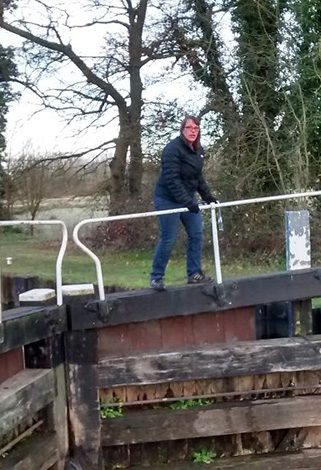
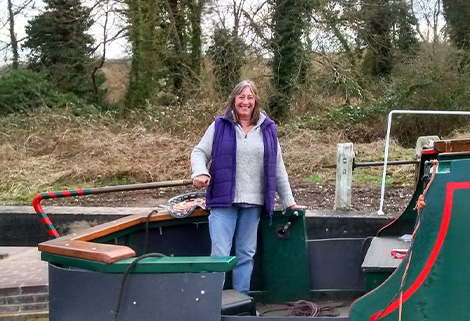
Last time, I left you on the towpath as I picked my old school friend, Philippa and her mum Margaret, from outside her mum’s house in Simpson. Later this week my companions were 3 of my lovely brothers and there's been a whole lot of reminiscing about old times. The other theme this week was the cold weather and layers of clothes were important for all of us. Phil quickly got the hang of locks and we kept warm jumping on and off Therapy, but poor Margaret was quite chilled by the time she was collected by a nice woman called "Diddly".

In between chatting about the happy times and the less happy things in our lives, reminding each other of teachers, people and incidents otherwise long forgotten, and Bunty's antics allowing, Philippa knitted me a beautiful fair isle patterned hat.

Bob (who appears to love the boat and can't keep away) joined us again for an afternoon, cycling out to Leighton Buzzard then cycling home again.

Philippa put the last stitch into my great new hat before being picked by the friendly Diddly at Cheddington.

girl knitting Fair Isle hat

boater at the helm of a narrowboat

Another brother, Dan met me next morning. He loves snow and was rewarded one afternoon as we drove through a blizzard, wrapped in hats, scarves, gloves and waterproofs. OK, it was cold but it was great fun!

Therapy has central heating and when we moor up in the evening we can shut the curtains, cook a hot meal and settle down to scrabble, cards or blethering. The voyage has been exactly as I hoped in that respect, giving me lots of time with people I love, something of a luxury in the modern age.

Jenny, Struan and kids joined us on the last stretch into Hemel Hempstead, and Dan's girlfriend Jidtka joined us at Hemel Hempstead. We were a big family team again and locks were devoured quickly. I sat back and played with my little grandchildren.

We had another big family meal on board that evening. On a 45-foot narrowboat it’s good that we're a close family!

My oldest brother Mick, a seasoned sailor joined us next day with my niece, Katherine who worked hard and kept us on our toes. Dan and Jidtka left and Ewan joined us, bringing my clean laundry and other essentials. It was a cold night especially for little Katherine but she quickly learned to play cards and proceeded to thrash aunty Sal and uncle Ewan.​

family gathering beside narrowboat Therapy

little girl working locks

aqueduct near milton keynes

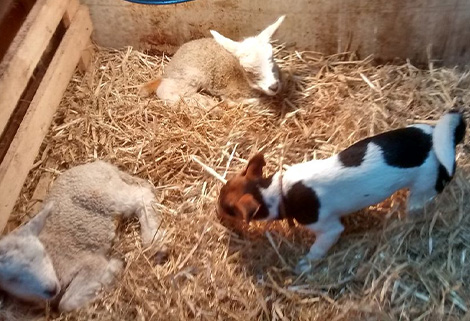
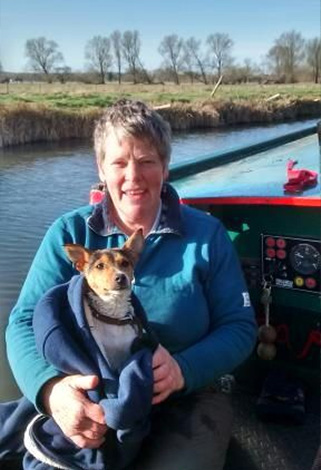
The countryside we're moving through is beautiful and we see places from the canal that we would never normally see. It’s a slower, more gentle world and you can't help but relax. Now as we approach Watford, I'm expecting more urban scenery but Cassiobury park is a fantastic nature reserve that we cruised through for miles and miles. At Watford Mick and Katherine leave us and Ewan took me down to the point where I would meet my next guests. Without Ewan the whole trip would never happen and the only difficult aspect of it is that he's not doing it with me. Together we decided that the big city is not a place for a wee puppy and as I'm approaching London I reluctantly let her go back to the farm with Ewan to learn about sheep.

I'm left moored up under a bridge in Watford, all by myself in the freezing cold, missing my husband and missing my dog. What will the next section bring? Will I make it to London?

Until next time, warm wishes to all.
Sally
Xx

cooking on the cut – spring 2023

cooking on the cut

with Lisa Munday

spring 2023

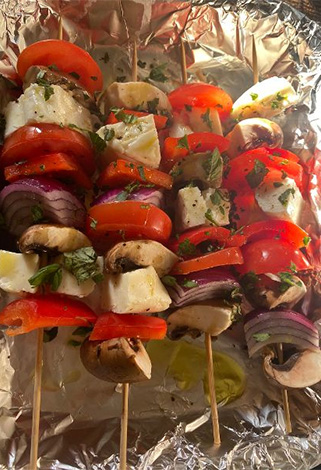
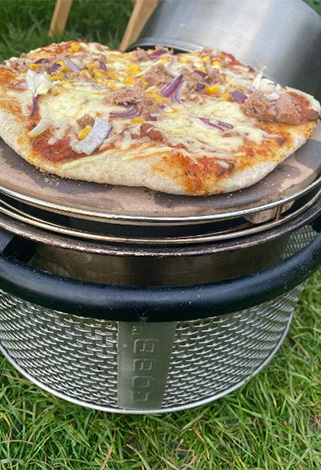
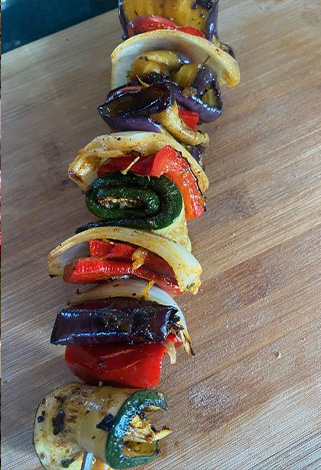
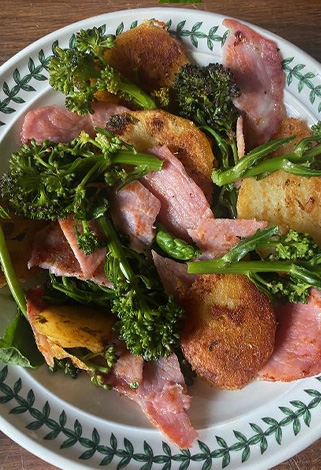
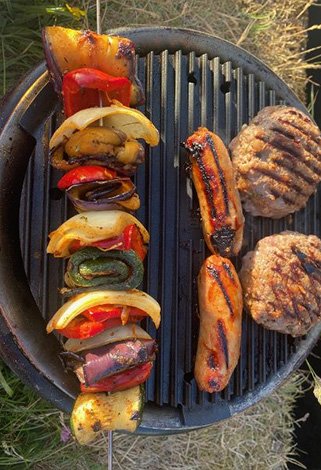
As we welcome the arrival of March, the cool air will soon give way to warm Spring sunshine and longer days. Most of us are bored of those starchy winter vegetables and stove top casseroles and are craving more greens, lighter meals and outdoor cooking. We have been using our Cobb and cooking over the coals over the last few weeks as the nights are drawing out, we’ll often skip breakfast and have brunch, then light the Cobb about 4 pm, so I’m sharing a few of my recipes with you to bring on that Spring feeling. We still need those hearty wholesome comfort foods so I’ve got a few of those favourites to share with you too.

We are lucky to have plenty of wild garlic growing near our Chesterfield Canal, so I’m using this as often as I can as it’s so versatile and I absolutely love it! Lots more Spring greens are appearing in the hedgerows and will be landing in the galley over the next few weeks, dandelion leaves, nettles and hawthorn buds to name but a few!

Stocking up on my store cupboard basics for the longer cruising season, I am reminded of the many ways with dried and tinned beans, pulses and grains, tinned fish, jarred chargrilled peppers and sun-dried tomatoes. Dried fruits and preserved lemons and garlic are also useful to have in for adding to many recipes. Another essential one for me is tinned spinach as it’s particularly useful for curries, egg dishes and pasta when short of fresh greens.

I don’t use a vast array of instant sauces, gravies and stock cubes etc, just my go to Vegetable Bouillon Stock, I favour the Swiss brand, this is so convenient as it contains all the stock ingredients required for the base for so many recipes, just one teaspoon into boiling water for veg, pastas, grains and casseroles makes all the difference. The humble cabbage is taken to another level using this! It’s great used with couscous and pearl barley which can be quite bland. I very rarely throw veg trimmings and cooking water away, it all goes into soup.

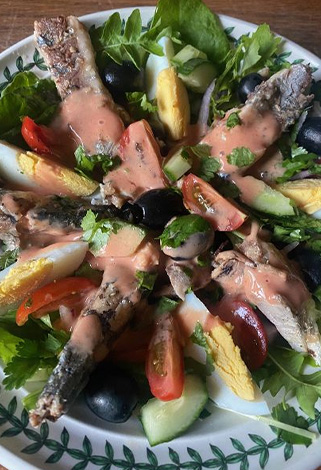
Tinned Salmon, sardines, tuna and mackerel can all be used in many ways and as the page develops with CanalsOnline Magazine there will be whole sections dedicated to individual categories.

Easter is not far away, so I have a few Easter bakes to share and some tasty Lamb and Chicken dishes. So, in no particular order here are my choices for this edition’s recipes to share with you.

TRAYBAKED TERIYAKI MACKEREL WITH GREENS

tray baked terriyake mackerel with greens

Tenderstem broccoli, sugar snap peas and leeks (or whatever greens you prefer, about 200g)
1 tsp sesame oil
1 tsp sesame seeds
180g fresh mackerel fillets (available in most larger supermarkets for approx. £2)
3 tbsp dark soy sauce
1 tbsp cider vinegar
2 tbsp caster sugar
2cm piece root ginger finely sliced (or ½ tsp ground ginger)
1 garlic clove finely sliced

  • Toss the vegetables with the oil and most of the seeds and spread out on a roasting tin.
  • Dry the skin of the mackerel using kitchen roll, cut a few slashes through the skin and place over the veg, skin-side up.
  • Sprinkle with the rest of the sesame seeds and roast in a hot oven for about 7 mins.
  • Meanwhile, combine the soy, vinegar, sugar, ginger and garlic in a small bowl. Pour over the
    mackerel and veg and return to the oven for 3 minutes. Serve with brown rice.

PEARL BARLEY AND TRAY ROASTED VEGETABLES

Another basic store cupboard ingredient to add to your stews, soups and salads. Remember to always thoroughly rinse all your grains and pulses through a sieve with plenty of cold water before cooking. Check the packaging for instructions but the general rule of thumb is 1 cup to 2 cups water for cooking.

  • Chop a selection of vegetables such as onion, sweet potato, courgette and pepper.
  • Toss in oil, plenty of black pepper, salt and ½ tsp smoked paprika and roast for about 25 mins.
  • Meanwhile boil your rinsed pearl barley in water and drain and rinse when cooked, rinsing stops it sticking together.
  • Toss with the roasted veggies to serve.

LEMON CHICKEN

lemon chicken

Chicken and lemon are a perfect combination and this dish uses the base known as “soffritto” in many Italian dishes.

For the soffritto, finely chop 1 small or ½ large onion, 1 carrot and 1 stick celery. Fry in a casserole dish with a generous tbsp olive oil, 2 crushed garlic cloves, 2 sprigs (or dried) rosemary and 2 bay leaves.

  • Coat four chicken thigh pieces in well-seasoned plain flour, tip off excess and fry in a separate pan with a generous amount of olive oil, about 5 mins each side until golden brown.
  • Transfer without the cooking oil to the casserole dish containing the veg, add the zest and juice of one lemon and drizzle over the chicken, stir to combine and add about 50/75ml white wine.
  • Let it bubble for a few minutes to burn off the alcohol and then add about 250/300 ml water to cover and bring to the boil.
  • Place the casserole lid over and cook slowly in the oven or over the stove for about 45 mins to 1 hour, until the chicken is tender. Stir occasionally to prevent sticking and skim off any excess oil.
  • Add extra salt and pepper to taste.

Serve with potatoes and greens. Parmesan or wholegrain mustard mash are perfect.

SPRING LAMB MARINADE  (ideal for 4 chops)

Combine 2 tbsp extra virgin olive oil, 1 tbsp balsamic vinegar, 1 tbsp lemon juice, 3 tbsp finely chopped rosemary, 1 finely chopped small onion, salt and black pepper.
Marinade for at least an hour before cooking over the barbeque or in the oven.

SPICED LAMB Swap the rosemary for chilli flakes and ground cumin

WILD GARLIC SALSA VERDE

spiced lamb and wild garlic salsa verde

This is the perfect accompaniment to Lamb or simply stirred through pasta.

  • Blanch a good handful of wild garlic leaves in a pan of boiling water, drain and squeeze out the excess water.
  • Blitz together with 1 peeled shallot, 1 tbsp white wine vinegar, grated zest and juice of 1 lime, approx. 120 ml olive oil, 1 tsp Dijon mustard, 1 tsp mint sauce, 1 tsp sugar, season with salt and pepper to taste.

PORK MARINADE

This is ideal for slow cooked belly pork or chops.
TIP – Rub the meat with sea salt first, this acts as a dry brine.

  • Toast ½ tsp each of peppercorns, fennel and cumin seeds in a dry hot pan for about 30 secs being careful not to burn the spices.
  • Then grind them in pestle and mortar with 1 dried bay leaf and mix in 1 heaped tsp paprika and a generous tbsp of brown sugar.
  • Rub the mixture into the meat and marinade for at least an hour before cooking slowly over the barbeque or in the oven.
  • This recipe can be pre-cooked in a low oven then refrigerated and cooked over the hot coals the next day.

DEVILLED CHICKEN WINGS

devilled chicken wings

These are quick and easy, better after marinating in a sealed plastic bag for a few hours, and so good cooked over the coals

800g chicken wings
2 garlic cloves crushed
60ml olive oil
2 tbsp Dijon mustard
45g brown sugar
2 tbsp Worcestershire sauce
2 tbsp balsamic vinegar
1 tsp cayenne pepper
1 tsp paprika

  • Snip the ends of the wings, then cut from the skin between the joint to give two pieces.
  • Mix all the other ingredients together and combine with the wings to marinade before slowly cooking to ensure they are cooked through to the bone.
  • Can be cooked in the oven, well-spaced apart on a large baking tray.

ONE POT TOMATO AND SPINACH KITCHARI

tomato an spinach kitchari

This is a heart- warming one pot meal with a spice kick.

130g basmati rice, rinsed
200g slit red lentils, rinsed well under cold running water
3 tbsp olive oil
1 thumb sized piece of ginger finely grated
2 garlic cloves crushed
2 tsp each turmeric, ground coriander, cumin seeds
1 -2 tsp chilli powder
Approx. 1.2 litres veg bouillon stock
150g cherry tomatoes, or whole tomatoes taken from a tin without the juice
200g spinach, I used a combination of tinned (well drained of juices) and freshly chopped wild garlic
1 finely chopped red chilli, or 1 tsp chilli flakes if you don’t have fresh
Pinch salt

  • Heat 1tbsp of the oil in a large saucepan or casserole and add the onion and a pinch of salt, fry over a medium heat until golden.
  • Stir through the ginger, garlic, turmeric, coriander seeds, half the cumin​ seeds and chilli powder, fry for 1 min.
  • Add the rice and lentils to the pan and pour in the stock. Bring to simmer then cover, turn down the heat and cook for approx. 25 mins, stirring occasionally, until the lentils have turned creamy.
  • Add the tomatoes and spinach and cook for a further 5 mins.
  • Heat the remaining oil in a small pan and fry the remaining cumin seeds for 1 min.

Spoon into bowls and top with the cumin and oil and the red chilli.
Serve with warm chapatis and yoghurt or just eat on its own.

PEANUT DRESSING

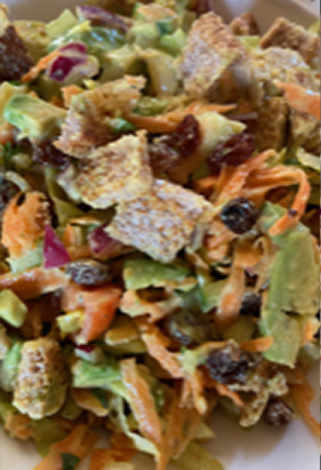
This is delicious tossed through noodles or stir fried vegetables as a vegetarian dish, or with stir fried chicken. It will keep for a few days in the fridge. It also makes a tasty crunchy salad with grated cabbage, carrots and onions etc.

  • Whisk together 100 ml shop bought sweet chilli sauce with 90g peanut butter and 3 – 4 tbsp water.
  • Add 1 tbsp (thumb sized piece) grated fresh ginger, juice of 1 lemon, 25g caster sugar and 4 tbsp soy sauce.
  • If you prefer extra heat add 2 chopped red chillies or dried chilli flakes.
  • Add a little more water if you prefer a thinner consistency.

Once your stir fry or noodles are cooked, stir through, allow to warm through and serve.

MINI EGGS CHOCOLATE BROWNIES

mini eggs chocolate brownies

200g good quality dark chocolate
200g unsalted butter
4 medium eggs
275g light brown soft sugar or caster sugar
100g plain flour
50g coco powder
150g chocolate chips
250g mini eggs​

  • Preheat the oven to 180/160 fan and line a 9” square baking tin (or similar) with baking paper
  • Melt together the butter and chocolate over a pan of simmering water and allow to cool slightly.
  • In a separate bowl whisk together the eggs and sugar until much paler and increased in volume.
  • Pour the chocolate butter mix into the whisked eggs and sugar mixture and carefully fold through.
  • Add the flour and coco powder, again gently folding through.
  • Finally fold through the chocolate chips and most of the mini eggs.
  • Pour the brownie mixture into the lined tin and bake in the oven for 25-30 mins. There should still be a very slight wobble in the middle of the tin when removed from the oven.
  • Leave to cool thoroughly before removing from the tin.
  • Finish with a little extra melted chocolate and sprinkle with the remaining mini eggs broken into small pieces.

Forget the calories, this is simply delicious!

LEMON SHORTBREAD BISCUITS

lemon shortbread biscuits

100g sugar
200g butter
300g plain flour
Pinch salt
Zest and juice from 1 lemon

  • Cream the butter and sugar together until soft and fluffy
  • Add the remaining ingredients and mix well with a spatula.
  • Work the crumbly mix together into a firm ball with your hands being careful not to overwork the dough.
  • Roll out onto a floured surface to about ½ to 1cm thick and cut into biscuit shapes, place onto a lined baking sheet and bake at 180/160 fan for about 15 to 20 mins until barely golden brown, taking care not to over bake.
  • As soon as you lift them out of the oven gently press a mini egg into the top, or when cooled drizzle with melted dark chocolate or make lemon icing by mixing lemon juice with icing sugar to a dropping consistency.​

winter survival kit

winter survival kit

six life-saving items for under £20

When we bought our 58' cruiser-stern narrowboat, Lutra Lutra, I thought that life afloat would be like that in a tiny home surrounded by water. The last 12 months have proved just how wrong I was. We have faced challenges that I never anticipated...and survived!

It's not quite Ray Mears, but here's a few items that I couldn't live without:

1. Three Hot Water Bottles
I vaguely remembered these items from my childhood. Thankfully, they are still on sale in Home Bargains. We have 3 and the water is heated on the woodburner during the evening. If it's particularly cold, I move them around the bed to warm up all the corners before getting in, or make my husband get in first!

spotty hot water bottle

2. A flannel and a plastic water carrier
We have been frozen in twice this winter already and stranded by lock closures once. With a 400l water tank, we can usually last a week between fill-ups, but you don't want to risk running dry miles from a water-point. In addition, the CRT taps are poorly insulated, and so even when you turn up with your wheelbarrow and water carrier, you may be disappointed. So, at the start of sub-zero temperatures, we get out the flannel and save the shower for a weekly hair-washing treat! We also got a second kettle so that the hot water bottle water is recycled each night, saving 2l each time. After all, no-one wants their coffee to taste of rubber!

plastic water carrier

3. Clear plastic sheeting and double sided sticky tape
AKA secondary double glazing, this has eliminated the terrible condensation that was forming on our metal window frames. Not only was this staining the wooden sills but the water absorbs any heat you put into the boat. It's almost impossible to heat a damp boat, and there's nothing quite like waking up to ice on the insides of your windows to make you feel like retreating back to bed. Similarly, we have insulated the underside of our metal hatch with a yoga mat and super-strong spray adhesive and the side of our bed with the cheap two-way stretch fabric that they use on car interiors. #staywarm

plastic film and double sided sticky tape

4. Vet Gloves
Handy if you come across a cow in labour...or when you get poly round the prop on the BCN. So handy, I think they should be listed on the boat safety certificate! And under £20 from Amazon.

vet gloves

Steve Burt wearing vet gloves

5. An iron cookpot (Le Creuset, if you're posh)
We eat seasonally. The gas stove is 'wet heat' meaning that it releases water vapour as the gas burns, and that causes condensation. (Incidentally, candles are the same, but they make you feel cosy, so I make an exception for a couple of those.) Condensation is our arch-enemy, so we cook on the woodburner as much as possible if it's lit i.e. from November to March. We have met boaters who cook exclusively on theirs, but I've found that a frying temperature means the cabin is unbearably tropical, so I tend to start my stews in my retro pressure cooker and then leave them to finish off on the woodburner. We cook porridge every morning on one heat log lit from the embers using a recycled eggbox-woodshavings-and-candlewax firelighter (homemade on my woodburner and available in my eco-shop). All-day rice pudding is awesome, and you can't beat a foil-wrapped baked potato placed next to the coal cage.

morso fire

crock pot on log burning stove

6. Cashmere jumpers
There's no substitute for pure wool, cashmere, angora etc. If you're lucky then you can find them for £10 in a charity shop. Layer them. The woollen fibres are naturally self-cleaning and don't smell, so you don't need to wash them for weeks, which is especially important if you're frozen in.

Cashmere jumper

That brings me to my final item. The CanalsOnline Magasine list of services on each cut. Brilliant for finding launderettes (don't ever dry washing in the cabin in winter), takeaways (for those days when the woodburner goes out), and pubs and churches for when you need your heart warmed.

Roll on the spring!

why didn’t they build the aqueduct?

why didn't they build the aqueduct?

a tale of Jim, Amanda and Mayfly from when they were a few decades older... but no wiser!

“Next thing we’ve got to do is get through the link and back before they close the blooming thing for the winter. I mean they spend all that cash on it and you have to jump through hoops before they even let you use it,” Amanda said, a little nervously.
“It shouldn’t be that bad. We’ve been running long enough to know that the outboard is reliable enough. It’s certainly got the power to punch the tide,” Jim smiled. “There’s plenty of people around if the thing does let us down.”
“But she won’t will she,” Amanda replied a little more calmly. “Mayfly has never once done that has she.”


The link north utilised two tidal rivers and a brook that ran close to the isolated northern section. Whilst Mayfly was more than capable of navigating between the two sections of waterway, Jim and Amanda’s knowledge of tidal water was sketchy to say the least and both were just a little nervous of making the jump or their being late for the locks which they, despite their experience, were not allowed to operate themselves.

“Well, here goes,” Amanda said, swinging the little motor round to take Mayfly under the bridge that spanned the entrance to the arm that would take them to the tidal river. Almost immediately they were met with a lock with a more than unusual mechanism that looked like it had been made of scrap from a garden shed. Despite the appearance, and difference to the norm, the locks in the area seemed to function perfectly well, and the couple soon found they were not alone in their travel. There were four steel narrowboats with whom they were able to share the locks.


“You’re a bit small for the crossing,” the owner of one of the craft said.
“Mayfly’s been a good companion for a long time,” Amanda smiled. “She won’t disgrace herself. They used to use little boats like this for island hopping in the Hebrides, so she’ll cope with worse than an estuary. Not sure I’d like to go to sea in her but people did, maybe still do.”
“They’d use a bigger motor than that though,” the man said.
“We’ll see,” Amanda replied good naturedly as they filed out of the lock.

The section of canal was rather pretty despite its closeness to a main road, and the crews of the little flotilla of craft soon bonded. Both Jim and Amanda exchanged stories, telling about their early days as two frightened teenagers setting off on an open ended adventure which, Amanda suddenly found herself thinking, hadn’t stopped so far.

   rural canal

The last lock on the section was not yet usable as the tide wasn’t at the right level for the boats to get across the estuary in time to get to the new canal link that they were aiming for. Both Jim and Amanda spent some time checking through the equipment that had been supplied.

“The GPS will hopefully tell us where we are, but we hardly need it because we’ll be following this lot. I guess we should connect to the motor on Bluetooth,” Amanda frowned slightly.
“That sounds very technical,” Jim smiled. “Anybody might believe we actually knew what we were doing.”
“If you don’t, I wouldn’t advise it,” Dan Rutherford, the owner of the boat that they’d shared most of the locks with said, having overheard the conversation. “We’ll keep an eye on you if you do choose to.”
“Thanks,” Jim smiled, feeling rather less than confident.

Two hours later it was time to go. The engine monitor of the outboard was displaying that all was well, and it was Amanda that flicked it into gear, opening the throttle to keep pace with the other craft. The determined growl of the little machine somehow inspired confidence as Mayfly picked up speed, and was more than able to punch current to keep up with the rest. Wash from the flat bottomed narrowboat hulls, was something of a nuisance, but they soon managed to find an area of calmer water to run in.

“How far are we up on the throttle?” Jim asked.
“We’ve got plenty spare if that’s what you’re worried about,” Amanda smiled, her confidence building by the minute as the little boat cut through the water leaving very little wake behind her.
“I guess it’s what she was built for, so it shouldn’t be a surprise,” she added.

   rural canal

Although the run wasn’t really that treacherous there were a few things they needed to keep in mind, the major two being not to miss the entrance to the link and also to go around the correct side of a marker. Having heard of the dire consequences of going the wrong way around it, both were on the alert. It was rather annoying that they’d have to make an overnight stop in what was once the docks, but was now occupied by a marina. The flotilla kept together and, bound by camaraderie, they decided to adjourn to a nearby pub for a meal together.

“You made it OK,” Dan smiled. “You must have been revving the ball bearings of that little thing though.”
“They’re ceramic,” Amanda smiled proudly. “She was re-engineered this year. We’re not sure quite what power she has, but it’s a fair whack more than it says on the tin.”
“It’s a nice little boat, looks good too,” Ruth Wilson, another owner added.
“She’s an old lady now,” Jim smiled. “We thought she was around fifty five or so, but she’s well into her seventies.”
“It must have been like Romeo and Juliet, when you first sailed off into the sunset,” Ruth smiled.
“Not exactly, I mean neither of us are dead yet, and we kind of aim to put that one off for as long as possible. We had to go, simple as that,” Amanda said.
“And we’re still running,” Jim laughed.
“I guess so,” Amanda replied. “There’s more than just an element of having to do this run.”

why can’t they leave things alone?

why can't they leave things alone?

I am a bit late writing this article: my phone has stopped working; apparently it needs ISO, whatever now,  and thus is no longer supported. To add insult to injury, the word processing software I use to write with now needs a new licence.

Technology is becoming more of a form of legalised piracy to extort money than to help. I don’t ever remember my trusty old Olympia typewriter needing much more than a new ribbon and a clean!!

Which brings us neatly on to the latest corporate act of vandalism from a leading gas supplier, the removal of the smaller gas bottles. Ok I know that these have always been the most expensive way of using gas but like many boats of Dawntreader's age, it is what the builders designed the gas locker around. To convert to the new larger 5 kilo propane is going to require some careful thinking and considerable expense to make a new locker, let alone have a corgi registered gas supplier come and make the necessary connections. To the point that I am now considering alternatives to gas and removing it all. After all, when I first started boating, it was paraffin lamps and wick stoves.

The first thing to do is list all things I use gas for, which is cooker, water heater and Propex heater. The next is why do I use it - the only real answer is because it's there !! and lastly what are my alternatives?

calor gas bottle boats

olympia typewriter

Firstly, the humble microwave can do a mug of coffee in under two minutes and a baked potato in 6 where as a Vaness Flavel oven takes about the same time it took to grow it. The hot water system for the shower can soon be replaced by the can of hot water method; I have a solar one I use sometimes in the cockpit, supplemented by what is basically a modern tea urn that provides enough hot water to wash up with.

So the answer seems to be 'go electric'. But this is not as easy as it sounds, as even with on shore power in the marina, supply is limited. Basically, we need to do an energy audit – how much power does a microwave, small water heater etc use and find a generator that can cope.

The plan is to use DT's old engine bay and have a lightweight built in diesel generator, complete with fireproof filters and pipe work and exhaust to outside world that can run the appliances. But not only for domestic duty – it would have to provide enough power for electric outboard charging and replace the old Suzuki - if you like a sort of hybrid power system. Thus removing the need for  yet another old dinosaur which is rapidly becoming obsolete. 5 litres of diesel is far cheaper than 5 kilos of gas and much more versatile.

Add into this a decent battery bank that can run a small invertor without causing a real headache and I think we are onto something. There are other alternatives, Kelly kettles are a must in life – I have had mine years, obviously you don’t use them inside the boat but on the towpath. Even half an old cardboard box can boil 3 litres of water in about 2 minutes – the surplus decanted into thermos flasks to use when required. A pan on top and you can have a bacon sandwich and hot water to wash up in. Spirit stoves or paraffin stoves are still available, as are baby Blake marine grade paraffin heaters, both of which are far more economical to run than gas.

What does worry me is that people will start to take risks with portable gas cartridge cookers and heaters of dubious quality and design. In the same way,  being an engineer, cheap Chinese diesel heaters scare the hell out of me. Then there are those who will run generators under canopies, or even burn candles. I have known all of these go wrong,  either gassing the occupant or burning boats down to the water line.

What I am certain of is I will not be carving up the boat trying to squeeze in a five-kilo bottle into lockers it simply won’t fit. Any more than I am upgrading my phone when I have a reasonably good laptop that does the same thing; and when that packs up it will be time for the typewriter!!

If we all turned our backs on some of these corporations and their continuous need to change things to make us buy so called newer and better, they would soon learn to leave things alone.

dinosaur

a red letter day

a red letter day

in the story of the Waterways Chaplaincy


1st January 2023 was a day that marked the transition of the Waterways Chaplaincy from being a part of Workplace Matters to becoming an independent, ecumenical charity within the Church Army family.

We have left Work place Matters (WM) with fond memories and much appreciation of the way that, in 2019, WM ‘birthed’ WWC and continued to nurture the ministry. The effectiveness of their encouragement over the years has seen WWC grow into a unique nationwide charity being Jesus’ hands and feet amongst the waterways communities.

You might say that it is a sign of success that WWC is now ready to strike out independently and grow further, but now with the support of the Church Army.

The Waterways Chaplaincy’s ministry has a more natural affinity with Church Army. Wilson Carlile, who established the Church Army in 1882, believed that God’s love is for everyone. He was passionate about his faith and wanted to share the good news of Jesus with people who would never dream of stepping foot in a church.

That continues to be the Church Army’s mission today and is why the Waterways Chaplaincy fits so well into its family of ministries.

a window on the world!

St Laurence's Church, Hungerford

Having passed on that news, I must tell you about our new church doors. St.Lawrence’s church, Hungerford, which is right next door to the towpath of the Kennet and Avon canal, was built in 1816 on the site of previous churches. It has a stout wooden outer door and, until a couple of weeks ago, ugly red baize inner doors. They have now been replaced by handsome new glass doors, manufactured in Germany, each one attractively etched with a ceremonial Cross. This means that the entrance into the church is lighter and brighter and those inside are able to look out into the churchyard with, at the moment, its carpet of snowdrops. More importantly, those outside can see what is happening inside before they venture in – or not, if the viewer is too shy to do so – perhaps next time he or she will have a change of mind?

The doors are the first step in refurbishing the back end of the church to provide a commercial kitchen, disabled toilets, and small meeting rooms that can be heated individually without heating the whole church (which actually means heating the high
roof!)

The doors and installation have been paid for by the Friends of the church following a lot of successful fund raising, and their donated £12,000 was match funded by Greenham Common Trust.

Our vicar’s wife, Alison Saunders, heads up the Kennet and Avon hub of the Waterways Chaplaincy and our vicar, Mike, is also a chaplain. The church is open all day and we would love to welcome you at any time!

a thorny rose

a thorny rose

To many of the uninitiated, the canals offer a bucolic, romantic way of life that could easily be part of “the darling buds of may”, but in truth there is a brutal edge to it and there are some topics in the canal world that are almost guaranteed to cause verbal (and occasionally physical) fisticuffs, and today reader we’re going to don our tin hat and enter the trenches of roses and castles.

The most often asked question is “Where did they come from?” A question in itself that is rather wrong, as the implication is that the style we see today has been the same since the Duke of Bridgewater said “Hey I think I’ve got a great idea”.

There is a lot of popularity behind the idea, largely thanks to Rolt’s writing, that the Romany folk came to the water very early on and brought their art with them, but there is scant evidence of them joining the canals at all and in practice the painting theory doesn’t work simply by dint of the fact that there is artistic evidence of rose and castle type paintwork on boats that predates the development of the painted ‘vardo’ that everyone thinks of.

The earliest imagery we have dates to 1820, and a painting by an unknown artist. It is only just visible, but it appears the picture panel on the cabin side bears flowers. The next one is 1838 and also has a floral picture panel.

1820 painting of 'Hope' (Flowers Afloat)

1838 watercolour (Flowers Afloat)

The first written description of artwork that can be confidently identified as roses and castles appears in 1858 and gives us the biggest lead:

“The boatman lavishes all his taste; his rude, uncultivated love for the fine arts, upon the external and internal ornaments of his floating home. His chosen colours are red, yellow and blue... the two sides of the cabin...present a couple of landscapes, in which there is a lake, a castle, a sailing boat, and a range of mountains, painted after the style of the great teaboard style of art... the brilliancy of a new two gallon watercan, shipped from a bank-side painters yard.. displayed no fewer than 6 dazzling and fanciful composition landscapes, several gaudy wreaths of flowers, and the name of its proud proprietor...running round the centre upon a background of blinding yellow.”

The crucial information here is the description of it being painted in the manner of a teaboard.

An object that households rich and poor alike had: a teaboard is just a tray intended for carrying the teapot and its accessories, and for the best part of 100 years tea trays were predominantly jappaned.

Developing just prior to the canals, jappaning is western imitation of Asian lacquer-work that started out on eye-wateringly expensive furniture and moved onto smaller household items as it became a craft suitable for young ladies of quality to indulge in. These young ladies also indulged in gilding (putting gold and silver leaf on things) and filigree (twisting wire into intricate shapes), and decoupage (sticking paper decorations to things and lacquering them into submission.)

As with all forms of fashion what the rich had, the poor wanted a piece of; by the time the canals were firmly established in the 1820s there were around 40 companies in the West Midlands mass producing japanned objects on tinplate and papier-mâché, a figure that kept rising right up until the mid 1870’s (when enamelling became trendy instead). The imagery that was most popular with jappaning was poetic landscapes and botanicals, with roses being particularly popular.

Tea tray (photo from Antiques Atlas)

Table (photo detail from Ebay)

Mary Delany is arguably a woman to blame for the craze of flower decoupage, creating a series of remarkably detailed “paper mosaiks” of flowers from tissue paper from 1772 to 1783.

Imitators down the years, especially when mass production became key, were not as skilled. The same imagery was rammed down the consumer's throat on every surface; the advent of ‘transferware’ china allowed patterns to be printed ad infinitum and brought the boom in the ‘Willow patterns’ on pottery that the boats themselves were key in spreading round the country.

The boats themselves would have had it in their cupboards, it was everywhere. Tea could well be brought out in a blue and white tea-set covered in castle scenes and served on a tray like a florists catalogue.

Mary Delaney rose (British Museum)

Willow pattern (Palm Florida Weekly)

People often overlook the fact that it wasn’t until quite late in the Victorian era that the boaters slipped down the financial ladder, and also that women were on the boats with their menfolk quite early on - in 1819 John Hassell noted there were “generally one or two females generally attending each boat” and in 1824 the Chester Courant noted that the boatman’s “wife is on board” as general knowledge.

Boatmen could be on a continuous cycle of trips for weeks, if not months, on end, so it wouldn’t be unreasonable for the couple to want to stay together where practicable, and the economic aspect wouldn’t be unwelcome - better to pay your own crew than a stranger after all – so it’s quite probable that art came to the water via the rather boring medium of fashion trickling down the social ladder and first coming into the cabins attached to the household goods of the boatman’s family.

How did we make the leap from fancy lacquer tea tray to painted table cupboards? The real answer is we may never know. Everything was painted and there were painters everywhere, and indeed the same man might be employed painting trinket boxes in the morning and slapping the owners name on the cabin side at dinner.

There is the odd legend of Arthur Atkins, a toll clerk for the Oxford Canal Co who claimed in the Coventry Standard in 1914, the occasion being his retirement, that he had painted the first boater's watercan and that in around 1858 he’d been at Braunston and sold Charles Dickens a boatman’s kettle (a fancy wooden trivet, plain on one side, painted on the other), the great author promptly gifting said piece to the Captain of a boat and wrote an article about it all to the great advantage of Atkins.


newspaper clipping

The story has more holes then a June bride. For a start we can see that painted cans easily predate 1858 and there is simply no record of anything like that happening with Dickens at all. There’s no trace of this article he supposedly wrote and in general his canal contact was fairly limited. It’s also highly convenient that date of the incident matches with the journey I quoted originally, the journey that was published in Charles Dickens’ magazine ‘Household Words’.

It is almost certain that young Arthur Atkins was present when the author of that journey, John Hollingshead, passed through, so it is plausible that it could have been a case of mistaken identity, but our source says the can was “newly shipped from a bankside painter” long before the boat they were travelling on arrived at Braunston.

1828 engraving (Flowers Afloat)

Intriguingly however, a search through the census shows that Atkins father, also called Arthur, was a painter. At Akins' birth at Bedworth in July 1840 his father is recorded as a baker, but 6 months later in the census he’s a painter. In 1851 he shows up at Braunston as a canal clerk, but this doesn’t suit all that well because in 1861 he’s gone to Birmingham and he’s a painter again. 1871 records him as a “Writer and painter”, which suggests signwriter, 1881 “decorative painter” and 1891 hes still wielding a brush in Birmingham as a “Painter and decorator”.

Given the fluid job descriptions, there’s a distinct possibility that the Arthur Atkins, boatbuilder’s foreman, declared bankrupt in 1869 is this same mysterious painter. Could it be his paintwork his son claimed as his own?

The Coventry Standard notes how Atkins jr was a “regular correspondent” with their writer Spectator, and although many of these have weathered the years quite badly, those that are legible give off a distinct air of someone over egging the pudding. It’s quite plausible that Atkins embellished or completely made up his stories, knowing that there was no way for anyone to verify the details.

The crucial thing to bear in mind when delving into the paintwork is that the vast majority of surviving examples post-date the first world war. The war decimated the male population and left the country with a dire shortage ofyoung men from all the trades, from farriers to painters. A pet research project of mine so far suggests that 65% or more of boatyard painters were lost, and that’s not including the individuals, boatmen or otherwise, who could be classed as ‘hobby painters’.

A cursory glance through museum pieces shows the abrupt change from diverse bouquets and landscapes to the ubiquitous roses and castles, which is most likely a direct result of there being far fewer painters and therefore far fewer styles, attending the same number of clients who now had a far smaller budget as the canals being the slow descent into financial loss.

Watercan detail

Watercan detail  (Flowers Afloat)

Watercan detail  (Flowers Afloat)

By the 1930s, the aesthetic preference of the public had changed from the sleek art nouveau to the geometric art deco and more professional painters slipped away. The Grand Union Canal Carrying Co leapt onto the scene in 1930s and demonstrated that by their modern paint scheme – simple two tone blue, plain lettering and even replacing the elegant “mouse ears” on the back cabin with dull rectangles. Grand Unions attitude to paint may even have been a contributing factor in that they could never get enough crew to work their massive fleet, as the boatmen themselveswere not fans of the change and more than ever started to take up their brushes to embellish their boats themselves.

This brings us almost to the modern age. When the trade failed and the pleasure boats started to appear, objects covered in canal painting became trendy souvenirs and both boatmen and painters alike readily filled the market. New painters began to emerge, grabbing on to every opportunity to learn from those masters from “the old days” and patiently working their way along the long slow path to becoming masters in their own right.

Today, the canals are once again flush with painters at every corner and, much like it was in the beginning, there are masters and glorified finger painters, and every level of skill in-between.

Beauty is of course in the eye of the beholder, and at the end of the day I can only repeat the wisdom of the infamous Ron Hough himself: “The only person that has to like your painting is the person who’s buying it!”

cooking on the cut – winter 22

cooking on the cut

with Lisa Munday

Christmas

Winter has well and truly arrived with short days and cold crisp frosty mornings, as we enter into this extremely cold spell the clear skies have given us some beautiful sunrises and sunsets, not to mention that amazing full moon.

This year has flown by, I have now shared four Seasons with Canalsonline magazine and am looking forward to lots of exciting things happening in 2023.

With so many heart- warming recipes at this time of year we have all enjoyed slow cooking those casseroles and throwing together hearty soups and one pot meals.

Now though we are thinking towards our Christmas feast and treats. Let’s not wait until the big day for those lovely homemade stuffings, bread sauces and the somewhat underrated red cabbage and Brussels sprouts. We have already cracked into our nuts and chocolate stash, not to mention the Port and Brandy, oh and the Baileys, which of course are purely for culinary use!

I’ve done quite a bit of “pruning” when walking Rosie through the woods and have a very natural look in the boat this year, homemade wreaths and swags using trailing ivy, fir, juniper and rhododendron, I have also collected lots of pinecones throughout the year which double up as great firelighters!

christmas decoration

So, the list of favourite seasonal ingredients is endless. The Christmas spices of cinnamon, cloves, nutmeg, star anise and ginger are essential for me, as are the use of chestnuts, walnuts and almonds with the fruits of cranberry, pomegranate, oranges and pears.

Parsnips, leeks, celeriac, red cabbage and of course sprouts are my favourite vegetables. For cheese it has got to be stilton and brie. Then those Christmas herbs of Sage and Bay are the perfect partner to Christmas meats, sausage and stuffing. It’s worth keeping some fresh herbs in as they make such a difference to any dish as opposed to using dried.

Store cupboard goodies are luxury mincemeat (if you don’t make your own) or make a basic mincemeat into luxury by adding extra chopped nuts, orange zest and brandy. A jar of goose fat is also a must for those luxury roasties.

Roast Gammon

A cooked gammon joint goes a long way. For me it has to be slowly boiled in cider and finished with a glaze using two tbsp Demerara sugar with ½ tsp mustard powder, studded with about half a dozen cloves.

roast gammon

roast gammon with honey roasted veg

  • First soak the gammon in water overnight in the fridge. When cooking in a large saucepan it’s useful to sit it on a trivet using a small plate or tin, this stops the bottom from overcooking.
  • The next morning after soaking drain and place in the pan, pour the cider over to cover and slowly bring to the boil and simmer for about half an hour.
  • I then transfer to a low oven or cook over the stove top for a further two hours on low heat.
  • Remove from the pan and allow to cool slightly before slicing off the thick part of the rind. Save the cooking juices to use as stock for soup.
  • Score the fat in diamonds and place a clove in each diamond. Mix the mustard and sugar together and smear over the scored fat.
  • Stand on a baking tray and spoon a little of the cooking liquid over the lean meat area.
  • Finish by roasting in a hot oven for 15 to 20 minutes.

BUTTERBEAN MASH

This a great dish to serve with a cooked gammon. Heat a tablespoon of olive oil and gently fry a small onion or a couple of shallots finely chopped with 2 cloves of garlic finely chopped. Drain a tin of butterbeans and mash with a potato masher or whiz in a blender. Stir into the onion pan and heat through, stirring in 4 tblsp crème fraiche and season with salt and fresh ground pepper. Add a little cooking liquid from the meat if the consistency is too thick.

ROAST VEG TIPS

I Always boil potatoes, carrots and parsnips before roasting. Ensure the steam has totally dried off when draining before roasting to avoid soggy veg. Squash, leeks and onions can go straight into the pan. For roast potatoes, after par boiling, make sure the edges are roughed up by giving them a good a shake in the colander. If honey roasting, melt equal quantities of oil, butter and honey in a pan and always make sure the roasting tray is hot before the veggies go in. Don’t forget to check after about 10 mins and turn to evenly brown the edges. Sprinkle malden salt flakes and fresh ground pepper to finish.

roast potatoes

roasted tomatoes

Stuffing and bread sauce mixes are so cheap to buy, but not a patch on home made. It’s worth taking the time to make your own, they will keep in the fridge for a few days or freeze well.

MAKE YOUR SOUP SPECIAL by adding cheese croutons.

bowl of soup

creamy soup with croutons

  • Mushroom or Leek soups are perfect with stilton croutons. Just make stilton cheese on toast and cut into small pieces to add to the top of your soup bowl.
  • If you have some tomatoes looking a little past it, roast them by drizzling with olive oil and placing a few garlic cloves, herbs and pepper over them, add a little balsamic if you have it, then blitz to a puree to use in soup or sauces. Cheddar croutons are great with a tomato soup.
  • Finely shred some spring onion or chilli and fry to top your soups or add a dash of cream or flavoured oil.
  • Grate any cheese over such as parmesan or cheddar.
  • Toast a few flaked almonds or crumble a few tortilla crisps over.
  • Butternut squash soup goes well with toasted sage leaves or crispy shallots and bacon bits or a dash of coconut milk if it’s a spicy soup.

HOMEMADE STUFFING

  • Cut about three to four slices of bread into small cubes. Gently toast on the stove top, in the oven or dry fry in a pan and set to one side. I use sourdough or any crusty bread for better texture.
  • Meanwhile, finely chop 1 carrot, 1 stick of celery, 2 cloves of garlic and a small onion (I use my mini chopper it saves so much time) and gently fry in oil and butter. Add freshly ground black pepper, chopped sage and thyme if you have it or a mixture of dried herbs.
  • Keep moving round the pan to avoid catching. Then add half a pint of stock and stir well.
  • Turn off the heat and top with the dried bread cubes and finely chopped walnuts and a few sage leaves fried in a little butter. Cover the pan and leave for ten minutes.
  • Then remove the lid and fork through to mix well. Dot with a few pieces of butter to finish.
  • If not using straight away this will reheat or crisp up in the oven.

I make a larger than necessary pan full of this stuffing and use it as a crunchy topping over baked cauliflower cheese, casseroles or toss through cooked sprouts with bacon lardons.

homemade stuffing before cooking

homemade stuffing

CHRISTMAS RED CABBAGE Is the perfect partner to red and white meats or just with brown lentils as a casserole. Here’s my version. I don’t use all the cabbage, saving some for a winter salad with the addition of white cabbage, raisins, orange juice and sweet honey dressing.

  • Finely chop 1 to 2 red onions depending on size and fry in about 75g butter in a pan or casserole dish .
  • Add 1 red cabbage finely sliced, 1 finely chopped apple, 1 tbsp chopped dried fruit such as prunes or raisins, 3 tsp soft brown sugar, juice of 1 small orange, 3 tbsp red wine, 1/4 pint stock, 4 cloves, 1 star anise, 1 cinnamon stick, salt and pepper.
  • Thoroughly mix all the ingredients to coat the cabbage well, cover and simmer for about an hour until the cabbage is tender and cooked. Can be cooked on the stove top or in the oven and will keep well for five days or freeze.

red cabbage

red cabbage after cooking

PEP UP YOUR PEAS
With fried sliced potato, leek and shallot. Stir in a little mint sauce to serve.

SPICY SPROUTS
This is an alternative way to cook your sprouts and particularly good with cold leftover meats. Slice them in half lengthways from the top, make sure they are dry if you have washed them otherwise they won’t go crispy. Roast in the oven tossed in oil. Meanwhile, gently fry two garlic cloves with finely chopped onion or shallot, add a squeeze of lemon juice and a generous drizzle of honey or maple syrup. Once the sprouts are cooked and crispy on the edges combine with the other ingredients and sprinkle over some chilli flakes, chopped spring onion and toasted nuts such as almonds or cashews.

MY MINCE PIE RECIPE

For sweet pastry use 150g plain flour with 75g unsalted butter rubbed in until like breadcrumbs, add 50g sieved icing sugar, 1 egg yolk and zest from ½ orange. Bring together with 1 tbsp cold water and shape into a ball, flatten into a disc and chill for half an hour. Roll out and line the tart tins with discs of pasty, prick with a fork and add the mincemeat filling. I add brandy, orange zest from the other half of the orange and a few extra chopped nuts such as walnuts. Place the pastry lids on and brush the edges using egg to seal, pierce a little hole in the tops to let out the steam. Cook at 180 fan or gas 6 for about 10 to 15 mins. Dust with sieved icing sugar when cool and enjoy with a glass of sherry!

Merry Christmas to everyone and a Happy and safe boating New Year!