As numerous canals continue to suffer low water levels, breakdown and assistance firm, River Canal Rescue, is receiving daily calls from boaters with fouled props and damage to rudders and skegs, plus associated damage to drive systems, impacting engine mounts with ‘legs’ failures, and gearbox coupling/drive plates.
RCR managing director, Stephanie Horton says many calls involve a combination of these issues, due to hitting underwater obstacles exposed by low water levels, and confirms a significant number of vessels are grounding in unusual locations. “When this happens,” comments Stephanie, “there are some simple things you can do.
“Where we can, we talk people through how to move their grounded boat. We have a ‘24hr’ rule in many situations as water levels can change, boats come by or customers just manage to get themselves free. It’s not a hard-set rule, but we do advise customers, in some cases, to wait 24hours, if they can, before using our services.
“If the boat can’t be moved, we liaise with CRT staff to check if low water levels are known and if this is likely to change. The CRT will usually endeavour to try to attend and move the boat, but if it’s unavailable or other issues are identified, then we’ll despatch a team. This type of event is usually covered by a fully comprehensive insurance policy.
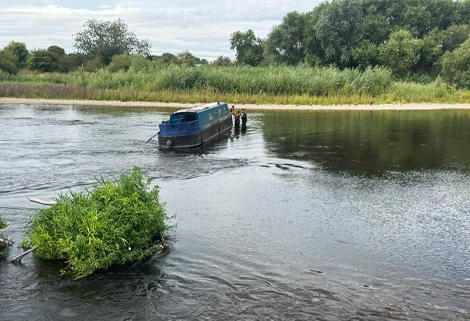
“If you run aground on a river, put on a life jacket and put your boat in reverse to see if you can move away from the obstruction. If this doesn’t work, walk around the vessel testing the surrounding water depth with a boat pole. This will pinpoint where the water’s shallower and where the problem is. On rivers you can usually see rocks or grave, as the water’s clearer.
“There’s always the option to get into the water and ‘push’ the boat; it may sound drastic, but if you’ve travelled up a non-navigable section then usually the water is less than 12inch/30cm deep. Once you’re off the boat it’s easier to get it moving - just ensure you have a way to get back on, when it refloats.”
Ballast
Stephanie continues: “If the front of the boat’s grounded, move some of the ballast that may be holding it down. The water tank is always at the front of a narrowboat so turn on the taps to empty it and move heavy items such as gas bottles, the anchor and any chains to the rear – this will give the boat more buoyancy at the front and potentially lift it a vital few inches, which may be all it needs to clear itself. Half a ton of water can create a six-inch difference. If it does clear, put the boat in reverse.
“If the boat’s grounded on one side, it’s a similar scenario; move anything that’s weighing it down in this area to the opposite side. Do this in cautious stages - if you over-balance, the vessel will list and it could end up taking on water.
Tow
“If there are people onboard, position yourself at the helm and ask the remainder to rock the boat gently; the momentum may move it. If the rear of the boat’s aground and the propeller’s lifted (which is a rare scenario), you’ll probably need a tow.
“And while it’s tempting to ask a passing boater for a tow, this should only be undertaken by an experienced boater. We’ve had cases where the person towing the vessel has got into trouble and we’ve ended up rescuing two boats. Also, anyone on a hire boat will invalid their insurance if they try to tow you, so it’s better not to put them in that position in the first place.”
“If you are able to free your vessel, check it thoroughly at the first possible opportunity – particularly the hull – as this could have been damaged.”
Patience
Stephanie advises: “Find out about restrictions and closures, the protocols and what’s happening in areas you plan to navigate. Situations develop all the time, so be aware of the risks around you and be cautious while cruising. If you’re on a canal and you find the boat is not moving as fast as usual, and water levels look low, DON’T simply increase your speed, be patient and wait until the water levels increase or you can get though a lock to a better location. Speed on low water levels puts pressure on the drive systems.”
Drive systems
Stephanie concludes: “Putting more revs on to speed up, creates rather than resolves the problem. Without the depth to ensure smooth travel though the water, the load transfers to the drive system, putting it under undue pressure, resulting in gearboxes overheating, and a higher risk of hitting or catching something underwater, damaging drive plates and couplings.”