
fitting a boat stove?
why BS 8511 is the starting point, not the finish line
written by Sebastian Meier, Marine Heating Solutions
Every autumn I get the same question from boaters planning a new stove: "Will it meet BS 8511?" It's a sensible thing to ask: it's the code of practice the Boat Safety Scheme points owners towards. But meeting the minimum in a 2010 document isn't the same as having the safest installation. As a BSS examiner and heating engineer, this is how I explain the difference to my customers.
What BS 8511 actually is
BS 8511 is the British Standard code of practice for fitting solid fuel stoves on boats. It was written in 2010 and, with nobody volunteering to update it, BSI has simply kept it in place at each five-yearly review. It's guidance, not law, and stoves, flues and safety thinking have moved on a long way since. That's why I treat it as a floor, not a ceiling.
The stove maker's instructions come first
Both the standard and the Boat Safety Scheme put the maker's boat installation instructions first. Where those are missing, incomplete or unclear, the standard fills the gap. In my experience, current instructions for modern stoves are often stricter on clearances and heat shielding than the outdated standard.
Choosing the right stove matters too. The BSS recommends a small stove, matched to the cabin, that the manufacturer or supplier confirms is suitable for boats.
One of the most common problems I find is a stove that was never meant for a boat. If its instructions call for a 4.5 m flue, or a flue that meets building regulations, it was designed for a house chimney, and no amount of careful fitting will make it safe on a boat.
An insulated flue, all the way up
The flue is the clearest example of good practice going beyond the standard. The 2010 code expects the chimney through the roof to be insulated, but still allows a length of uninsulated pipe inside the cabin, ideally under a metre. The BSS guidance on fitting a new stove or chimney goes further, recommending insulated sections both inside and outside the boat, at the diameter the stove maker specifies.
Both agree on the basics: at least 2 m of chimney from the stove to the top, no bends steeper than 30°, and 600 mm showing above the roof when you're moored.
Insulation keeps the flue gases hot. Hot gases draw better and leave less tar and soot behind, and the cooler outer skin of an insulated flue puts the woodwork and linings around it at far less risk. The BSS also points out that an insulated chimney usually means burning less fuel.
On older boats I often find single-skin mild steel flues rusting where they meet the cast iron roof collar. That spot is usually hidden behind the ceiling or a decorative cover, so nobody sees it. Once the rust eats through, sparks and fumes can escape, which is both a fire and carbon monoxide risk.
On my own installations I fit stainless twin-wall insulated flue from the stove collar to the cowl, with no single-skin section at all.
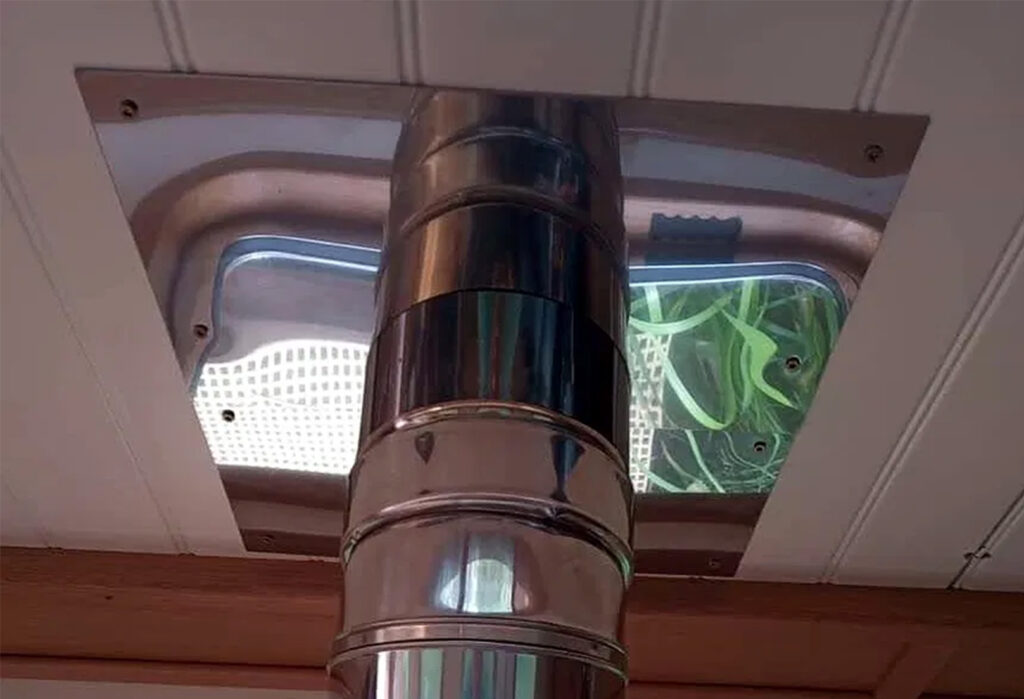
An insulated stainless steel twin-wall flue running all the way up to the ceiling, where it passes through a ceiling plate (fire stop plate) and out through the cabin roof.
Protecting the woodwork
Most boat cabins are lined in timber, and timber doesn't like being kept warm for years on end. The standard and the BSS set a strict limit on how hot woodwork near a stove may get, because beyond that the wood can start to break down through a process called pyrolysis, which is a serious fire risk.
The most common problem I find is a single layer of tiles or cement board fixed straight onto the wood next to the stove, whether a wall, a cabinet or a step. Heat simply passes through it. I once removed an old stove to fit a new Salamander Hobbit. When the tiling came away, the timber bulkhead behind it, protected only by a thin 10 mm cement board, had turned to charcoal. It could have gone up at any moment.
The arrangement I use is the one shown in the Soliftec guide to installing stoves on boats, published on the BSS website: a 10 mm air gap behind 25 mm calcium silicate board, with a clear gap between the board and the stove, and the panel running well above the stove's top. The air gap stops heat conducting through the board straight into the wood behind.
As a rough guide, heat protection less than about 40 mm thick from wall to face needs further investigation. The exception is a stove with its own tested, built-in heat shields, like the Go Eco Adventurer supplied and fitted by Marine Heating Solutions, shown below.
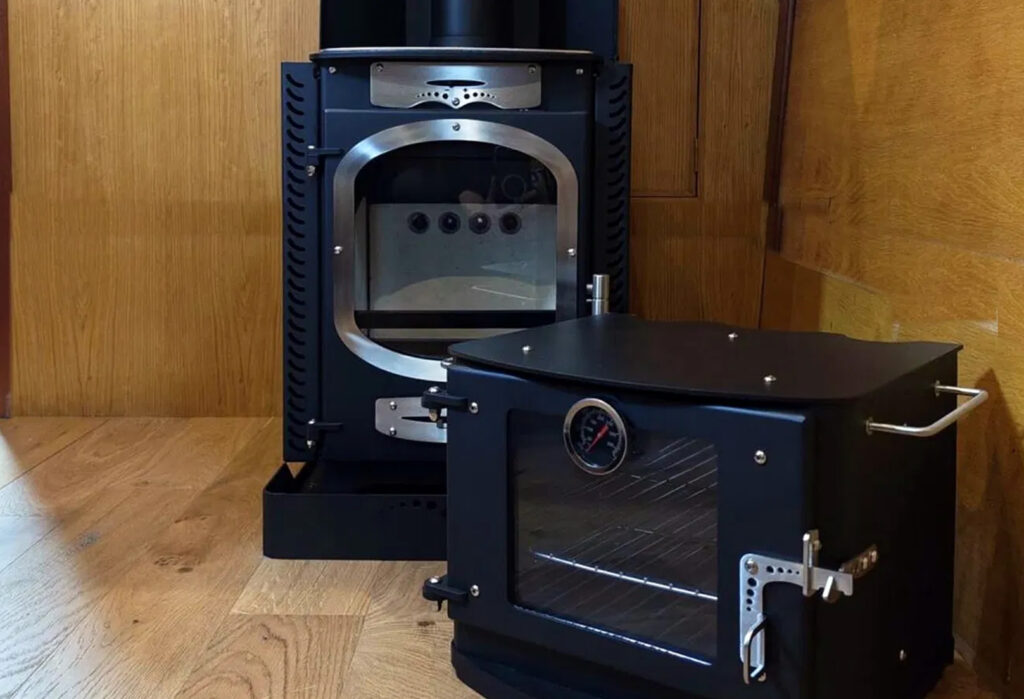
Go Eco Adventurer, oven lifted off: bolt-on hearth and heat shields, tested by the maker. Fitted free by Marine Heating Solutions with the narrowboat kit.
Enough air, and a CO alarm
Solid fuel stoves use a great deal of oxygen. The bigger the stove, the more fixed ventilation your boat needs, split between high and low vents. BS 8511 added a stove allowance to the ventilation formula the BSS uses. Fixed vents should never be covered up. If a vent makes the boat draughty, it's in the wrong place or the wrong size.
Carbon monoxide alarms show how far things have moved since 2010. The 2010 code only asks for owners to be pointed towards fitting one. Since April 2019 the BSS has required at least one CO alarm on nearly every boat with accommodation, and recommends one in the same space as the stove.
Three quick checks on your own stove
• Is your flue insulated all the way from the stove to the roof?
• Do your stove's instructions say it's suitable for a boat and a short flue?
• Are your vents open and clear, and does your CO alarm work?
Read the full guide
I've gone into more depth, including how insurers view installations, in my full guide to why boat stove installations should go beyond BS 8511.

Sebastian Meier is a Gas Safe registered engineer, OFTEC certified technician and Boat Safety Scheme examiner with nearly 20 years' experience on the inland waterways. He runs Marine Heating Solutions, installing and servicing LPG, diesel and solid fuel appliances on boats across England, Wales and southern Scotland.