caspar
Roger the Lodger was one of the less popular people who came to stay at the museum to help me to mind the boats. He was quite rotund, rather arrogant with a posh voice and a generally haughty air. He claimed to be related to a Duke. If about 300 of the correct people were to suddenly die, he would inherit the title, and he had a plan!
The museum basin was not fenced off and was effectively a public footpath. In the evenings the dock policeman would walk through on his rounds. At 7.30 am a line of small men would walk through, as though intending a rendezvous with Snow White. At about 4.30pm they would return. What they did in between was a mystery. One, the, er, heaviest of them, sat all day in a little office burning coal on his fire. The rest inhabited a workshop, equipped with comprehensive but outdated equipment. Whenever I went in there they always seemed to be reading newspapers, but they were always eager to help by making things for me. Excited to have some work to do.
At other times teenagers might appear when the museum was shut, some just having a look, but others bent on mischief. I once came upon a bunch of lads beside the toll house and noticed bubbles in the water, not far from where my motorbike had been parked. They were fast runners!
In the daytime there were the Job Creation workers, constructing ornamental walls around the site. This was a scheme for keeping people employed, using government money, in a time of recession. Most of them quietly got on with their work, but one was vehemently opposed to work and organised others in a revolt that substituted loud mouthed and uncouth behaviour for actual effort. I’d had several clashes with him.
One of their least popular tasks was cleaning reclaimed bricks, of which there was a pile near the moorings for visiting boats. One day, whilst they were pretending to be engaged in this, a steel boat tied up on the moorings. Shortly after, a man came running into the museum to complain that his boat was receiving a bombardment of bricks. I went to remonstrate with them, and in particular their leader, who told me, in fluent Anglo Saxon, to do something anatomically impossible. I had no option but to discuss the matter with their supervisor. They were sacked.
By now, because the museum was open 7 days a week, the boats were not clustered away from public access at night. Next morning I found that several had superficial damage and one, a little weed cutting boat, had been sunk. It was obvious who had done it but, before the days of universal CCTV, I had no proof.
I consulted Roger, and we quickly agreed that we needed a dog to improve night time vigilance. I took a train to Liverpool, then a ‘bus from the Pier Head to the suburb of Allerton, where the RSPCA had their animal shelter in those days. I was shown into a concrete yard surrounded by prison cells with canine inmates. The prices were £11.00 for a pure breed and £8.00 for a mongrel. A mongrel it would be then, but which one?
I walked round and round the cages and soon worked out that there were two types of dog, those that barked all the time and those that lay still and looked depressed. Who can blame them. Perhaps they knew that, after so many days unclaimed a nice vet would give them that final calming injection.
There was one exception, a scruffy long haired black mutt of average size. When I approached his cell he got up and barked. When I moved on he lay down quietly. Clever dog, I thought. I’ll have that one please! He was released from his prison and immediately ate another dog’s dinner as well as his own. I attached a length of string to his collar, handed over £8, and we were off.
I doubt if I could get a dog from the RSPCA nowadays. I’m told that they won’t let an animal go unless they’ve made sure that it’s new home will be the height of luxury.
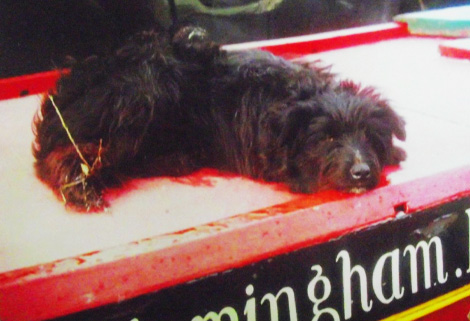
Back at the museum I introduced our new colleague to Roger, who decided that he should be called Caspar. I’m not sure why. He was named after one of the three wise men of the Christmas story, but the connection never seemed clear to me.
Caspar seemed to know immediately what his job was. We converted an unused section of steambox into a kennel for him. If anyone he didn’t know walked through the site out of hours he would follow them, barking rhythmically but not threateningly. Just letting them know.
In the daytime Casper was friendly with visitors. He was an expert at working school parties for titbits, especially when they brought packed lunches and he could work his way along a line of kids, begging sandwiches and crisps.
Caspar had the run of the museum and there was nothing to prevent him straying, but he rarely did. If I went away for a time, perhaps visiting my parents in Northamptonshire, someone else would be left to guard the museum and feed Caspar. I would usually return via Chester station and cycle the 8 miles to Ellesmere port. There were 3 different routes I could take. Whichever way I went, Caspar would meet me about a mile from home! The ability of a dog to detect a distant bicycle is uncanny.
Sometimes I would see him sitting patiently at the visitor moorings for no apparent reason. Out on the farm moorings at Croughton lived a retired seafarer called Bill who had adopted a stray cat. The cat had trained him to supply it with only the most expensive cat food. Every month Bill started his engine and boated to Ellesmere Port to buy his copy of a waterways magazine from the museum shop. Casper had heard the distant sound of Bill’s engine and was awaiting his share of the delicious cat food.
Roger moved to Liverpool. He bought Mosquito off Dave but abandoned it. Caspar eventually moved with me to Runcorn. As he got older he developed cataracts so I took him to a special eye vet but was told that if he operated there was a 50% chance of him losing his sight altogether, so I should leave it for the time being. He carried on guarding the Runcorn boatyard, sometimes bumping into things. Aged about 12 he went off his food. The vet found that he had advanced stomach cancer, so we had to say goodbye.