
Roydon Marina
We spent the first few days in the marina finding our way around and getting to know our new neighbours, all very laid back and chilled out, just what we needed after two weeks continually on the move. The people around us were very friendly and welcoming and we slipped easily into our new way of life, it was becoming everything we had hoped it would be. We had a great sense of achievement, having travelled from Watford, via the Grand Union, Regent and Hertford Union canals, and the rivers Lea and Stort, to Roydon marina, not bad going, we thought, for our first ever cruise on a canal boat. It was good to finally relax though, knowing that tomorrow there would be no locks to work, no bridges to negotiate and no worries regarding the electrics; all that was behind us, we had started a new chapter in our lives.
Since setting off from Watford we had travelled every day, but now that we were in the marina and had reached our destination phase one of our plan was complete, but it felt a little strange to be stationary. We had been so focused on getting to this point that we had given no thought to the next phase of our adventure, how to market Art Deco as a short break destination. It seemed so simple and easy when we were living in our flat in Sheffield, overlooking the canal basin, watching the boats come and go, but now we had to get down to reality and make some firm plans. The difficulty was though, the more we discussed our future, the more difficult it seemed to become.
The first problem was that the marina was registered as a leisure facility and no business was allowed to be conducted from it, we could not even use it as a postal address. The other problem was the fact that we did not see the attraction of the area, there was simply not enough to offer guests, either from the river or the surrounding area. We had not been thorough enough with our research; we were naïve, thinking that the Lea Valley Country Park would have enough in itself to offer. In fact the ‘park’, in reality is a narrow corridor that follows the course of the river; move a half mile from either side of it and you are into an industrial landscape. No matter which way we looked at it we could not see a way to make it work. It was not a disaster, we had not planned for it to be a full time job and pay a wage, it would be something to do now and again, and hopefully meet some interesting people along the way. We decided to put the plan on hold for a while and enjoy the time leisure cruising, something we had not been able to do on our journey down.
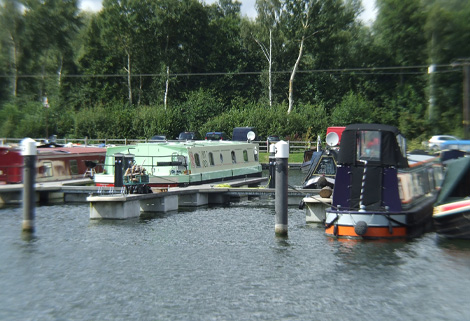
Our mooring in Roydon Marina
This delay allowed us to finish a few outstanding jobs on Art Deco. As I have mentioned before, things were rushed with the build towards the end and there were a few items that did not get finished. I had designed a fold down dinner table for the saloon, consisting of a wooden frame with screw on metal legs and a glass top, etched with the Art Deco rose. The builders had made the frame but had not had time to fix it in place, so that was one job that needed completing. We had chosen oak flooring throughout the boat, but it was quite cold to the feet, so we decided to carpet the two sleeping cabins, job number two. Last job was fitting a stove in the saloon which we had purchased at the Crick inland waterways boat show the previous year. We thought that it fitted our modern style of boat perfectly and I remember saying to Joyce at the time that it was much better than one of those black cast iron stoves normally seen on narrow boats. How wrong can one person be.
I was completely taken in by the salesman, believing everything I was told about his revolutionary new take on a boat stove. It was a contemporary design made from stainless steel, clean burning, it didn't need a flue as there were no fumes and was simple to install. I had the builders fit a small shelf diagonally across the right hand corner at the front of the saloon and the stove was simply suspended underneath. It really looked the part, sleek and modern and it fitted perfectly with our minimalist approach to décor. The fuel it burned was ethanol, a clean burning liquid which sat in a trough at the base of the unit. There were artificial coals, shaped to look like pebbles masking the fuel and when it was lit the flames danced amongst them, all very pleasing to the eye, but completely useless as a boat stove.
What a disappointment it turned out to be! It gave out very little heat and, as we found out later, when ethanol burns it creates its own volume in water, absolutely useless in the confines of a boat. After a few minutes of use the walls and roof of the boat were running with condensation! That was it, I fired up the lap top and found a Morso Squirrel stove for sale on Ebay, which our daughter and son-in-law collected and brought down a few weeks later. The black cast iron stove that I had been so critical of in the past, was perfect and served us well throughout our time on the boat. The old adage; if it ain't broke don’t fix it, came to mind and I was more than willing to eat my words. Pete, one of our new friends in the marina had been a marine engineer and he fitted the Morso for us and wouldn’t take any money for the work, a favour among friends he said, words we would hear time and again on our travels on the rivers and canals.
The ethanol stove was so short lived that unfortunately we have no photographs of it, we were so eager to get rid of it! I did try to contact the manufacturers, but, surprise, surprise, they had ceased trading. We eventually sold it on Ebay, after stating in bold capital letters that it was not suitable as a heat source. The lady who bought it was going to use it as a feature for a summer house, at least it would be used and we got a bit of money back, so not a complete disaster.
There was still one major problem that needed solving, the bow thrusters. The thruster tube was now 75% submerged, the thrusters did work but not as efficiently as they should, that last 25% needed submerging. More ballast was needed and for once we had a stroke of luck. A wide beam barge just along the pontoon was being renovated, and can you believe it, they had too much ballast! The owner was delighted to let us have it, he had been wondering how to get rid of it and we were only too pleased to take it off his hands: a win, win situation all round. We borrowed a wheel barrow and transferred the concrete blocks from his boat to our front hold and put them on top of the blocks we had installed at Watford and it worked; the thruster tube was now fully submerged.
Ware
To celebrate we decided to take our first cruise out of the marina, to the town of Ware on the river Lea. It would mean going back down the Stort. We had already concluded that Art Deco was too big to get any further up river, Roydon bridge being far too low for us to get under. The river was very busy as we set off; a temperature of around 30 degrees was forecast before thunderstorms arrived over the coming weekend. Traffic and boats moored close to the locks made for slow progress, but this was a leisure cruise not a race so we settled into it. We came upon Stanstead Abbots an enticing village complete with a village green, beside which was a traditional looking pub. We would have liked to stop and have a look around but the moorings were full, so we travelled on.
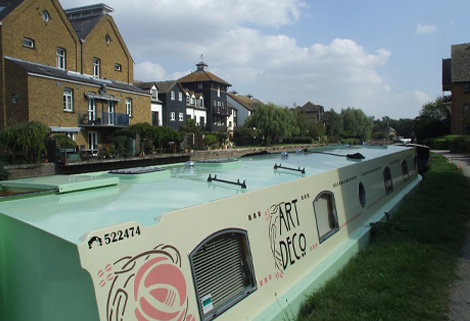
Our mooring in Ware
I had consulted Nicholson again, and there was a warning notice regarding Stanstead lock, stating that the top paddles gave an unexpected rush of water into the lock chamber, catching out the unwary and to make things even more difficult there was a swing bridge over the lock, which had be opened before entering. So we approached with apprehension. There was a boat coming from the opposite direction just entering the lock so we helped them operate the lock and sure enough as the top paddles were opened there was an amazing sight, as torrents of white foaming water rushed into the lock, fortunately we were prepared and there was no problem. In the end we negotiated the lock with ease and carried on our merry way, thankfully there was just one more lock to go, the lock gates were massive and heavy, and it was a struggled to open and close them. Now we realised why some people just sat aboard their boats and stayed in the marina, the locks in both direction on this river take some man-handling, cruising the Lea is not for the faint hearted.
The river bisects Ware high street by means of a very low bridge; we would have not been able to travel any further had we not sorted the ballast problem, but we were through the town before we knew it. We turned around just before Ware lock and found a lovely spot to moor next to Town Bridge. Ware is famous for its 18th Century gazebos in the gardens of the houses backing on to the river, they were renovated in the 1970s, and they are as charming as the town itself. It was 4.30pm by the time we were moored, it had taken us five and a half hours, with a break for a spot of lunch. This was turning out to be a challenging trip, so we decided to stay over and sample the night life of the town. Ware is a great place for a pub crawl, there are dozens of hostelries within a short walk of each other. We only tried one or two of them though; there is nothing like a day wrestling with heavy lock gates to tire you out. During the night we had thunder and lightning, the storm had arrived early, but by morning the sun had returned and the prospect was for another hot day.
We set off early, while it was relatively cool, determined to make better time on the return journey and remarkably we did, getting back in just two and three quarter hours. Granted two of the locks were open and ready to receive us, but still halving the journey time was rather satisfying, we were getting good at this boating game!. We did have one problem on the river Stort as we were coming towards Low Lock. The wind caught hold of the boat just as we reached an enclave of moored craft and we hit one of them, it was a gentle bump and no damage was done to either boat. Luckily the owner was very understanding and, when he asked if we could take a couple of his friends and their luggage back to Roydon Marina we were glad to oblige.
As we entered the marina I decided to try running the boat on the electric drive, and I loved it. Cruising along with no sound at all was very relaxing, but it did not have the power of the diesel engine which we had to return to in order to moor at our berth. Pleasant as it was cruising on electric drive, it did use a lot of power, not a problem today because we have shore power at our berth, but if we were away for any length of time it would not be practical. Our long term aim is to become ‘constant cruisers’ and the only way we will be able to charge the batteries when we are cruising is to use the diesel engine.
All in all it was a very successful first leisure cruise, the hybrid worked well in both charging and electric drive mode and it gave us confidence to travel further afield, something we were both looking forward to. As we planned to become "constant cruisers" we decided to get ourselves some professional tuition regarding boat safety and handling so we booked ourselves onto the Inland Waterways Helmsman Course, a course that one of our neighbours recommended.
Training Day
The day of the course arrived and Paul, the instructor was with us by 9.40am. The first lesson of course, was a lecture on Health and Safety, I shouldn’t be cynical, there are all sorts of hazards waiting to catch you out both on and off the boat. This was followed by a lesson on rope handling and knot tying. Joyce is left handed and found it extremely difficult especially when the tutor demonstrating is right handed, but she managed okay. Finally the theory was over and we cast off ready for the practical lesson with me at the tiller and Paul at my side. The progress was slow, Paul was quite meticulous, every part of boat handling and lock management was explained in the minutest detail, all very informative and we soon came to realise the importance of the course and just how little knowledge we had. A lot of time was spent learning the correct way to enter a lock and throw the mooring rope over the bollard and securing the boat in the lock side.
The most useful tip that Paul gave me was to use short bursts of the throttle, with the tiller positioned fully to the right or left, depending on which way you want the boat to go. It gives you good sideways motion with little or no forward motion and makes manoeuvring in tight spaces very easy and much less stressful. Lunch time was approaching so we moored at Dobbs weir and had sandwiches on the boat, courtesy of Joyce and a much needed pint at the Fish and Eels. It had taken us four hours to travel two and half miles, but we had negotiated four locks along the way, gaining knowledge of "best practice" regarding lock management. We will never approach a lock again in the way we had previously done.
Lunch over and panic set in when Paul announced that Joyce must take the tiller and bring the boat into the next lock, after all this was a helmsman course and to get her licence she had to prove she was competent handling the boat. She had taken over once or twice in the past when I needed a toilet break, but had not done any precise manoeuvres, but now she had to step up to the mark. The river was busy with people enjoying a pleasant Saturday afternoon, and Joyce was doing well until we approached the first lock where we came upon two hire boats full of young adults in party mode. Against all the odds she managed to moor the boat on the lock side and then entered without any problem, with only a little help from Paul. Through the lock safely, she turned the boat around to head back towards Roydon, fully expecting this to be the end of her tuition. But no, she had to take it back though the lock, negotiating a tight bridge on the way. The young people on the day boat were about to close the lock gates before we had time to enter until Paul shouted for them to stop, which to their credit they did and helped with the lock, nearly knocking one of themselves out with the windlass in the process.
We travelled up the Lee and made the turn onto the river Stort, where I took over again for the run up to the marina. A strong wind had developed and I knew I would have a problem mooring the boat stern on, and after two failed attempts Paul took over and using his theory of short throttle bursts in forward and reverse managed after a few aborted attempts to get us moored. The lessons we learnt will be put into practice and will make our life as ‘continuous cruisers’ much easier and more enjoyable. We both showed we were competent handling the boat and received our Helmsman licence; a good day's work and well worth the effort.
Decisions...
With our teething problems behind us we were able to give some thought to the future. The marina had provided just what we needed at the time, a stable environment to get used to the big changes in our lifestyle and a place to get all the boat problems sorted, but it had never been our long term plan to stay. We had enjoyed our time there and had made some good friends, but we thought it was time for us to move on.
We spent a lot of time researching which would be the best waterway on which to offer Art Deco as a short break destination and there was no contest, it would be the non-tidal section of the river Thames. Based there we would have just over 90 miles of river to cruise, from Teddington tidal lock in the east to Osney lock at Oxford in the west. We would have preferred to have the option of travelling into central London but that would mean getting a licence to cruise the tidal Thames and being a commercial waterway it is far more regulated than the non tidal section. Art Deco would need a VHF radio and we would need a certificate to operate it, and a whole host of regulations regarding boat safety to conform to. After a few conversations with folks who had tried it we decided it wasn’t worth the bother, we would be quite happy with the non tidal Thames There would be plenty of interesting places to visit along the section we had chosen, towns and villages such as Henley, Marlow, Kingston and Oxford along with the jewel in the crown, Hampton Court.
We pencilled in early September as our leaving date, by that time we will have spent around three months in the marina, long enough, we wanted to travel further afield and try out our business plan. If things went well we could start welcoming our first guest aboard Art Deco in the spring of 2015. The Saturday evening before we left the marina we invited all our new friends on board Art Deco for drinks and nibbles to thank them for all the help and advice they had given, and to say good bye. It was a great evening and went on well into the night and we promised to keep in touch and planned to return for a Christmas get together in the local pub in December. The following Monday we filled up with diesel and water, pumped out the effluent tank and left Roydon Marina for good. We would be returning in December, but not aboard Art Deco, she will be moored on a waterway somewhere near a railway station where we can get a train to Roydon.
Our travels begin, and a meeting with 'Mad' Jack
We would enter the Thames via the Grand Union canal at Brentford, retracing part of the journey we had made from Watford, and we were looking forward to it. On our way to Roydon we had been so keen to get to the marina that we had seen very little of the surrounding area, passing through towns and villages as quickly as possible, having “no time to stand and stare” to borrow a quote Wordsworth. The Thames and our business plan could wait a while, we wanted to take life easy and enjoy ourselves, after all that was the main purpose of this adventure.
A little further up river from Ware is the town of Hertford, the end of the Lea navigation for all but small craft, so it seemed logical to start our journey to the Thames from there. On our way we stopped in Ware for lunch and as we sat on the back deck having a beer, a little 40 foot narrow boat pulled along side and the skipper called out, “I’ve been looking for you guys, heard you're the boat with the fancy hybrid engine.” “That’s right I replied, how do you know about it?” “I’m Morrison” he replies and I know everyone and everything that goes on on this river, and without being asked, he tied up against us and jumped aboard! “That beer looks good” he said with a smile as he made himself comfortable, so I went below and fetched him a cold one.
This was our first encounter with one Jack “Mad” Morrison. He was a character of indeterminate age and according to him had lived alone on his boat ‘Bounty’ for as long as he could remember. He says he knows everyone and everything that happens on the Lea. He was a marine engineer and was keen to look at our engine, so I opened the engine hatch and he had a good poke around, stating that it looked very impressive. He asked where we were heading and when we tell him he replies, “great! that’s where I’m heading, follow me, I know the best places to moor. We travel in convoy and at Hertford lock, three of his mates joined him on board and once through the lock we all carried on our merry way. We were apparently heading for the basin at the end of the navigation, a few good pubs there he tells us, but I know from the Nicolson that there is a low bridge just before the basin, we will have to take it steady.
Sure enough, up ahead I could see the bridge, and as we get closer I know it’s going to be tight so I pull into the side and stop, not wanting to chance it. It is a modern concrete bridge that carries the A10 trunk road over the river in a single span, very wide but also very low. Morrison saw us stop, turned around and came along side to ask what the problem was. When I explain an argument erupted, he said we will just make it, I disagree, but he is so persuasive that I agree to try, on the understanding that I can abort at any time. He agreed and followed Art Deco up to the bridge, but as I get close I see that we won’t make it so stop mid stream. To my astonishment his three mates jump aboard and push on the underside of the bridge, lowering the boat slightly and shout to me to keep going forward. I comply, but they soon tire, and we ended up stuck under the bridge. Morrison came along side and tied Bounty to Art Deco climbed aboard and as I engage reverse the four of them pushed on the bridge roof and we slowly reversed our way out.
Thankfully there was no serious damage just a few scratches, but the river at this point is not wide enough for us to turn around, we will have to travel in reverse all the way back to Hertford lock, over a mile away. Morrison agreed to take the tiller, and to his credit did a brilliant job but when we got to the lock the river still was not wide enough so the boat had to go through the lock in reverse. Fortunately at the other side we were able to turn around and found a mooring spot just below the lock. We feared that we would be stuck with them for the night, but they were keen to get away and thankfully went on their way to Hertford, no doubt to enjoy the delights the pubs had to offer.
After breakfast the following morning we walked into Hertford and spent the morning looking around the town, stopping off at one of the many pubs for lunch before returning to Art Deco in the late afternoon. We didn’t see sight of Morrison or his boat that day and I thought that would be the last we would see of him, but Joyce admitted that she had given him our phone number, he was so persuasive she said! We spent a second night moored at Hertford lock, it had been an eventful cruise, but we had to admit it had been quite exciting and we enjoyed it immensely. We were in no hurry to move on, the CRT ( canal and river trust) who are responsible for the waterway state that unless there are notices to the contrary, any craft can moor in one place for a maximum of fourteen days. We liked the mooring and Hertford was only a 30 minute walk away so decided to stay a while.
“Dave, want some cheap diesel?” I recognise Morrison’s dulcet tones and hesitated, we were running low on fuel its true, but did we really want to be involved with him again? Joyce is asking who’s calling and when I tell her she is frantically motioning NO! “25p a litre” he says, we were paying upwards of 50p at the time, it was a tempting offer but before I have time to answer he says “meet me at Stanstead lock tomorrow afternoon” and ended the call.
What were we to do? It seemed too good a deal to miss, so after weighing up the pros and cons we decided to go, we would be heading down river in a few days time, far away from his stamping ground. It was only a short cruise down river the next morning, through Ware and Hardmead locks and sure enough as we approach Stanstead lock we saw Bounty moored just above with Morrison on deck to greet us. He is alone thank goodness, his mates are gone and he is his charming self, flirting, as ever with Joyce. Moored in front of him was a wreck of a boat, it must have been a working barge back in the day, but it was now long past its sell by date.
He climbed aboard and instructed me to come along side, tying me up midships. “Un-screw your fuel cap” he said as he reached down into the barge’s hold and pulled up a hose which he fitted into the fuel tank. There was a small in - line pump attached which he switched on and eventually fuel could be seen flowing through the clear tube and into my tank. This went on for what seemed a long time, but was probably less than 10 minutes before the tank was full. I replaced the fuel cap, he untied me and as I moored Art Deco by the lock he disappeared into a small cottage a few meters up the tow path. He returned shortly and said “wait for me at the Fish and Eels” which was just down river at Dobb’s weir. We obligingly obeyed his command and as we sat with a drink in the garden of the pub, we wondered if we had just been involved in some sort of crime? It all seemed very clandestine and we had seen no money change hands. Soon the distinctive chug of Bounty’s Lister engine interrupts our musings as he approaches and soon he is sat with us, pint in hand. He has a twinkle in his eye as he asks ”have you got a fiver Dave?” I take one out of my wallet and hand it over to him and as he takes it I start to question him, but he gives me a wink and says “ask no questions, get no lies”.
River Lea
Travelling down the Lea a few days later we came to Broxbourne, and there was a mooring free near the town centre so we decided to stop and have a look around. It looked quite an affluent place sporting lots of independent shops and a couple of large supermarkets, a good place to stock up we thought. Back in the marina we had relied on the internet to order our groceries, Tesco would deliver right to the boat, but that was not an option now, we had to get our own shopping. We liked the look of the place so we decided to stay a few days. The south east of England is unknown to us, apart from a few visits to London, so we wanted to explore more than just the immediate river side.
We had an enjoyable few days looking round the town and surrounding area before we set off again down river in search of new adventures. We were approaching Waltham Abbey, a place where we had overnighted on our way to Roydon and thought it deserved a better look. We found a mooring just by the bridge and as it was a lovely afternoon we found a decent looking pub and had drinks in the garden. We spent a couple of days in the town, then it was off again down river, through the imaginary portal that is Enfield lock and carried on down river before mooring for the night just below Tottenham lock.
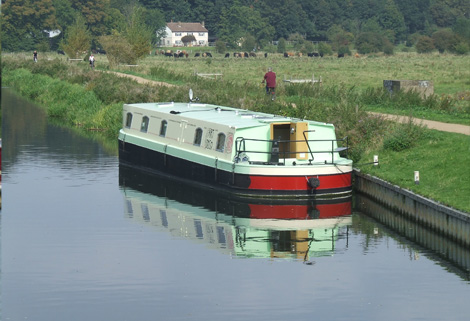
Art Deco moored just below a lock
Once again we were very much in an urban landscape, gone are the green fields and rolling countryside, to be replaced by factories and warehouses and the grimy moored boats added a sort of ‘edgy’ feel to the place. but the light was fading, we were tired and needed to eat and rest. As we were securing Art Deco a lady from the boat in front came over and explained that a body in a suitcase had been fished out of the river that morning, the police had just left she said, “I’m on my own and don’t feel safe around here, I’m moving off first thing in the morning.” It seemed a bit of an extreme reaction to us, we had hoped to stop for a few days and decided not to change our plans, after all lightening doesn’t strike twice, or does it?
We spent the following day looking around Tottenham Hale, we needed supplies and Google maps showed Tottenham High Street nearby, the only problem was that to get to it we had to go down, and I kid you not, (look on Google maps) Carbuncle Passage! The name certainly fitted the area, it was a run down and neglected place so after stocking up we decided to move on the following day.
The next morning I did my usual engine checks but as we prepared to leave the engine would not start, very unusual - it always started with the first turn of the ignition. I was taught to always look for the simplest solution first, so did we have fuel? Of course we did, we had filled up courtesy of Morrison not long ago, but I thought I would check anyway. Art Deco did not have a fuel gauge, it had a dip stick instead, so I unscrewed the fuel cap, dipped the tank, and to my astonishment there was no more than a few millimetres of diesel showing on the stick. Some b*****d must have syphoned the tank in the night! We needed to get diesel and after asking round a few fellow boaters, without luck, I found the nearest petrol station on Google and set off walking the three miles there and back. I had to buy a container and of course roadside fuel stations do not sell red diesel, road diesel is exactly the same fuel without the red colouring, but as it’s taxed it is more expensive. The cost of the container and 2 litres of fuel cost me more than the full tank I had from Morrison just the week before, payback time for our little scam!
As soon as I got back to the boat I put the fuel in the tank and we were away, vowing never to return. Fortunately, just down river was Springfield Marina where we would be able to fill up with red diesel. As the mechanic from the marina was filling us up I related our problem with the stolen fuel. He said they had locking fuel caps for sale in the chandlery, and if I moved down the pontoon, away from the pump, I could moor there and fit it. I paid him for the fuel and cap, moved down the pontoon and waited for him to return. He was gone quite a while and I was about to go and find him when he returned with the fuel cap and his tool box. “It’s not just a case of replacing your cap with the locking one”, he said, “the old fitting will have to come out and the correct one fitted in it’s place”. Without another word he started removing the original fitting and replacing it with the new one. An hour later, after drilling new holes for the screws, he had the locking cap fitted. He would not take any money for his work but I shoved a fiver in his pocket and told him to have a drink on me!
Before we left I asked if there were any visitor moorings in the marina, we needed somewhere to leave the boat while we returned to Roydon for the Christmas Party. He said they had a couple and I gave him the dates and he said he would reserve one for me. They also had electric hook up, another problem solved, I would be able to do a battery equalisation at the same time. We carried on down river and shortly, in the distance we could see the bright red structure of the Arcelor Mittal Orbit, the sculpture and viewing platform in the Queen Elizabeth Olympic park, so we knew we were approaching the turn onto the Hertford Union canal which would lead us to the Grand Union canal. As there were plenty of mooring spaces available on the river and we thought it would be interesting area to spend a few days, we were in no hurry, so we found a spot and moored up.
Queen Elizabeth Olympic Stadium
The following morning we went for a walk and were pleasantly surprised with our surroundings. The park itself was superb, being only a few years old, in fact the whole area was amazing, very modern and it had a good vibe to it. Later that evening after we had eaten, sitting with a bottle of wine we reviewed our present situation and started pencilling in a plan for the following year. We decided to travel up the Grand Union to Stoke Bruerne, the iconic canal village by the Blisworth tunnel. This seemed the logical place to start our journey south to the Thames, we would not be able to travel much further north due to the narrow locks around Birmingham. As we were well into autumn and with winter approaching we needed to find a area to base ourselves before continuing north the following spring. Somewhere safe, with amenities near by and an interesting cruising area. We didn’t want to be stuck in one place all winter, we planned to move around as much as the weather would allow, in fact we had to move to keep the batteries charged. The hybrid set up was such that the 48 volt alternator was attached to the flywheel of the engine, which meant that it only put charge into the batteries when the engine was in gear and the prop was turning. An option was to detach the prop shaft from the gear box, not too difficult a job, but I kept that as an emergency measure and luckily we never had to use it.
After much discussion and map studying we opted for the easy way out, stay where we were! It suited us perfectly, there was Old Ford lock just down river with a water supply and Elsan disposal, Springfield Marina up river with diesel and chandeliers, the large Westfield shopping mall just a short walk away and Stratford Station with overground and underground rail services nearby. The area was good for cruising too, and what looked like, some interesting places to visit, we even had easy access to Limehouse Basin with the river Lea running into it via the Limehouse cut.
It turned out to be everything we had expected and more, we had a wonderful three months in and around the area. We made our promised visit to Roydon for the party just before Christmas, leaving Art Deco in Springfield marina, hooked up to shore power. We had equalised the batteries before leaving so on our return all the cells were up to 100% and in optimum condition. The winter of 2014/15 must have been a ‘kind’ one, or am I looking back through rose coloured glasses? We certainly did a lot of cruising, not staying in one place for more than a few days at a time. The area we covered was between Broxbourne in the north to Limehouse in the south, some 30 miles of the river Lea, with many interesting places to see in between.
Characters
Being so close to central London, there were many folks living aboard boats, from individuals to families and everyone in between. We met a wide spectrum of ‘interesting’ people, those who wanted to ‘disappear,’ professionals who had full time jobs in the city and a few retired couples like ourselves. Living on a boat is a great leveller. One day we could be sharing a drink with an ex American air force fighter pilot who had ‘burnt himself out’, and the following day with the head of music at Middlesex university who insisted we go aboard his narrow boat because we didn’t believe he had a piano on board! Or chatting to ‘John’ the quiet one who didn’t share any personal information, not even his real name. Everyone was treated with the same respect, no one was judged.
At first we were surprised by the number of single women who were living alone on the river, but as time went by we realised that on the river there were small communities, grouped together who looked out for each other. There was always someone about, no matter what time of day or night it was, so crime was very low. Although some areas we moored in had a reputation as hot spots of crime, the river seemed exempt from it, we never experienced any or saw any, although I suspect that has changed now.
Once again technology played its part in helping these small communities to thrive. There was a Facebook group where boaters ‘met’ and shared experiences and offered advice and tips. The schedule of the fuel boat who delivered diesel, logs and coal, direct to your boat was posted. There were engineers who could fix any mechanical problems, carpenters, plumbers and marine electricians, in fact you could find all sort of help on the site.
The most useful aspect of the site though was the swapping of moorings. The CRT rules required that each boat had to move to a different spot every 14 days, and the site allowed boaters to swap places with each other. This usually happened in the early hours of the morning when you could safely move without anyone grabbing the vacated places. When we first arrived in the area we wondered why boats were moving around in the early hours? The answer was they were swapping places! It was a great community to be part of, everyone helped each other, it was like having a very large extended family around you and was very reassuring.
We didn’t restrict ourselves just to the river, we wondered further afield, mainly on foot, and Google maps was a great help. We were never bored, there was always something new and interesting to see and whenever we moored in a new place we consulted Google and then explored the area. We came across places we would never have seen if we had not been living this lifestyle, we thought ourselves very lucky indeed. Wherever we moored other boaters would come and talk to us, asking where we had come from and where we were going. It soon became clear that we were the exception: we moved around, whereas most of our neighbours tended to stick to the same general area, moving only every three weeks as the law demanded. It’s true, we were retired and had no commitments, where as most of our fellow boaters had work to go to, or kids to get to school.
Victoria Park and London
We cruised all the river Lea, but we always returned to the area around the Olympic Park, it was our base, a place to call home. On one of our walks, we came across Victoria Park, a place we had passed on our way to Roydon as we cruised along the Hertford Union canal. Unlike the Olympic Park this was a proper, old fashioned Victorian park, and it was beautiful, with well tended flower beds, a cricket pitch and lots of green spaces. On the edge of the park, away from the canal was ‘The People’s Park Tavern’, a great watering hole and a great place to eat. It was a community pub, run by the locals, and was a lively place with live music and dancing, performed in the large covered outdoor space. We wiled away many happy hours there and it will be remembered as one of the best pubs we found. In December the park was host to an eclectic market. Ignore everything you know or have heard about Christmas markets, this one was most defiantly different. There were none of the usual tacky goods normally associated with these events, everything on offer was hand made by local artists and craftsmen.
The park lies in the borough of Hackney, which is home to many small businesses and is a real bohemian place, frequented by artists, craftsmen and musicians who have their studios and workshops there. The cafes and bars reflect this and were wonderful places to sit and chat. It came as no surprise to us that many of the customers lived on the boats moored on the canal. In the summer months some of them cruised the canal system, selling the items they had made and there was always a pub to be found where local musicians were playing. It was our favourite place on the Lea and we have a lot of happy memories of the time we spent there.
We enjoyed visiting central London and managed it many times over the winter. Most of the time we opted for the tube from Stratford underground station, but that meant we had to return the same day. If we cruised there on Art Deco we could stay in Limehouse Basin for a maximum of three nights as visitors, paying £10 a night. The problem with this option was the fact that it wasn’t an easy journey, lots of moored boats and tight bends to negotiate and the scenery could only be described as grim. There is a saying which states “It's grim up north”. Well, we come from the north and I can honestly say that I have never seen any place in the north as grim as the Limehouse Cut. It basically consists of a concrete channel cutting through a run down urban landscape. That aside, once we were in the basin, we loved it. We could spend all day wondering the capital, find a good pub in the evening for a meal and a few drinks, then walk back to the boat, it was wonderful. One of our favourite pubs to visit was ‘The Grapes’ a short walk from Limehouse Basin and owned by Sir Ian McKellen, in fact on one of our visits he was ‘holding court’ sat at the bar, surrounded by his admirers.
We liked Kew Gardens and made many visits over the months, Christmas time being especially memorable when the gardens are illuminated. The Grand Union Canal enters the Thames at Brentford opposite the gardens so it was a good place from which to survey the river and familiarise myself with the layout. This stretch of the Thames is the tidal part and it’s about a 5 mile cruise upstream to Teddington where the tidal lock is situated, upstream from there is the non-tidal Thames. Boats like our’s are allowed on this stretch without the necessary licence as long as they make the journey in one go and without stopping. A slot has to be booked at the lock and exit is allowed only at slack water which is usually around 2.5 hours either side of high tide. We spent our first Christmas on the boat by the Olympic Park, enjoying Lobster Thermidor for Christmas Day dinner, purchased from a restaurant near by followed by a walk in Victoria Park and a few drinks in The People’s Park Tavern. It was very different from the family Christmas dinners we were use to but thoroughly enjoyable.
