
lilith
the genesis of an obsession
It was October 1974 when I arrived in Chester on a pair of floating chicken hutches. My intention was to live aboard my humble craft for the next 3 years whilst attending the nearby Chester College with the aim of becoming a teacher.
I soon discovered that I had innocently sailed into a conflict between posh boaters and ‘undesirables’. Because of my ramshackle boats, I found myself classed in the latter category. As one of the chief ‘undesirables’ decided to emigrate to Holland he had to dispose of his assets here. This gave me the opportunity to buy a full length boat for £100. A simple BCN joey.
The boat carried a metal plate in each end with the number 9 painted on it, her Stewarts & Lloyds fleet number. She had been part of the huge fleet that used to carry products from Coombeswood tubeworks. Her top bends were painted yellow, denoting that she had later belonged to Alfred Matty, canal contractors. I later discovered that one of the tricks of the seller was to tow away unattended boats, sell them to several people, then disappear, leaving his victims arguing about who was now the rightful owner. Happily. I was never challenged about the ownership of number 9.
At the time I was engaged to an R.E. teacher called Kathy. The romance of the canals had really got to me and I envisaged a future living in a back cabin. She saw herself enjoying life in a nice semi detached suburban house. We compromised on a full length conversion of our new old boat. When she visited to view our future home, I pointed out that the boat needed a name. “Call it ‘Lilith’” she said, explaining that it was Hebrew for a screech owl and that she’d solved someone’s final crossword clue that day by knowing that fact. I won’t go into the mythology around Lilith, but, suffice it to say that it’s rather more than her explanation and evokes strong reactions from people of particular religious affiliations. Anyone wishing to know more should search on t'internet.
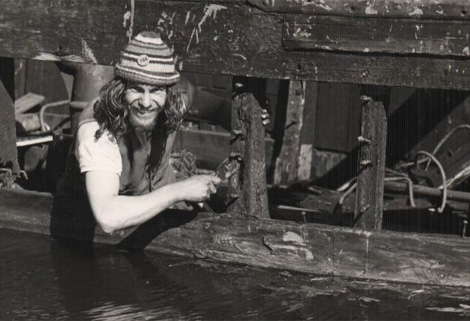
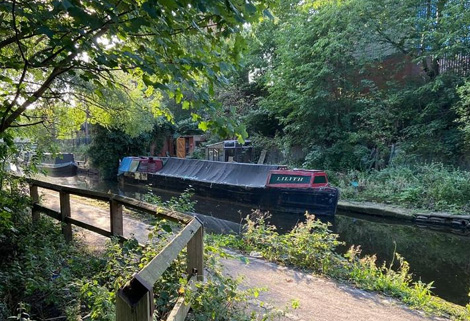
I found a mooring for “Lilith” on a farmer’s field halfway along the Wirral line of the Shroppie. It cost 50p a week! It was clear that before beginning the conversion I would need to do some work on the hull. Opposite my Chester mooring was Taylors boatyard. Alan Parry was busy there rebuilding a classic Taylors cruiser, “Barbara Joan”, which had been burned out by vandals. I asked him where I could get some oak. He advised that I shouldn’t waste my money on oak but should just go to the local timber merchant and buy lengths of red deal. “It’s just as good” he claimed. I was puzzled by this but took his advice as he was a proper boatbuilder. Eventually it dawned on me that he was just being kind. He assumed that, like most wide eyed youngsters that start doing up an old wooden boat, I would soon give up. He wanted to protect me from wasting too much money.
Work really started in the Easter break in 1975. I bought the longest piece of 2” X 8” red deal that they had at the local builders merchant and somehow balanced it across the saddle and handlebars of my folding bike, then carefully pushed the contraption the mile to my boats. I loaded it on to the roof of one of my tatty craft, then set off to deliver it to “Lilith”. I chipped out a plank, cut rough scarph joints on the ends of the new plank and bolted it into place. As I removed one plank, those around it started to disintegrate, so I repeated the process on them.
Soon I got to planks that were curved and so the wood needed steaming. I had no equipment so I approached Alan Parry again. He lent me a gas fired industrial wallpaper stripper to generate steam. David Jones, who had taken over Taylors yard, let me use some space and the master boatbuilder, Arthur Howard, lent me some big G clamps. I put the plank into a long plastic bag, scrounged from a carpet shop, then led steam from the wallpaper stripper into it for a couple of hours.
Whilst the plank was cooking I set up a crude former. I put a stout wooden beam on to blocks so that it was off the ground, then put two more blocks on top of this at what looked like the right distance apart. When the plank was ready I removed it from its bag and laid it on top of the blocks, then used the clamps to bend the floppy plank down to touch the beam halfway between the blocks. I would then lash the plank down so that the clamps could be removed and returned to Arthur. Next morning I would release the plank, now hardened to its curve, load it upon to the boat roof and take it out to “Lilith” for fitting. This method would not work on most boats. Luckily, joeys are of a simple shape with no complex curves or twists.
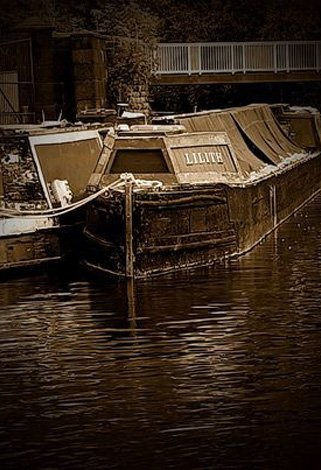
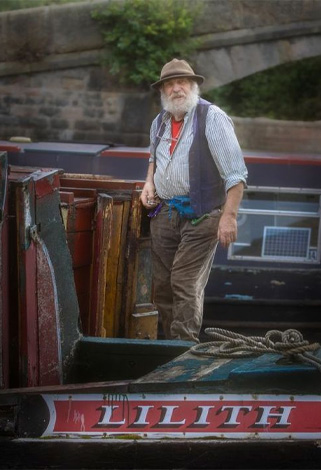
In the 1970s ex Stewarts & Lloyds joeys were everywhere as they gradually dispersed their fleet. Of all the wooden joeys that in every corner of the network, I’m only aware of 3 survivors. Birchills resides in the Black Country Living Museum. Daisy now belongs to Forces Veterans Afloat and has been somehow re-bottomed in steel. Someone kindly did some research and discovered that No9 was originally built in 1901, though how much original material survived is a moot point. As Lilith she is now celebrating her 125th year, though more than 50 years after her restoration began, she now needs lots of new planks again.
Lilith now belongs to the Wooden Canal Boat Society, a charity devoted to saving historic wooden canal boats, restoring them and putting them to work for the community. Website https://www.wcbs.org.uk/